Quick Takeaways
- Middle schoolers need movement, laughter, and belonging before they’ll take any academic risk — your first week of school activities for middle school ELA should deliver all three.
- The first week of middle school ELA is your best chance to establish that your classroom is different from what they’ve experienced before.
- Grade 6, 7, and 8 students have meaningfully different needs; the best first-week span flex across all three without talking down to any of them.
- Low-stakes ELA skill work belongs in Week 1. It signals what your class values before the formal curriculum begins.
- The less you have to build from scratch in August, the more energy you bring to September.
First Week of School Activities for Middle School ELA
There’s a particular kind of pressure that middle schoolers carry into the first day of school. Some of them are arriving in a brand-new building, navigating a locker for the first time and trying not to look stupid. Some are walking into a class where they don’t know anyone, or where the friend group from elementary school has dissolved and they’re starting over. Some are trying to project confidence they don’t feel. Some are just hoping nobody talks to them at all.
I think about this every August. I think about sixth graders especially — they walk in looking simultaneously terrified, and determined to seem like they’re not terrified at all. And the worst thing a teacher can do at that moment is hand them a syllabus and start talking about the curriculum.
The first week of school activities you choose for middle school ELA aren’t a detour from the real work. They are how you earn the right to do the real work. A student who feels truly welcomed in your room, who knows at least three people by Friday, who has laughed at least once in your class and survived… that student is exponentially more willing to read something hard, write something personal, and say something uncertain in a discussion.
Here’s what a successful first week actually looks like.
What Are the Best First Week of School Activities for Middle School ELA?
The best first week of school activities for middle school ELA prioritize movement, low-stakes connection, and genuine fun before any academic content — then layer in skill previews once students have settled into their new classroom.
This is different from what works for high school. Middle school students are at a more tender developmental moment: the social stakes feel higher, the self-consciousness runs deeper, and the tolerance for anything that feels forced or babyish is extremely low. Activities need to feel both age-appropriate and truly fun.
Icebreakers That Work for Grades 6, 7, and 8
The first week of school activities for middle school that work reliably are ones that involve movement, friendly competition, or the chance to learn something surprising about someone else. Sitting in a circle and going around the room answering a question is not this. Icebreaker games with energy and a bit of stakes are what land best.
A few that belong in your first week of school:
Get to Know You Bingo is a strong opener for Day 1. Students move around the room finding classmates who match the squares on their bingo card (“has a sibling at this school,” “knows a funny joke,” “loves spicy food”), which means every student is physically moving and talking within the first five minutes. The competitiveness of bingo keeps the energy up without making anyone feel singled out. This Get to Know You Bingo game includes an editable template so you can customize the question prompts to fit your classroom culture.
Classroom Feud (Family Feud style) is consistently one of the highest-energy activities I’ve played with middle schoolers. Teams, buzzers, survey-style questions — the format is familiar from TV, and the competitive element brings out a side of students you don’t always see in week one. The Family Feud Game includes both digital and printable options, so it works whether you’re projecting or going fully physical.
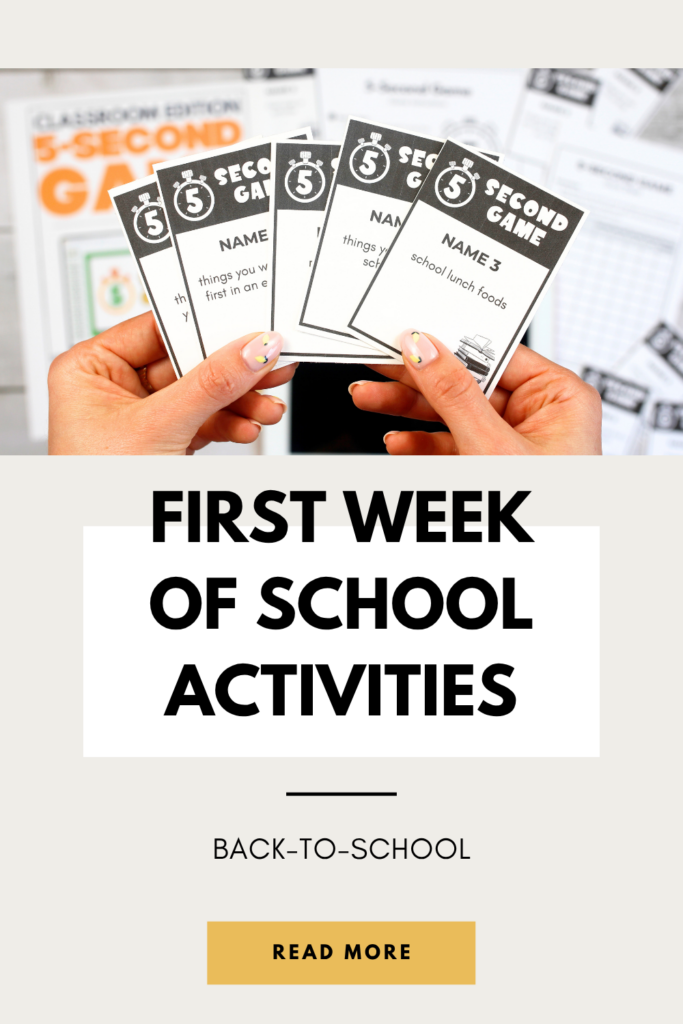
The 5 Second Game is fast, loud, and forgiving — you have five seconds to name three things in a category, and the pressure of the timer is a quick hack to loosen up the room. Middle schoolers respond well to anything that involves a little controlled chaos. This 5 Second Game is available as a ready-to-play resource, and also includes editable card templates to add your own question prompts.
The Dice Icebreaker Game takes a different angle: students roll dice and answer get-to-know-you questions corresponding to each number. It works well as a transition activity or as a quieter Day 2 option after a more energetic opener. This Dice Icebreaker Game is designed specifically for adolescent students and the questions are pitched appropriately. It also includes both group and independent versions.
“This was a great resource to get students engaged and to feel comfortable with their classmates. They enjoyed the activities and got them talking and starting to build relationships early on. I will use the activities throughout the school year!”
Jennifer F.
Middle School Teacher
Student Surveys: Know Your Readers and Writers
One of the most useful things you can do in the first week of middle school ELA is get honest information about who your students are as readers and writers before a formal assessment.
This Student Information Sheet is an editable survey with questions about students’ reading habits, writing strengths and struggles, responsibilities outside school, and goals for the year. Middle schoolers are often surprisingly candid on paper in a way they aren’t out loud — you’ll learn things in twenty minutes of reading through these responses that would take weeks to surface in class. This is also where you find the student who hates reading because of one bad experience in fourth grade, and the one who secretly writes stories at home and has never told a teacher.
You’ll reference these surveys all semester. Keep them somewhere accessible.
Build in ELA Skill Work Before the Unit Begins
The first week is also your best opportunity to show students what ELA in your room actually looks and feels like, before the formal curriculum creates pressure around it.
With middle schoolers, I’ve had the most consistent success with something inquiry-based and a little mysterious. The idea isn’t to front-load content — it’s to give students a taste of the thinking your class is going to ask of them, in the lowest-stakes possible context.
An inference-based mystery activity works well here: students read clues, collaborate, and figure out what happened. The learning is real, and the engagement is off the charts! By the time you name “inference” as a word in your curriculum, students already have a felt sense of what that means.
Building plagiarism literacy into Week 1 is also worth the time, especially with middle schoolers who are entering secondary ELA and may have never had a real conversation about academic integrity. This Avoiding Plagiarism Unit covers types of plagiarism (including AI-generated content) in language that’s accessible without being condescending. Introducing it early means you’re building the conversation from the ground up instead of back-tracking after the first writing assignment.
The Bundle That Handles the Whole First Week
If you want your entire first week of school activities for middle school ELA prepped and ready to go, this Back to School Bundle has everything you need. It includes classroom management tools, icebreaker games, a visual syllabus template, student survey resources, exit ticket templates, mindfulness materials, and more. Everything is designed for secondary students (grades 6-12) and available in both digital and print formats.
Teachers who use it consistently describe the same experience: they feel more prepared, their students feel more welcomed, and the year starts off on the right foot.
“This resource made the first week of school so much smoother! The activities are fun, practical, and help build a strong classroom community right from the start. I loved how the games encouraged teamwork and positive relationships, while the organization and management tools kept everything structured. It saved me hours of planning and gave my students a welcoming and engaging start to the year. Highly recommend for any teacher who wants both structure and fun on day one!”
Kimberly N.
Middle School Teacher
A Note on Grade-Level Differences Within Middle School
Grade 6, 7, and 8 students are not the same, and it’s worth adjusting your approach slightly for each grade level.
Sixth graders tend to need more explicit permission to participate. They’re often still figuring out what the rules are in secondary school, what kind of student they want to be perceived as, and whether it’s safe to seem enthusiastic. More structure in the first week activities is a gift to them, not a constraint.
Seventh graders are at peak self-consciousness. Anything that puts them on the spot individually is at higher risk. Team-based activities where individual performance is absorbed into a group result tend to work better.
Eighth graders, depending on your school culture, sometimes need to be won over. They’ve been here before. They know the moves. The activities that land best with Grade 8 are ones that feel like real, competitive games — something that respects their experience rather than assuming they’re still where they were two years ago.
Frequently Asked Questions
What should I do on the very first day of middle school ELA?
Day 1 should be almost entirely community-building with minimal paperwork. One energetic icebreaker, brief introductions, and a short student survey is a solid start. Save the syllabus walkthrough for Day 2 — students are too overwhelmed on the first day to absorb curriculum information anyway.
How long should first week activities take in middle school ELA?
Plan for 20-30 minutes of activity time per period in the first week, with the remaining time for housekeeping, introductions, and getting-settled logistics. By the end of the week you can begin extending the activity portion into skill previews.
What if middle school students refuse to participate in icebreakers?
Non-participation is most common with Grade 7 and 8 students who are playing it cool for their peers. Choose activities where team performance makes individual reluctance less visible, keep the energy in the room high, and make sure you participate, too! Most reluctant students find an entry point once the activity has momentum.
Should I have students work in groups during the first week of middle school ELA?
Yes, but be intentional about grouping. In the first week, students don’t have established friendships or working relationships in your room yet. Activities that mix students randomly — like Bingo or Partner Pairing Cards — do a lot of the relationship-building work for you without requiring anyone to self-select into groups.
What’s the difference between first week activities for middle school vs. high school ELA?
Middle school students generally need more movement, more frequent energy resets, and activities that don’t require individual vulnerability in front of peers. High schoolers can handle more sustained discussion and independent work earlier. Both age groups respond to activities that feel clever and appropriately paced — neither group wants to be talked down to.
The Best First Week of School Activities for Middle School ELA
The students who have a good first week in your middle school ELA class are primed for the rest of the year differently. They come back on Monday of Week 2 with a reason to be there. They know your name, they know a few classmates, and they have some sense — even if they couldn’t articulate it yet — that your class is going to be worth their attention.
That’s not a small thing to build in five days. But the right activities make it entirely possible.