Quick Takeaways
- Burnout doesn’t start in February. It starts in August, with the decisions made before the school year begins.
- The urge to over-prepare in summer is itself a burnout signal, not a solution to one.
- Sustainable Back-to-school teaching requires reducing the number of decisions you make from scratch, not working harder.
- Community-building activities and ready-made curriculum are not shortcuts — they’re how experienced teachers protect their longevity.
- Starting the year with enough left in the tank to actually be present with your students is the highest-leverage thing you can do for your classroom.

Back to School Without Burning Out: A Guide for Secondary ELA Teachers
The last two weeks of August are a total dichotomy for teachers. You’ve settled into the pace of summer – living life slowly, staying up later than usual, and sleeping in where you can. But a quiet alarm is going off: something you can ignore during the day when you’re busy, but that finds you later in the evening when you know it’s time to start planning soon. “I’ll do it tomorrow,” you say.
The school year hasn’t started, and you’re already tired.
I know this feeling. I spent years treating it as motivation. It took me much longer than I’d like to admit to recognize it for what it actually was: my nervous system telling me that the cycle I was about to enter was not going to be gentle on me.
Starting the school year without burning out is not about being less dedicated to your students. It’s about being honest with yourself about what the year actually costs you, and making different choices in the months before it starts.
Here’s what I’ve learned, and what I recommend to every teacher that I know.
Why Do So Many ELA Teachers Burn Out at the Start of the Year?
Secondary ELA teachers burn out faster than most because the job makes uniquely relentless demands: text selection, discussion design, individualized writing feedback, differentiation across wide ability ranges, and a grading workload that compounds with every assignment. There is no part of the year where the preparation load feels light.
The start-of-year burnout feels different than the wall you hit mid-year. It comes from the collision of two things: the enormous emotional investment teachers bring to new beginnings, and the structural reality that nothing is in place yet — you have no routines, no relationships, no systems in place. Everything has to be built from scratch, and it has to be built fast!
The trap is trying to solve this with more preparation. More planning over the summer. More units built in advance. More resources hunted down. More hours. What usually happens instead is that the preparation itself becomes the source of exhaustion, and teachers arrive on the first day of school already depleted.

The Mindset Shift That Changes Back-to-School
The most useful reframe I’ve found is this: back-to-school is not about impressing anyone. Back-to-school is about building a classroom that can keep you sane for the next ten months.
That means the first week’s purpose is not to deliver a brilliant lesson. Its purpose is to create enough psychological safety and enough relational foundation that students will take risks when the lessons that matter come later. You don’t have to be spectacular during back-to-school. Just be present, consistent, and human. See how much better this feels already?
It also means that doing the same first week every year — with the same icebreakers, the same student survey, the same community-building activities — is not a lack of creativity. It’s wisdom. The energy you save by not rebuilding the first week from scratch is energy you have for October, November, the novel you love in January, and the student who needs something extra in March.
What a Sustainable Back-to-School Season Actually Looks Like
A sustainable back-to-school season does require a bit of energy spent in the right place. You need a clear plan, quality resources, and no improvisation happening at 10pm the night before.
In practice, that means:
Your classroom systems, set up before Day 1. This is where most of the late-summer energy gets lost: not to lesson planning, but to the administrative scaffolding that surrounds it. Building a syllabus from scratch. Designing a student survey. Figuring out how you’re going to track parent communication and anecdotal notes and extra credit requests and whether Marcus turned in that missing assignment. All of it feels urgent, and none of it requires you to reinvent the wheel.
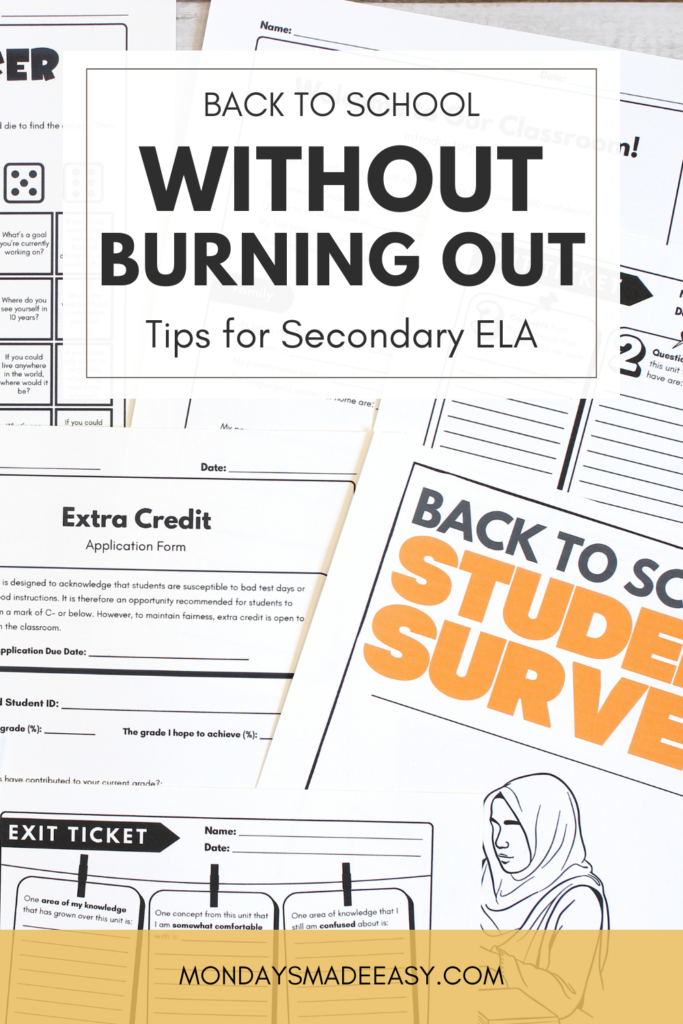
The Classroom Systems Toolkit is designed specifically for this. It includes 11 ready-to-use classroom management and organization tools: editable daily agenda slides with countdown timers, both a formal and a visual syllabus template, a student information survey, a parent contact sheet, exit ticket templates, student data tracking sheets, a digital student planner, a form for extra credit requests, partner pairing cards, and classroom library decor. Everything that is typically made in a panic during the last week of summer — in one place, ready-to-print, with customizable options to fit your needs.
What changes when your systems are handled before school starts? You walk into Day 1 with the syllabus ready to read through, the agenda template loaded, and the survey ready to fill. You walk out of Week 1 with student information you’ve already collected, parent contact forms already organized, and a data tracking sheet waiting for your first observations. The admin layer runs smoothly without you improvising it.
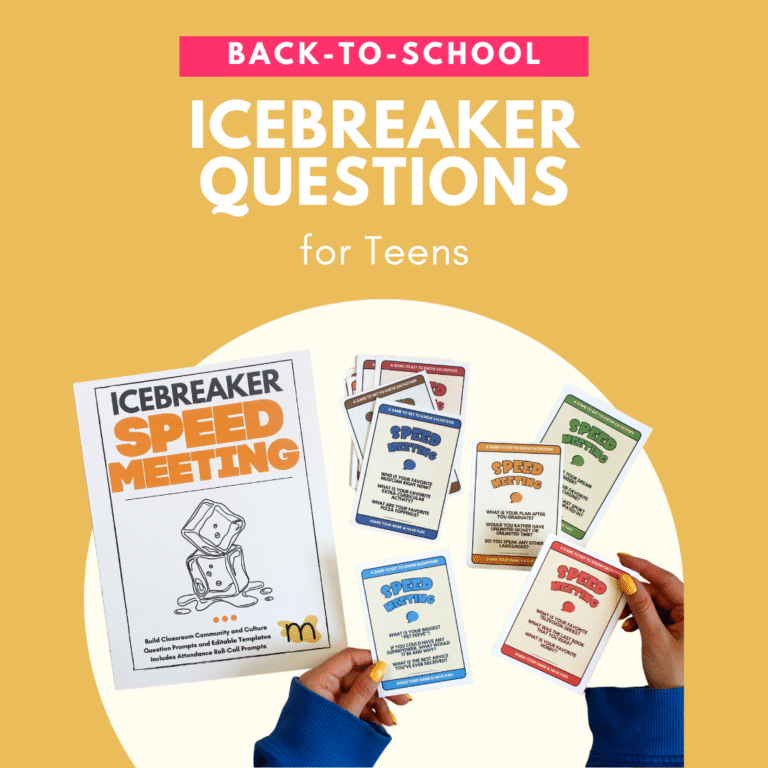
Community-building activities that are ready to go. The relational side of back-to-school takes real energy too, and it should — it’s worth investing in! This Back to School Icebreaker Games Bundle handles this without requiring you to look up, test out, or design anything. A full week of icebreaker games and community activities, highly rated by students, ready to go. You show up, you have some fun, and you go home at the bell (while your students actually smile at you and say goodbye!)
Curriculum that doesn’t start from scratch. The first unit is always the most vulnerable to the burnout trap — you’re building it while also running the class, establishing routines, settling into a new year, and handling all of the chaos that the beginning of a new year brings. Having a unit that’s substantively ready before back-to-school means you’re teaching during this time rather than preparing.
Your evenings. This one is not a metaphor. If you are spending your evenings building classroom systems or hunting for icebreakers, something has gone wrong in the preparation stage. The days are long during this time: the adjustment to being in the building again, the emotional demand of meeting a new group of students, the physical reality of being on your feet for seven hours. Your evenings are recovery time. Protecting them is non-negotiable!
The Connection Between Preparation and Presence
Here’s the thing about burnout that we all tend to gloss over: it doesn’t just cost you energy. It costs you presence. And presence is the resource your students need most.
A teacher who walks into the first week rested, with their materials ready and their systems in place, is capable of something a depleted teacher isn’t: actually being in the room with their students. Noticing the quiet kid in the third row. Catching the moment when a class activity is starting to go sideways and pivoting before it does. Choosing warmth over efficiency when a student needs both.
The first week of school is the most relationship-dense week of the year. Students are forming impressions of you and of your class that will last all semester. Meeting that week with reserves rather than running on empty is one of the most pedagogically important things you can do.
Free yourself to be fully there during that first week back. You’ll quickly notice the difference it makes.
What to Let Go of Before Back-to-School Start
There is always more that could be done. More units that could be refined, more materials that could be polished, more reading you could do about best practices. None of it matters if you’re exhausted before the students walk in.
Things worth letting go of before the first week back:
The aesthetically pleasing classroom. It matters less to students than it does to social media algorithms. If having classroom decor makes you feel better about being in your classroom, then it’s a worthy investment; but if you feel the pressure to deck your room out to match the vibe of your colleague down the hall – focus instead on the way your class feels instead of the way it looks.
The comparison to the imagined colleague who has it more together. They don’t. Every teacher you’ve ever admired for seeming on top of it had their own version of the summer spirals. They might just hide it better, or sacrifice more in their personal life to show up more prepared in their professional life.
The idea that starting the year with pre-made resources means you’re doing it wrong. Using well-designed, teacher-tested materials is not shortcutting your students. It’s protecting your capacity to actually serve them.

Frequently Asked Questions
Is it possible to actually enjoy the start of the school year as an ELA teacher?
Yes, and it’s worth aiming for rather than just surviving it. The conditions for enjoying the back-to-school season are the same as the conditions for surviving it sustainably: solid preparation, ready-to-use resources, and protected time. The emotional experience lightens significantly when you’re not scrambling.
How do I stop over-preparing in August without feeling guilty?
Set a clear boundary on what “done” looks like rather than letting preparation expand to fill available time. Define your non-negotiables (student surveys ready, first week activities selected, first unit planned to Week 2) and call it done when those are complete. Guilt about stopping is part of the burnout pattern, not a signal that more work is needed.
What’s the most common start-of-year mistake ELA teachers make?
Skipping the first week community-building to get to content faster. It feels efficient in the moment and costs significantly more than it saves. Students who don’t have a relational foundation in your room take longer to engage with content, take fewer risks in discussion, and are harder to bring back once they’ve disengaged.
Does using pre-made resources actually reduce burnout?
When the resources are genuinely high-quality and don’t require extensive adaptation, yes. A resource like the Classroom Systems Toolkit — which covers 11 classroom management and admin tools in one place — removes a category of work from your plate entirely, not just a task. The burnout cost of building that scaffolding from scratch compounds over years. Having it ready before school starts changes what Back-to-school asks of you.
What does the first week look like for an ELA teacher who is actively protecting against burnout?
It looks like this: a syllabus ready to hand out on Day 1, a student survey that runs itself, daily agenda slides already loaded, community-building activities that are field-tested and ready to run, and a lesson plan for each day that you were not writing at 10pm the night before. You leave at a reasonable hour because the infrastructure is already in place.
The ceiling-staring, the August dread, the feeling of being tired before the year has even started — those aren’t signs that you care too much. They’re signs that the system you’re using to run your professional life is asking more of you than it should.
Avoiding Back-to-School Burnout in Secondary
You can start the year differently. It takes different inputs: real preparation rather than perpetual preparation, resources that work rather than ones you have to fix, and the discipline to stop when you’ve done enough rather than chasing the feeling of being fully ready (which never actually comes).
Back-to-school doesn’t have to cost you your sanity – you’ll need it to get you through the next 10 months, so protect it wisely!