Quick Takeaways
- The first month of high school ELA is less about covering content and more about building the conditions where content can land. Sequence matters enormously.
- Community-building in Week 1, foundational ELA skills in Weeks 2-3, and a reading-anchored unit by Week 4 is the rhythm that serves most secondary classrooms well.
- September planning done intentionally reduces the reactive scrambling that compounds burnout later in the year.
- There are ready-made resources that carry each phase of the first month — you don’t have to build everything from scratch.
- The choices you make in September create the classroom culture your students will live in until June.
How I Plan My First Month of High School ELA
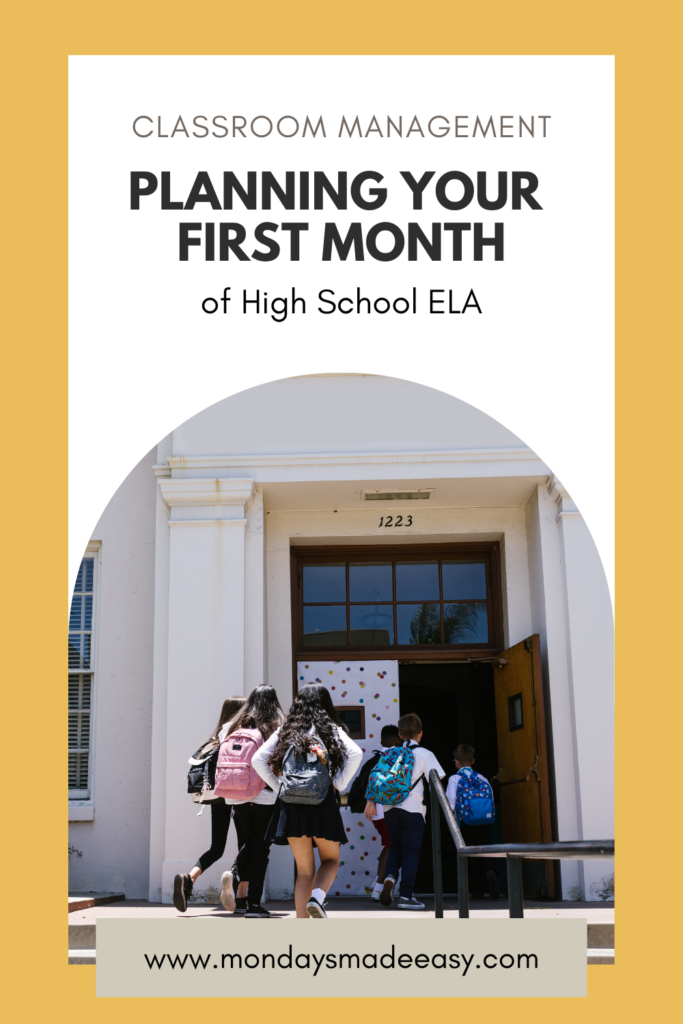
The August before my third year of teaching, I sat down with a blank course map and did something I’d never done before: I tried to actually plan the entire first month before school started, not just the first week.
I’d always been a “one week ahead” planner. Usually less. And it worked, technically, in the way that running on four hours of sleep technically keeps you functional. But heading into September of Year 3, I was tired of the Sunday scaries, tired of feeling like I was always one day ahead of my students, and curious about what it would feel like to walk into September knowing where I was going.
What I discovered was that planning the first month of high school ELA forced me to make decisions I’d been deferring indefinitely: what actually needed to happen in September before anything else could work? What was I asking students to do in Week 3 that assumed things I hadn’t taught them in Weeks 1 and 2? Where were the natural connection points between my first unit and the skills students would need all year?
The conclusion I came to is that sequencing matters more than any individual lesson. Here’s how I think about it.
How Should You Plan the First Month of High School ELA?
The first month of high school ELA should follow a three-phase arc: community and orientation in Week 1, foundational ELA skills and classroom culture in Weeks 2-3, and an anchored reading or writing unit beginning in Week 4. Each phase builds the conditions that the next phase requires.
Trying to compress this arc (ie. jumping to formal curriculum in Week 1, or spending three weeks on community-building before any academic work) tends to create problems in both directions. Students who never get a proper orientation take longer to orient themselves with their peers. Students who don’t see academic rigor until October are harder to recalibrate.
Week 1: Orientation, Community, and Getting to Know Your Students
When planning the first month of high school ELA, the goal of Week 1 is almost entirely about relationships. You’re establishing that your classroom is a place where people know each other, where the teacher is a person (not just an authority figure), and where the work that’s coming will be worth doing.
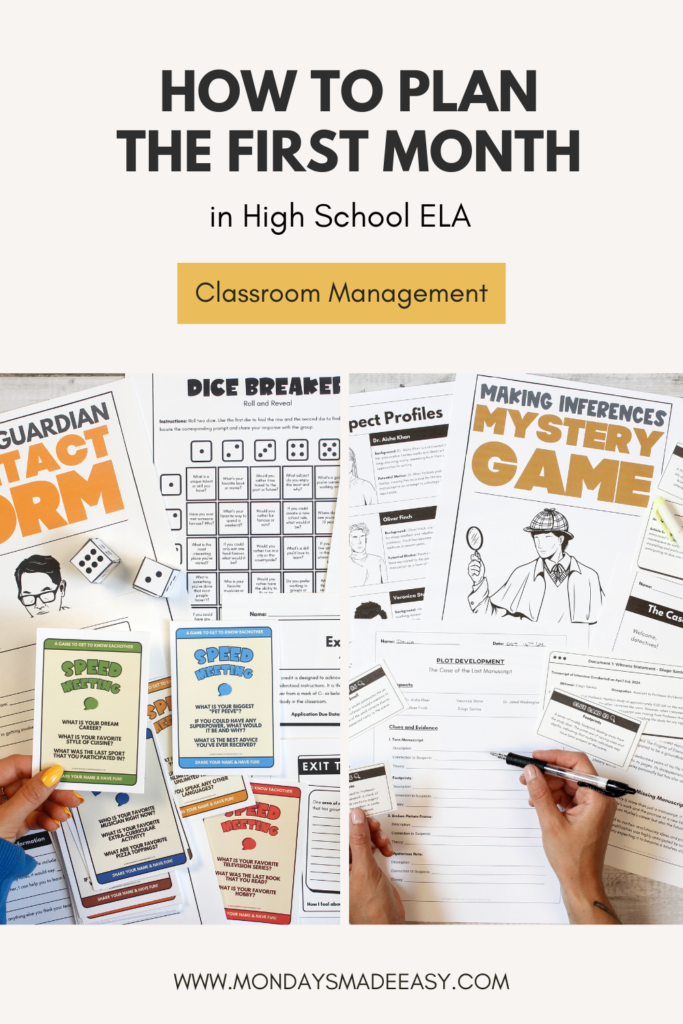
That means icebreakers, yes — but also administrative work that becomes relationship-building material when you approach it intentionally. This Student Information Sheet is one of the most useful tools I introduce in the first week. It’s a student survey that asks about reading and writing habits, responsibilities outside school, past English class experiences, and goals for the year. It takes about fifteen minutes in class, and it provides you information you’ll use until June.
The other piece of Week 1 is establishing your classroom systems visibly and explicitly. Students who don’t understand your expectations in September will improvise their own — and their improvisations probably won’t match yours! A visual syllabus, a clear routine for the first ten minutes of class, and a brief explanation of how you’ll use exit tickets all belong in Week 1. This Back to School Bundle includes a visual syllabus template, classroom management tools, and exit ticket templates alongside a ton of fun icebreaker games — so the community piece and the systems piece can happen together without doubling your prep work.
Week 2: Building Foundational ELA Skills Before the Unit Begins
By Week 2, your students have built some trust. They know each other’s names and have some sense of what your classroom feels like. Now is when you start previewing the thinking skills that will anchor everything else.
Inference is the skill I focus on first, because it underpins almost every ELA task students will encounter: reading for subtext, understanding narrator reliability, analyzing character motivation, interpreting figurative language. Getting students comfortable with inference before they need it in a unit context is one area I always focus on in September.
This Making Inferences Mystery Game is how I introduce this skill every year. Students work in teams to solve a mystery using only written clues, which means they’re practicing inference in the most engaging possible context. The debrief is where the metacognitive work happens: “what you just did — reading for what’s implied, not just what’s stated — is what we do every time we read anything carefully.” It’s a bridge between team building and literacy before the formal reading work begins.
Week 2 is also the right time to have the academic integrity conversation, before anyone’s turned in a written assignment. This Avoiding Plagiarism Unit gives students a real understanding of what plagiarism means, why it matters, and what the line is around AI-generated content — not as a threat, but as a foundational piece of how your class operates. Students who have this conversation early are measurably more likely to make better choices when they’re actually writing.
“I teach 7th and 8th grade library classes, with mini lessons and book checkout. This was the perfect overview of different types of plagiarism. The PowerPoint clearly highlighted the points. Our final class before break was Plagiarism Bingo. We made everyone a winner, by playing until all students had earned Bingo. Students received candy as a prize, which was a big hit. This was a good way to make a dry topic more engaging!”
Chelsea D.
Middle School Teacher
Week 3: Classroom Routines and Discussion Culture
By Week 3, you should have enough classroom cohesion to start running the kinds of discussions and collaborative activities that your units will depend on later. This is when I use low-stakes discussion tasks to establish norms explicitly: what does good discussion look like in this room, what’s the expectation around accountable talk, how do we disagree respectfully with a text or with each other.
Exit tickets are particularly useful in Week 3 as a formative tool and as a routine-builder. By using them consistently from early September, they become automatic by October — students know that the last five minutes of class belong to a short written reflection, and you get a quick formative check on comprehension without adding to your grading pile. The 8 exit ticket templates in this Back to School Bundle are adaptable to just about any lesson in every subject area.
Week 3 is also when I start collecting baseline diagnostic information. Not a formal assessment, but something low-stakes that gives me a sense of where students are as readers and writers. A brief written response to a shared text works well here. What matters is that you have some actual data before the first unit is underway.
Finally, this week is also a good moment to pull out a short story unit. If you don’t have one yet, three great stories to open the year are “The Lottery,” “Lamb to the Slaughter,” and “Thank You, Ma’am.“
Week 4: Into the First Unit
By Week 4, your classroom has a culture. Students know the routines, the expectations, and rules about how thinking and talking work in your classroom. When planning your first month of high school ELA, this is a great time to dive into the first long-range unit.
What the first unit is will vary by course and grade, but the principles for introducing it are consistent: begin with a big question the unit will explore, ground it in text as quickly as possible, and make clear how the skills students practiced in Weeks 1-3 connect to what they’re about to do.
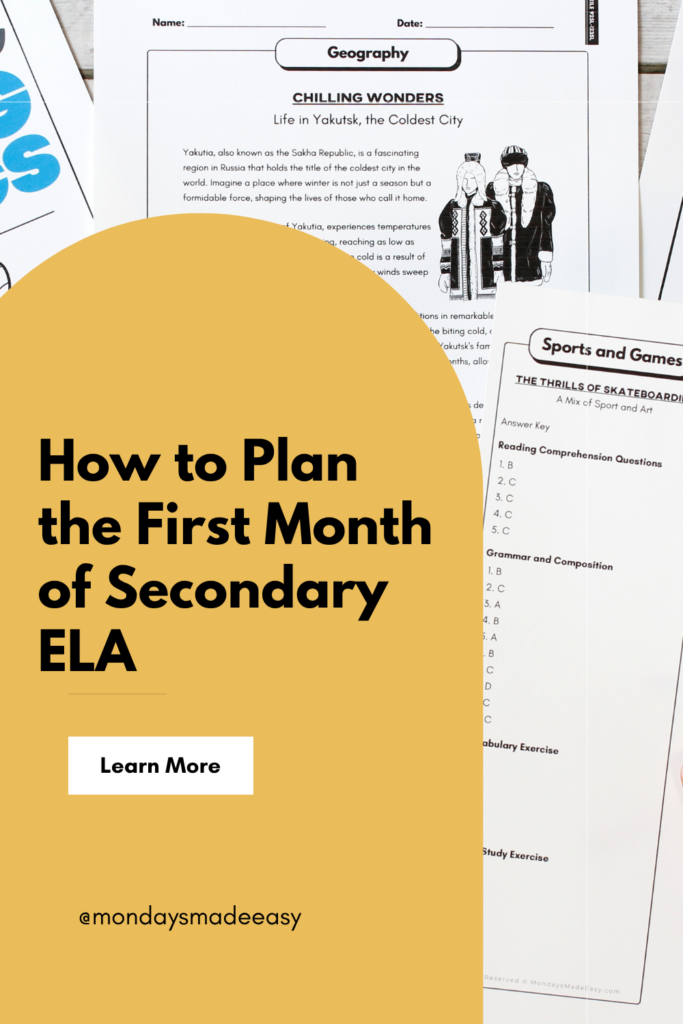
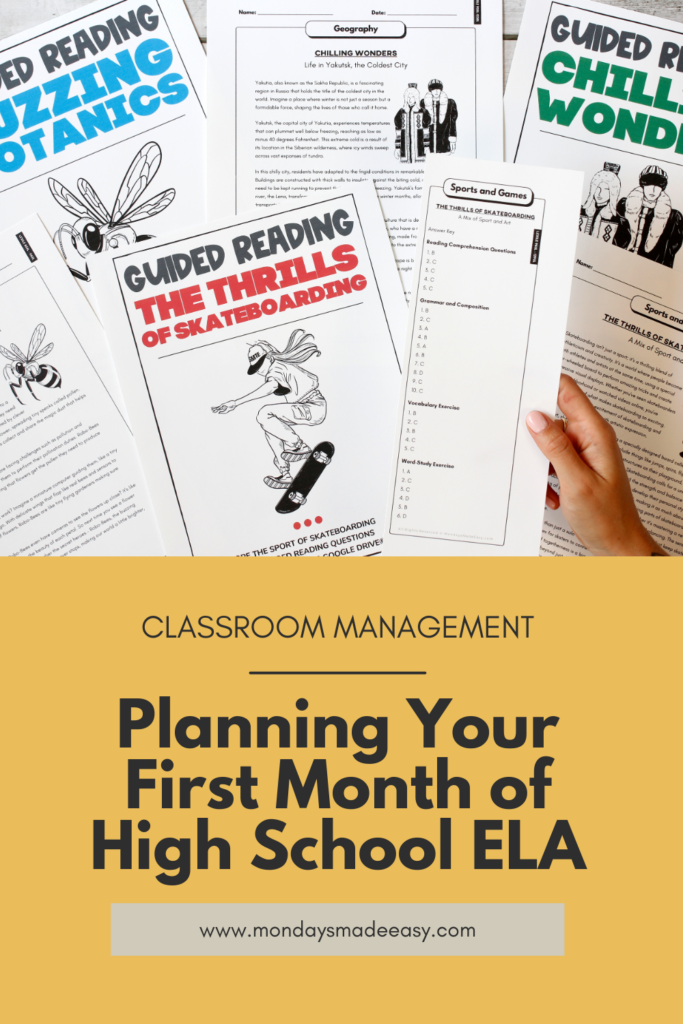
If your first unit involves substantial independent reading, the Guided Reading Program for Secondary ELA is worth considering. It provides comprehension passages, data tracking, and a built-in structure for reading support across ability levels, which is particularly useful when you’re getting diagnostic data on a new class for the first time.
“These resources are going to save me so much time! Having a list of readings with premade activities, all trackable and easy to implement is going to help my reading program so much! Thank you!”
Megan L.
Middle School Teacher

The Planning Principles Behind All of It
If I had to name the through-line of how I approach the first month, it’s this: every decision in September should be reducing friction for something you need in October.
The student survey in Week 1 reduces friction when you’re differentiating in Week 5. The inference activity in Week 2 reduces friction when you’re teaching character analysis in Week 6. The plagiarism unit in Week 2 reduces friction when the first writing assignment is due in Week 7. The discussion norms established in Week 3 reduce friction for the Socratic seminar you’re running in Week 9.
September is the time to build that infrastructure in your classroom.
Planning Your First Month of High School ELA: Tying It All Together
The first month of high school ELA is the year’s most consequential planning. What you choose to do with it, in what order, for what purpose, shapes the classroom culture your students will inhabit until June.
Planning the first month of high school ELA is worth taking seriously. It’s also worth having the right resources to make it feel manageable instead of monumental.
Frequently Asked Questions
How much curriculum content should I cover in the first month of High School ELA?
Less than you think. The first month is about building the conditions for learning, not maximizing content coverage. One or two well-established skills and a partial introduction to your first unit is a realistic and appropriate target for September.
Should I include formal assessment in the first month of High School ELA?
Low-stakes diagnostic assessment belongs in September: brief written responses, reading observations, discussion participation. High-stakes formal assessment (graded essays, major tests) is better introduced in Week 4 or 5, once students have a real sense of your expectations.
How do I balance community-building with academic content in September?
The first week is wisely spent focusing almost entirely on community-building. By Week 2 you’re introducing skills. By Week 3 you’re running routines and collecting diagnostic data. Week 4 is when the heavy lifting begins.
What if I teach multiple courses with different first-month needs?
The sequence is the same with all courses — orientation, skills, routines, long unit — but the specific activities and content will differ. The best resources are the ones that work across any grade level or subject area: student survey templates, icebreaker games, and exit tickets that you can adapt rather than rebuild from scratch.
How do I plan the first month without spending my entire summer doing it?
Work from a template rather than a blank document – these daily agenda slides work well. Identify the three or four non-negotiables for each week (community activity, skill work, system-building, diagnostic task) and slot ready-made resources into those spaces. The planning time goes from days to hours when you’re not creating from nothing.