


Description
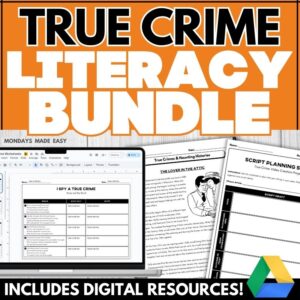
Can your students solve these word riddles? Challenge them to practice inference skills with this true crime reading comprehension activity! Students will read five nonfiction articles and decode word-based riddles linked to each story. Suitable for online learning with digital worksheets for Google Classroom®!
Included with this True Crime Riddle Activities:
- 5 True Crime Nonfiction Articles
-
- Explore real stories about “The Crooked Queen of Crypto,” “The Lover in the Attic,” “Death by Immurement,” and more!
- Lexile levels range between 950L – 1250L
- “I Spy a True Crime” Riddle Worksheets – Digital & Print
-
- Includes 10 word puzzles per article
- Detailed Answer Key
- Teacher Instructions for using these resources
How to Use This True Crime Riddle Activities:
Challenge your students to solve riddles and practice inference skills with this true crime reading comprehension activity! Students will read five nonfiction articles and decode word-based riddles linked to each story. This activity is ideal for literacy centers, fast-finishers, sub plans, or as a creative way to reinforce nonfiction reading comprehension and inference skills. Riddle Activities like this one combine the intrigue of mystery with the rigor of critical thinking, allowing students to strengthen comprehension skills while engaging in an interactive classroom challenge. When students work through Riddle Activities, they practice making connections, identifying textual clues, and forming logical conclusions—all while having fun.
You can begin by distributing the articles featuring five short nonfiction stories about strange and shocking crimes. Each article presents an overview of a real case and includes vivid, clue-worthy details that support close reading. These passages are all one page in length and fall within a Lexile range of 950L to 1250L, ensuring they are accessible yet challenging for middle and high school readers. The variety of stories ensures that every student will find something engaging, from unusual thefts to unbelievable mysteries. Teachers can use these articles as standalone nonfiction reading exercises or as part of larger Riddle Activities that promote inference and deduction. By framing nonfiction reading within the context of solving a puzzle, students are more motivated to pay attention to detail and think critically about what they’re reading.
Next, assign the “I Spy a True Crime” riddle worksheets. Students read a series of riddle-style clues that connect to each article. To solve the riddle, students must use inference skills and locate supporting text evidence. This task strengthens analytical reading, supports text-based evidence gathering, and encourages students to think like detectives by using indirect clues to draw direct conclusions. Riddle Activities like these make reading comprehension lessons more interactive, transforming what could be a simple worksheet into a thought-provoking experience. The clues challenge students to engage with the material on a deeper level, interpreting figurative language, context hints, and descriptive details. As they search for the correct answers, students learn to connect cause and effect, make educated guesses, and cite textual evidence—all key elements of strong literacy development.
To deepen engagement, consider having students work collaboratively in pairs or small groups. Cooperative learning enhances the impact of Riddle Activities by allowing students to share reasoning and compare interpretations. This collaborative process mirrors real-world problem solving, where multiple perspectives lead to more accurate conclusions. Teachers can also turn the riddle-solving process into a timed challenge or competition to make it even more exciting. These creative extensions keep students motivated and transform reading comprehension practice into a memorable classroom experience. Whether students are decoding clues independently or working as a team, Riddle Activities create an atmosphere of curiosity, excitement, and active learning.
To consolidate this activity, a detailed answer key has been provided. Use this answer key to facilitate a group discussion to explain reasoning or allow students to check their work independently. Reviewing answers helps reinforce how inference and textual evidence connect, providing a clear model of critical thinking in action. During this discussion, teachers can highlight the strategies students used to draw conclusions and point out how small textual clues led to big insights. When paired with other Riddle Activities, this structured reflection helps build metacognitive awareness—students begin to understand how they think, not just what they think. This process is invaluable for developing deeper reading comprehension and analytical reasoning skills.
What makes Riddle Activities especially powerful is their versatility. They can be used across grade levels, incorporated into ELA units on nonfiction, or tied to lessons on inference, tone, or author’s purpose. Because they are self-contained and easy to set up, teachers can use them as early-finishers’ tasks, literacy center rotations, or substitute lesson plans that require minimal preparation but yield meaningful engagement. The true crime theme adds an element of intrigue that captures students’ attention immediately, making Riddle Activities both academically enriching and genuinely enjoyable.
Ultimately, Riddle Activities like this true crime reading comprehension challenge transform literacy practice into an adventure in critical thinking. They prompt students to become text detectives—analyzing details, questioning motives, and drawing logical conclusions based on evidence. By blending riddles with nonfiction texts, these activities reinforce essential reading strategies while maintaining a sense of mystery and excitement. Teachers looking to make comprehension practice more dynamic will find that Riddle Activities are the perfect bridge between entertainment and education, helping students strengthen their inference skills in a fun, memorable way.
✨ Kindly note that due to copyright restrictions, this resource is not editable, except for the files specifically labelled as editable. This is a common practice within the online marketplace in order to protect the clip artists and software providers that have authorized their intellectual property for the development of this resource.
⭒ For classrooms utilizing Google Classroom® ⭒
To access the digital version of these worksheets, simply follow the instructions within the resource to copy the files directly to your Google Drive®.





Jenny W. –
Fabulous resource !! Well organized and engaging !! Students loved these short stories.