


Description
Whether you use socratic seminars, literature circles, fishbowl discussion, or other student-led conversations – this group discussion outline helps you automate grading and provides meaningful feedback for students. It includes sentence starters, question stems, data tracking spreadsheets, and a grading scale rubric.
Included with this Student-Led Discussion Outline:
- 21 Question Prompts for Any Novel
- 40+ Sentence Starters and Question Stems
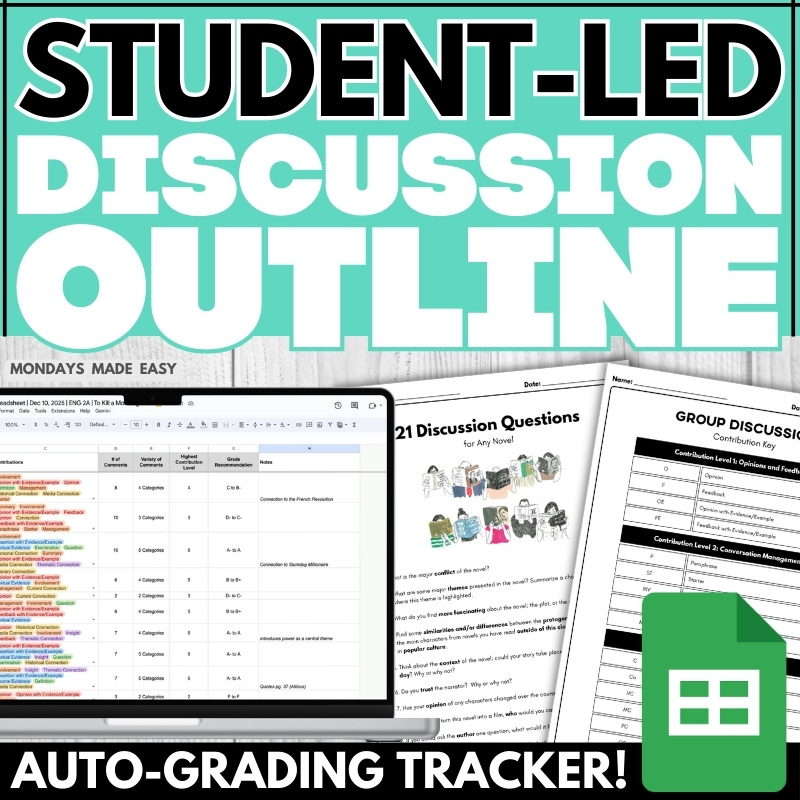
- Automated Discussion Tracking Template – Google Sheets®
- Manual Discussion Tracking System – Ready-to-Print
- Assessment Guidelines for Group Discussions
- Grading Guidelines with Example
- Grading Scale Rubric
- Teacher Instructions (with video) for using these resources
How to use this Student-Led Discussion Outline:
This classroom discussion strategy empowers students to lead meaningful discussions independently while providing you with built-in tools for assessment. It includes both qualitative and quantitative methods to streamline grading and deliver specific, actionable feedback on student performance.
By shifting responsibility to students, this approach encourages ownership, accountability, and confidence during academic conversations. Rather than relying on teacher-led questioning, students actively guide the direction of the discussion while still working within a clearly defined structure. The Student-Led Discussion Outline supports this independence by making expectations visible and measurable, allowing students to focus on thoughtful engagement instead of guessing how participation will be evaluated. Teachers benefit from a system that captures meaningful data without interrupting the flow of conversation, making discussions more authentic and student-centered.
This structured discussion outline features over 40 Sentence Starters and Question Stems designed to scaffold participation in academic conversations. Using the provided assessment guidelines, students can self-evaluate the quality of their contributions, reflect on their speaking skills, and identify clear strategies for improvement.
The variety of sentence starters ensures that students can enter discussions at different levels of complexity, whether they are responding to a peer, building on an idea, or challenging an interpretation with evidence. Within the Student-Led Discussion Outline, these scaffolds promote equity by giving every student access to academic language, particularly those who may struggle with articulating ideas on the spot. Reflection becomes an ongoing process, as students learn to recognize patterns in their participation and set intentional goals for future discussions.
The assessment guidelines included with this resource feature a Contribution Key – a graphic organizer that categorizes various types of responses students can make during classroom discussions. These categories include contributions such as offering opinions, asking questions, citing textual evidence, and making historical or thematic connections. In addition to these response types, the key provides participation cues that help students actively engage their peers by inviting others to speak, offering clarification, and responding to questions in a collaborative manner.
This Contribution Key brings clarity and transparency to discussion expectations, which is essential for productive group work. When students understand the range of acceptable and valued responses, they are more likely to take risks and contribute meaningfully. The Student-Led Discussion Outline uses this tool to reinforce respectful dialogue and shared responsibility, ensuring that discussions remain balanced and inclusive rather than dominated by a few voices.
The Contribution Key assigns point values to different types of responses based on their level of complexity. This system allows students to assess the depth of their contributions and set clear goals for improvement. By referencing the key during or after a discussion, students can reflect on their participation and identify which response types will help them contribute more meaningfully in future conversations.
This points-based system emphasizes growth and depth over frequency of speaking. Students begin to understand that higher-quality contributions require preparation, active listening, and thoughtful responses. Within the Student-Led Discussion Outline, this reflective component encourages students to plan how they will engage before a discussion and evaluate their performance afterward, reinforcing metacognitive skills that transfer beyond a single lesson.
To assess classroom discussions, this resource includes an Automated Discussion Tracking Sheet for Google Sheets®. This template enables you to provide both qualitative and quantitative feedback on student participation. Using the built-in drop-down menus, you can efficiently record each student’s contributions during group discussions. The sheet automatically calculates scores based on the frequency and complexity of responses to streamline the assessment process and make feedback more actionable for students.
This digital tracking system is ideal for classrooms with multiple discussion groups happening simultaneously. The Student-Led Discussion Outline integrates seamlessly with this tool, allowing teachers to focus on observing student interactions rather than manually tallying data. The automatic calculations reduce grading time while providing students with clear evidence of their participation patterns and progress.
A Manual Discussion Tracking System for paper-based assessment is also provided. This system simply uses the short codes provided in the Contribution Key to easily track student participation.
This flexible option ensures that the resource can be used in any classroom setting, regardless of technology access. Teachers can move between groups with ease while still collecting consistent data. The Student-Led Discussion Outline remains fully effective in paper-based environments, offering the same clarity and accountability as the digital system.
To assign a final grade, a Grading Scale Rubric has been included. This rubric translates participation data into overall performance levels to help you determine final grades based on the assessment guidelines provided.
The rubric ensures consistency and fairness by aligning participation data with clear performance descriptors. Students benefit from understanding exactly how their discussion habits impact their overall evaluation. When paired with the Student-Led Discussion Outline, this rubric reinforces transparency and helps students view discussion as a meaningful academic skill rather than a subjective requirement.
Finally, a Graded Example Discussion Data Tracking Template is also included to model assessment expectations for students.
This example provides a concrete reference that demystifies the assessment process and helps students visualize success. By reviewing a completed model, students gain a clearer understanding of how contributions are tracked and scored, strengthening confidence and reducing uncertainty.
✅ Video instructions on how to use these data tracking systems are included!
These step-by-step videos ensure smooth implementation and support both new and experienced teachers. With clear guidance, flexible assessment options, and intentional structure, this resource makes the Student-Led Discussion Outline easy to implement while maximizing the quality and impact of classroom discussions.
✨ Kindly note that due to copyright restrictions, this resource is not editable, except for the files specifically labelled as editable. This is a common practice within the online marketplace in order to protect the clip artists and software providers that have authorized their intellectual property for the development of this resource.
See what other teachers are saying about this Student-Led Discussion Outline:
“This should be really helpful for the beginning of the year and all year for my students who are reluctant to share. I especially like the question stems as a model for appropriate commentary.” – Roberta H.
⭒ For classrooms utilizing Google Classroom® ⭒
To access the digital version of these worksheets, simply follow the instructions within the resource to copy the files directly to your Google Drive®.