
Description
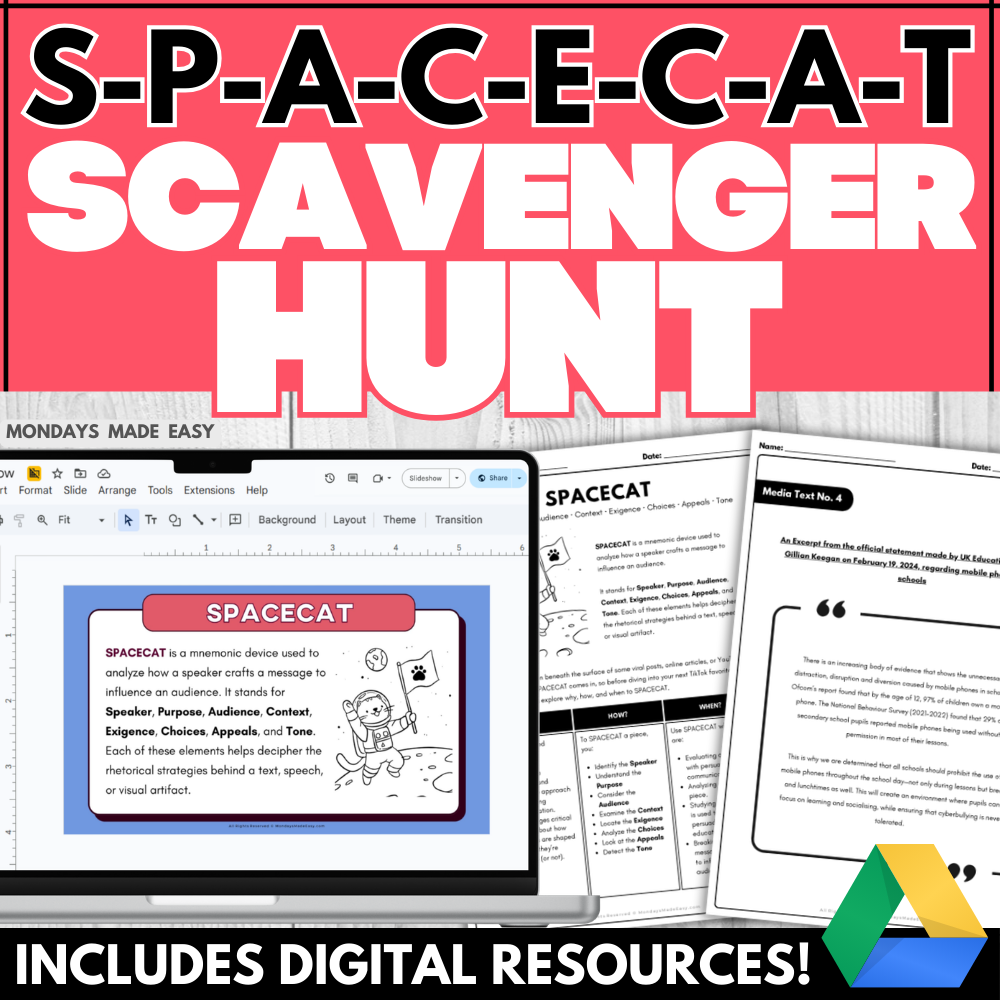
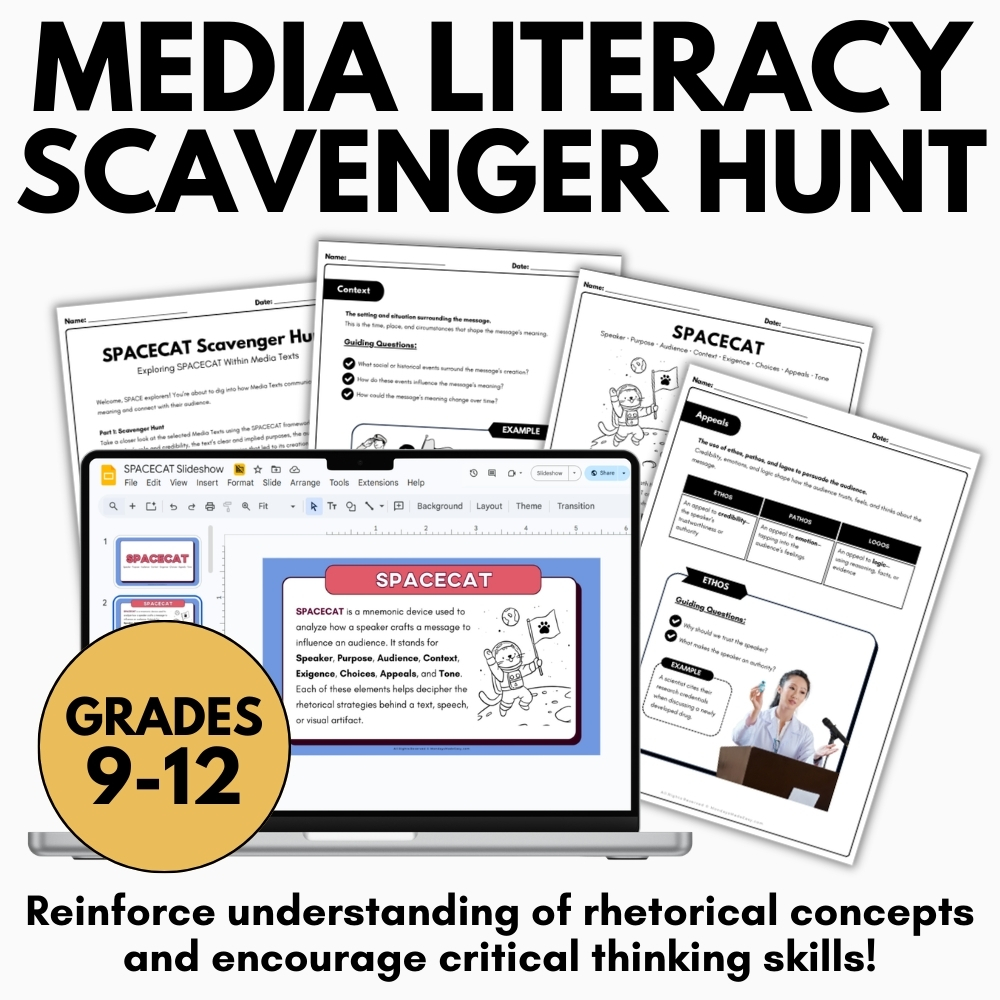
Help your students master rhetorical analysis with this interactive SPACECAT Media Literacy Scavenger Hunt! Students will explore how real-world media texts use rhetorical elements to persuade, inform, or influence. This engaging lesson guides students through speaker, purpose, audience, context, and more. Includes digital worksheets for Google Classroom®.
Included with this SPACECAT Rhetorical Analysis Scavenger Hunt:
- SPACECAT Slideshow Lesson – Google Slides®, Powerpoint, and PDF
- SPACECAT Informational Handbook
- Rhetorical Analysis Scavenger Hunt Activity – Digital & Print
-
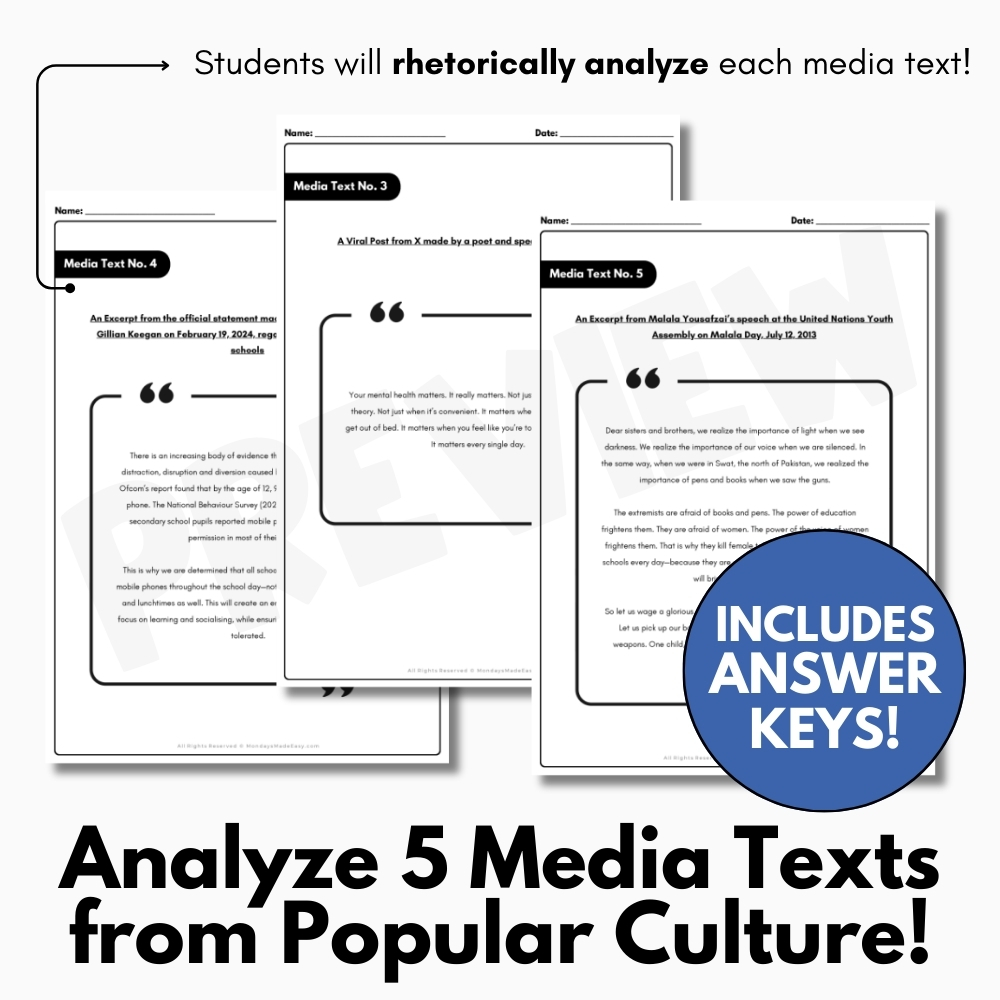
- Explore 5 different media texts provided with this activity (no internet needed)
- SPACECAT Graphic Organizer – Digital & Print
- Summary Paragraph Handout and Differentiated Scaffold
- Detailed Answer Key and Student Example Paragraph
- Teacher Instructions for using these resources
How to Use This SPACECAT Rhetorical Analysis Scavenger Hunt:
This media literacy activity is ideal for reinforcing rhetorical concepts and encouraging critical thinking across diverse media texts.
This activity provides students with an engaging opportunity to practice rhetorical analysis in a structured yet interactive way. Through the SPACECAT Scavenger Hunt, students learn how to evaluate messages across different forms of media while identifying the strategies that shape communication. Media texts often contain layered meanings that are influenced by context, audience, and purpose, and this activity helps students develop the skills needed to analyze those elements carefully. By applying rhetorical concepts to real examples, students gain experience identifying persuasive techniques and understanding how communication works in practical situations.
Begin by introducing students to rhetorical analysis with the SPACECAT Slideshow and Informational Handbook. These materials break down each rhetorical element – Speaker, Purpose, Audience, Context, Exigence, Choices, Appeals, and Tone – using simple definitions and relevant examples.
The slideshow and handbook provide the conceptual foundation for the SPACECAT Scavenger Hunt by explaining the key components of rhetorical analysis in an accessible format. Each element of the SPACECAT framework helps students examine communication from a different perspective. For example, students learn to identify the speaker and consider how the speaker’s credibility influences the message. They also analyze purpose and audience, recognizing that communication strategies change depending on who the message is intended to reach. By studying these elements in advance, students gain the background knowledge needed to participate effectively in the SPACECAT Scavenger Hunt.
To apply their knowledge from the slideshow lesson and informational handout, students will complete the SPACECAT Scavenger Hunt Activity. Begin by distributing the SPACECAT Scavenger Hunt handouts, which include 5 different media texts. You do not need devices or an internet connection to access these media texts; they are all included within the handouts provided. These texts vary in type and tone, offering a wide range of rhetorical strategies for students to examine.
The SPACECAT Scavenger Hunt activity invites students to actively explore rhetorical strategies by analyzing several carefully selected media texts. Each example has been chosen to highlight different persuasive approaches, tones, and contexts. By examining multiple texts in one activity, students can begin to compare rhetorical strategies and see how communication techniques vary depending on the medium and intended audience. Because the materials are printed within the handouts, the SPACECAT Scavenger Hunt can be completed without technology, making it accessible in a variety of classroom environments. This design allows students to focus fully on the analytical process rather than on navigating digital platforms.
Using their SPACECAT Graphic Organizer, students will rhetorically analyze each media text. They can track rhetorical elements across texts and begin to notice patterns in media communication.
The graphic organizer is a key component of the SPACECAT Scavenger Hunt because it helps students structure their analysis systematically. As they examine each text, students record observations about the speaker, audience, purpose, and rhetorical choices used in the message. This organized approach allows students to compare how different texts employ persuasive strategies. Over time, students begin to recognize patterns, such as how tone shifts depending on the intended audience or how certain appeals appear frequently in particular types of media. The graphic organizer ensures that the SPACECAT Scavenger Hunt remains focused on thoughtful analysis rather than quick or superficial observations.
To consolidate their learning, students will write a rhetorical summary in their Summary Paragraph Response worksheet. To scaffold writing, a Summary Paragraph Skeleton is provided. A student sample is also included to model expectations.
The writing component of the SPACECAT Scavenger Hunt encourages students to synthesize their observations and express their analysis in a clear, organized format. Writing a rhetorical summary allows students to move beyond simple identification of rhetorical elements and instead explain how those elements work together to shape meaning. The paragraph skeleton provides sentence starters and structural guidance, helping students organize their ideas logically. For students who are still developing their analytical writing skills, the included sample response offers a model of what a strong rhetorical summary might look like. Through this process, the SPACECAT Scavenger Hunt supports both analytical thinking and written communication skills.
A detailed answer key has also been provided.
The answer key supports the implementation of the SPACECAT Scavenger Hunt by providing teachers with guidance for reviewing and discussing the activity with students. Because rhetorical analysis often involves interpretation, the answer key offers suggested responses and explanations rather than rigid answers. Teachers can use these explanations to facilitate class discussions, clarify misunderstandings, and highlight strong analytical insights. Reviewing the answers together also allows students to compare their interpretations and refine their understanding of rhetorical strategies.
Overall, the SPACECAT Scavenger Hunt provides a comprehensive approach to teaching rhetorical analysis through interactive exploration. By combining instructional materials, hands-on analysis, and reflective writing, the activity helps students gradually build confidence in their analytical abilities. Students learn not only to identify rhetorical elements but also to explain how those elements influence the meaning and effectiveness of communication.
As students progress through the SPACECAT Scavenger Hunt, they begin to develop stronger critical thinking skills that extend beyond the classroom. In an increasingly media-driven world, individuals are constantly exposed to persuasive messages that shape opinions and behaviors. By learning to analyze communication through the SPACECAT framework, students become more thoughtful readers, viewers, and listeners.
Ultimately, the SPACECAT Scavenger Hunt empowers students to approach media messages with curiosity and analytical awareness. Through careful observation and discussion, learners gain the tools needed to interpret persuasive communication and evaluate the rhetorical strategies used in a wide variety of media texts.
✨ Kindly note that due to copyright restrictions, this resource is not editable, except for the files specifically labelled as editable. This is a common practice within the online marketplace in order to protect the clip artists and software providers that have authorized their intellectual property for the development of this resource.
⭒ For classrooms utilizing Google Classroom® ⭒
To access the digital version of these worksheets, simply follow the instructions within the resource to copy the files directly to your Google Drive®.