
Description
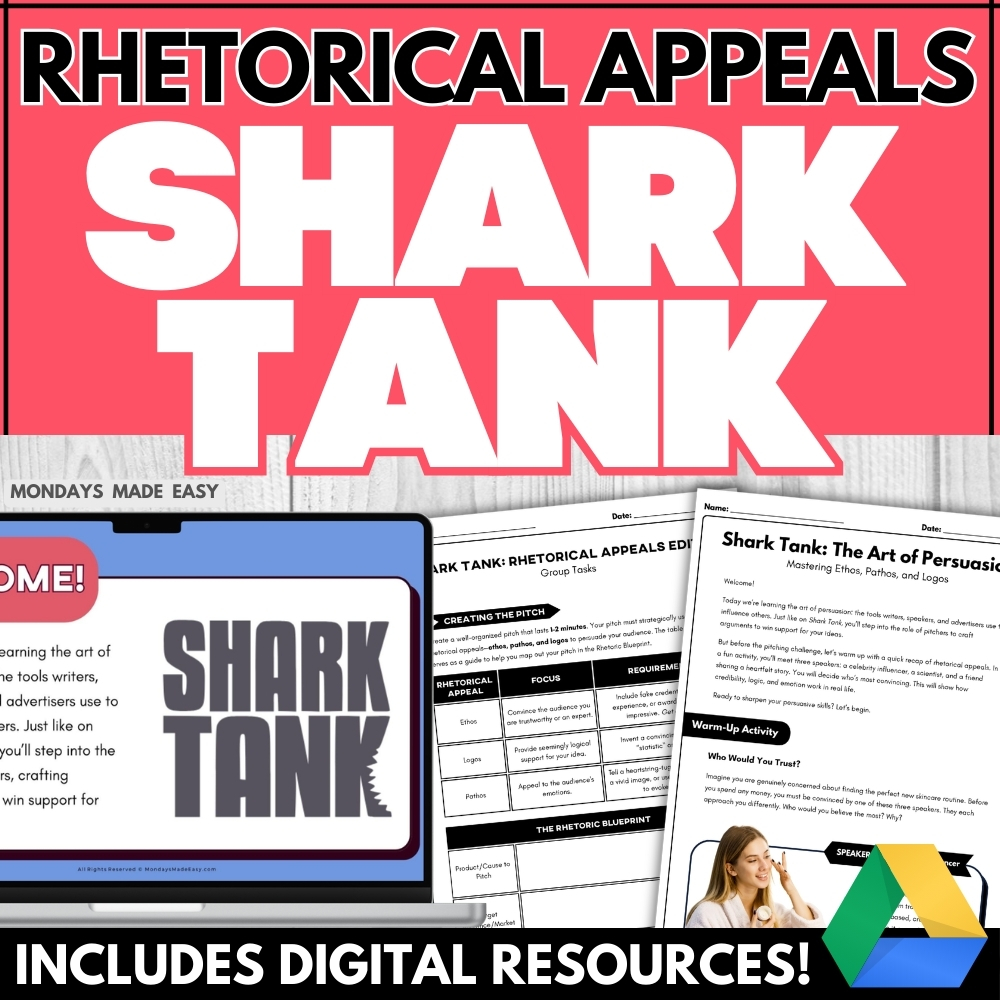
Bring the Shark Tank experience into your classroom – but with a fun twist! In this engaging project, students learn to apply rhetorical appeals – ethos, logos, and pathos – by developing and pitching their own absurd product idea. Includes digital resources for Google Classroom®!
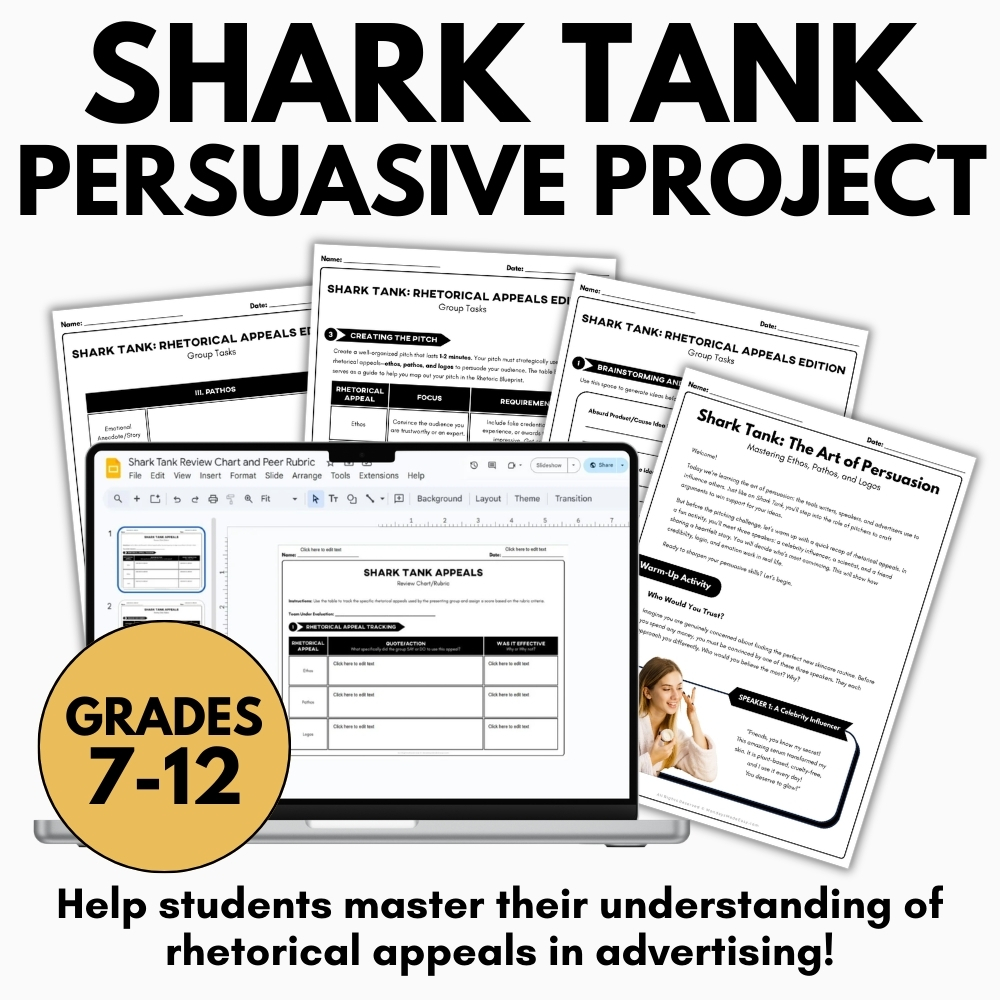
Included with this Shark Tank Persuasion Project:
- The Art of Persuasion Slideshow Lesson – Google Slides®, Powerpoint, and PDF
- The Art of Persuasion Informational Handout
- Shark Tank Assignment Instructions – Editable & Ready-to-Print
- Rhetorical Appeals Pitch Presentation Worksheets – Digital & Print
- Peer Review Rubric and Pitch Review Chart – Digital & Print
- Activity Exit Ticket – Digital & Print
- 4-Level Rubric – Editable & Ready-to-Print
- Teacher Instructions for using these resources
How to Use This Shark Tank Persuasion Project:
This Shark Tank project blends public speaking, media production, and rhetorical analysis in a fun, real-world simulation – perfect for ELA, media, or business classes alike!
This activity uses the familiar format of Shark Tank to immerse students in a persuasive communication challenge that mirrors real entrepreneurial pitches. By simulating a business pitch environment, students must combine creativity, strategic thinking, and rhetorical awareness to present their ideas convincingly. The Shark Tank framework encourages students to think critically about how persuasive communication works in professional contexts, particularly when attempting to sell an idea or product to a skeptical audience. Through this project, learners practice collaboration, develop confidence in public speaking, and explore how persuasion functions across business and media settings.
You can begin this activity with the Art of Persuasion Slideshow Lesson to introduce the persuasive power of rhetorical appeals: ethos, logos, and pathos. Use this lesson to explore how successful pitches appeal to logic, emotion, and credibility, then analyze real-world examples as a class.
The slideshow serves as the instructional foundation for the Shark Tank project by introducing the rhetorical principles that drive effective persuasion. Students learn how ethos establishes credibility, how logos appeals to logic through evidence or reasoning, and how pathos engages the audience’s emotions. By examining real-world examples of persuasive communication, students begin to recognize that strong pitches rarely rely on only one rhetorical strategy. Instead, successful presenters carefully combine multiple appeals to create a compelling message. This introduction prepares students to think strategically about how they will structure their own Shark Tank presentations.
Next, distribute the Art of Persuasion Informational Handout and Shark Tank Assignment Instructions. These resources guide students through the steps of inventing an absurd product, targeting an audience, and developing a pitch that strategically applies rhetorical techniques. Students will work in small groups to build their product concept and prepare their presentation collaboratively.
These resources provide clear guidance for students as they begin the creative process within the Shark Tank project. The assignment instructions outline expectations while encouraging students to think imaginatively about product design and marketing strategies. Because the product concepts are intentionally absurd or humorous, students are free to explore bold and unconventional ideas without worrying about realism. At the same time, the challenge of convincing an audience to invest in an unusual product pushes students to think carefully about how persuasive messaging works. Through collaboration, students develop communication and teamwork skills while planning their Shark Tank pitch.
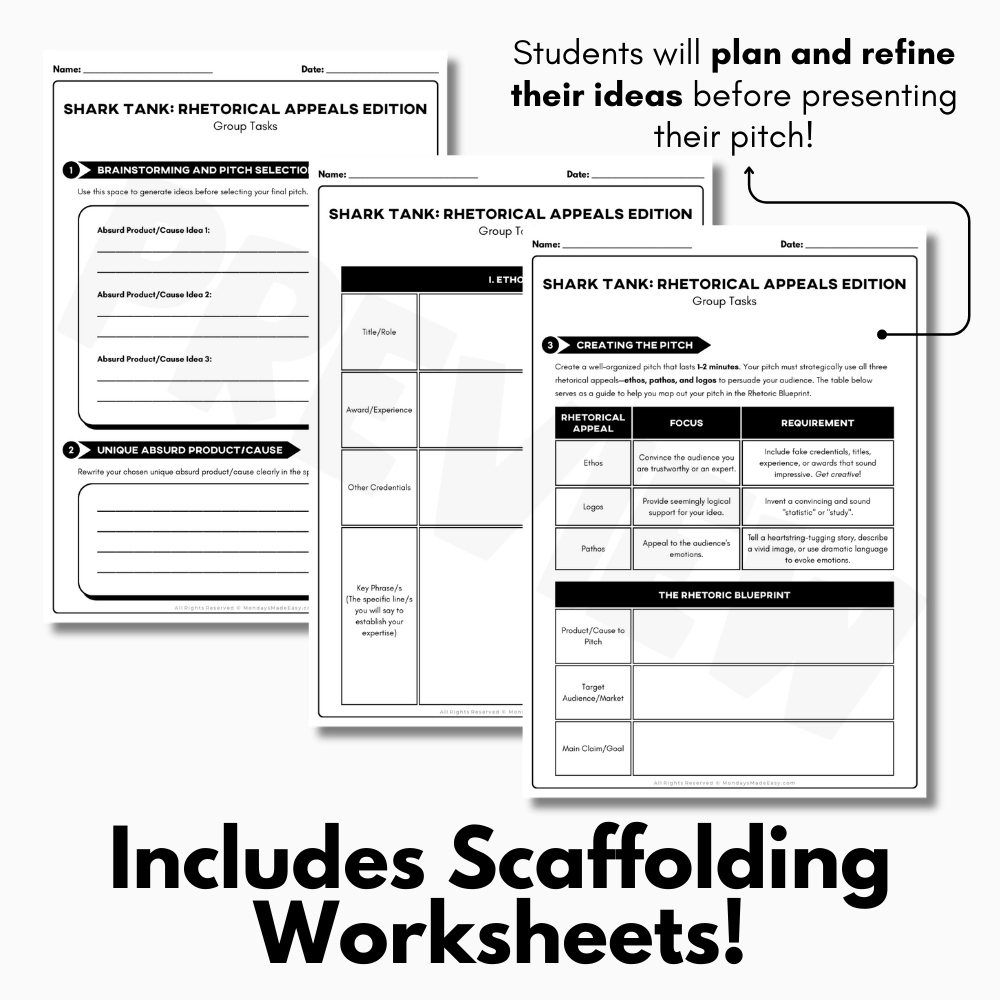
Use the Rhetorical Appeals Pitch Presentation Worksheets to scaffold their planning and refine their ideas. These resources prompt students to identify the central message of their pitch, plan persuasive appeals, and anticipate potential objections.
The planning worksheets help students structure their ideas as they prepare for the Shark Tank presentation. By identifying their central message, students clarify the purpose of their pitch and determine what they want their audience to believe or support. The worksheets also encourage students to consider how ethos, logos, and pathos will appear in their presentation. For example, students may establish credibility by presenting themselves as experts, appeal to logic by explaining how the product solves a problem, or evoke emotion by highlighting how the product improves people’s lives. Anticipating objections further strengthens their strategy, ensuring that their Shark Tank pitch is thoughtful and persuasive.
While students present their pitches, facilitate a peer review using the Pitch Review Chart. This handout helps students analyze each presentation’s rhetorical effectiveness and reflect on how they used ethos, logos, and pathos. Students will also use the Peer Review Rubric to evaluate each presentation.
The peer review stage encourages students to actively engage with each Shark Tank presentation rather than simply observing their classmates’ pitches. As they listen to each group, students use the review chart to identify rhetorical strategies and evaluate how effectively those strategies influence the audience. This process strengthens analytical thinking while reinforcing the rhetorical concepts introduced earlier in the lesson. Using the peer review rubric also encourages constructive feedback, helping presenters understand how their message was received. Through this collaborative evaluation process, students gain deeper insight into what makes a successful Shark Tank pitch.
Finally, use the 4-Level Rubric to assess each student’s rhetorical knowledge, planning, communication, and application. This rubric is provided in both editable and ready-to-print formats to customize it to meet the needs of your unique classroom.
The assessment rubric provides a structured framework for evaluating student performance within the Shark Tank project. It focuses on multiple aspects of the assignment, including understanding of rhetorical appeals, clarity of communication, organization of the pitch, and overall creativity. Because the rubric is editable, teachers can adapt it to emphasize particular skills such as persuasive writing, presentation delivery, or teamwork. Using a clear rubric also helps students understand expectations in advance, allowing them to plan their Shark Tank presentations more effectively.
Beyond the formal assessment, the Shark Tank activity offers valuable opportunities for reflection and discussion. After all presentations are complete, teachers may invite students to discuss which pitches were most convincing and why. These conversations encourage students to analyze the persuasive strategies used in each presentation and consider how different rhetorical approaches influenced the audience.
The Shark Tank simulation also highlights how persuasion operates in real-world contexts such as marketing, entrepreneurship, and media production. Students begin to see that successful pitches require careful planning, strong communication skills, and an understanding of audience needs. By practicing these skills in a creative classroom setting, students gain experience that extends beyond traditional academic tasks.
Ultimately, this Shark Tank project transforms rhetorical analysis into an engaging, performance-based activity. Students not only study persuasive techniques but also apply them directly through the creation and presentation of their own product pitches. The experience encourages creativity, critical thinking, and collaboration while helping students build confidence in their ability to communicate ideas effectively.
Through the Shark Tank project, students learn that persuasion is both an art and a strategy. By combining rhetorical knowledge with imaginative storytelling, learners gain a deeper understanding of how persuasive communication shapes the messages they encounter in media, business, and everyday life.
✨ Kindly note that due to copyright restrictions, this resource is not editable, except for the files specifically labelled as editable. This is a common practice within the online marketplace in order to protect the clip artists and software providers that have authorized their intellectual property for the development of this resource.
⭒ For classrooms utilizing Google Classroom® ⭒
To access the digital version of these worksheets, simply follow the instructions within the resource to copy the files directly to your Google Drive®.