



Description
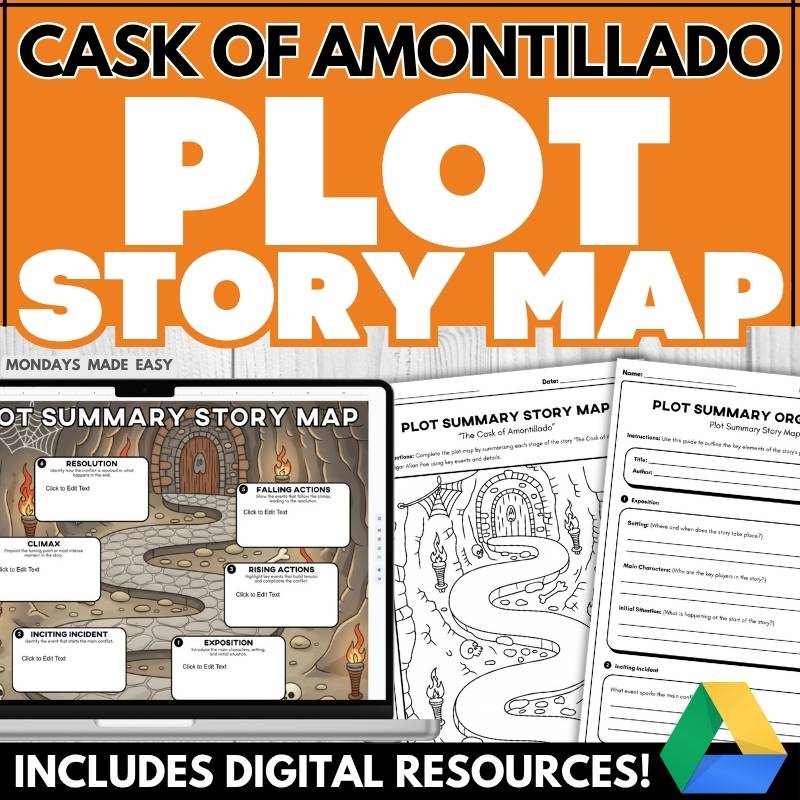
Guide your students through the chilling events in “The Cask of Amontillado” by Edgar Allan Poe with this plot summary story map activity! Students will map the story’s key events, analyze structure, and reflect on Montresor’s calculated revenge using the visual graphic organizers provided. Includes digital resources for online learning!
Included with this Plot Summary Story Map for “The Cask of Amontillado”:
- Story Map Instructional Guidelines – Editable & Ready-to-Print
- Plot Summary Planning Sheet – Digital & Print
- Story Map Visual Graphic Organizer – Digital & Print
-
- Includes independent activity and collaborative poster
- Reflection Sheet – Digital & Print
- Detailed Answer Keys and Student Examples
- Teacher Instructions for using these resources
How to Use This Story Map Activity for “The Cask of Amontillado”:
Edgar Allan Poe’s “The Cask of Amontillado” is a chilling short story about revenge and retribution. Rich with literary devices and figurative language, this story is a fantastic model for teaching verbal irony, foreshadowing, setting, and mood. Guide your students through a visual summary of this classic short story with this story map activity! Using a story map allows students to break down the sequence of events and analyze how Poe builds suspense, establishes tone, and leads readers toward the darkly satisfying conclusion. By mapping the story visually, learners develop a deeper understanding of the text’s structure and gain insight into how Poe’s choices as an author create the tale’s haunting atmosphere.
You can begin by reviewing the Story Map Instructional Guidelines, which outline the expectations for the plot summary and story map activity. This guide helps students understand the purpose of story mapping and introduces essential narrative elements such as exposition, rising action, climax, falling action, and resolution. Discussing each stage of the plot ensures students grasp how Poe layers each event with irony and tension. For example, teachers can emphasize how the exposition establishes Montresor’s motive for revenge, setting the stage for the dark climax deep within the catacombs. The guidelines also provide strategies for annotating key textual moments, allowing students to make connections between structure and meaning. These directions can serve as a reference throughout the unit, ensuring that each learner remains focused and organized while completing their story map.
Next, have students complete the Plot Summary Organizer. This scaffolding worksheet supports comprehension by prompting students to summarize key moments in the story while identifying cause-and-effect relationships and narrative pacing. Encourage students to use quotations and specific examples from the text to reinforce their understanding. For instance, students might include Montresor’s chilling line, “I must not only punish but punish with impunity,” in their rising action section to highlight how it foreshadows his calculated cruelty. The Plot Summary Organizer also helps students visualize how Poe constructs the tension step by step, from the deceptive kindness in the carnival setting to the final sealing of Fortunato’s fate. By analyzing these moments through a story map approach, students can see how the story’s structure intensifies the reader’s emotional engagement and sense of dread.
Then, students will transfer their ideas into the Story Map Graphic Organizer. This visual layout helps them structure their thinking and trace the story’s dramatic arc, making it especially effective for visual learners. The story map also reinforces how Edgar Allan Poe crafts suspense through narrative structure, allowing students to observe how each event contributes to the buildup and resolution. You can have students color-code sections or include brief illustrations to show transitions in setting and tone. For example, students might shade the exposition in bright carnival colors, gradually darkening their visuals to mirror the descent into the catacombs. The story map can be completed individually for quiet reflection or as a collaborative class project where students discuss and debate which details belong in each part of the narrative. This flexibility makes the activity engaging for various learning styles and classroom settings.
The collaborative story map poster variation allows students to work together on a larger visual representation of the story’s structure. Each group can be assigned a different narrative section—exposition, rising action, climax, falling action, or resolution—to illustrate and explain. This encourages teamwork, discussion, and textual analysis as they negotiate which details best capture the essence of each plot stage. The collaborative poster also serves as a classroom display, showcasing collective understanding and pride in their analytical work. Teachers can later use these posters as reference tools for reviewing story structure or as an anchor chart during discussions about narrative techniques in other texts.
Finally, students will complete the Reflection Sheet, where they analyze their own responses and evaluate Montresor’s character, motives, and the story’s resolution. This component supports metacognitive thinking and reinforces comprehension through reflective writing. The reflection prompts students to consider questions such as: What drives Montresor’s desire for revenge? How does Poe’s use of irony shape the reader’s perception of justice? How does the story’s structure amplify its psychological tension? These questions push students to think beyond surface-level comprehension and engage with the moral and thematic depth of the story. Pairing reflective writing with the story map ensures that students not only understand what happens but also why it happens and how Poe’s craft contributes to its impact.
This resource also includes detailed answer keys and student examples to consolidate learning and model responses. The provided story map examples serve as visual references, showing students how to effectively organize their ideas and summarize key events. Teachers can use these examples to guide struggling learners or to demonstrate how textual evidence supports analysis. The answer key helps facilitate class discussions, allowing educators to clarify misconceptions and highlight different interpretations of key moments in the story. By reviewing these materials, students strengthen their ability to construct evidence-based arguments and communicate insights clearly.
Overall, this story map activity transforms the reading of “The Cask of Amontillado” into an interactive and analytical experience. Students are not merely retelling the plot—they are engaging in literary exploration, developing critical thinking, and visualizing how narrative structure contributes to meaning. By the end of the unit, they will not only understand Poe’s chilling tale more deeply but will also possess transferable skills for analyzing any piece of literature. The combination of visual mapping, textual analysis, and reflection ensures that this story map resource enhances comprehension while sparking curiosity and discussion about one of Poe’s most memorable stories.
✨ Kindly note that due to copyright restrictions, this resource is not editable, except for the files specifically labelled as editable. This is a common practice within the online marketplace in order to protect the clip artists and software providers that have authorized their intellectual property for the development of this resource.
⭒ For classrooms utilizing Google Classroom® ⭒
To access the digital version of these worksheets, simply follow the instructions within the resource to copy the files directly to your Google Drive®.












Caitlin R. –
Great