Description
Help students identify misleading headlines and analyze bias in news reports with this media literacy lesson! Teach students how to recognize misinformation, apply media conventions, and evaluate headlines for bias and accuracy. Includes digital worksheets for Google Classroom®!
Included with this Misleading Headlines Lesson:
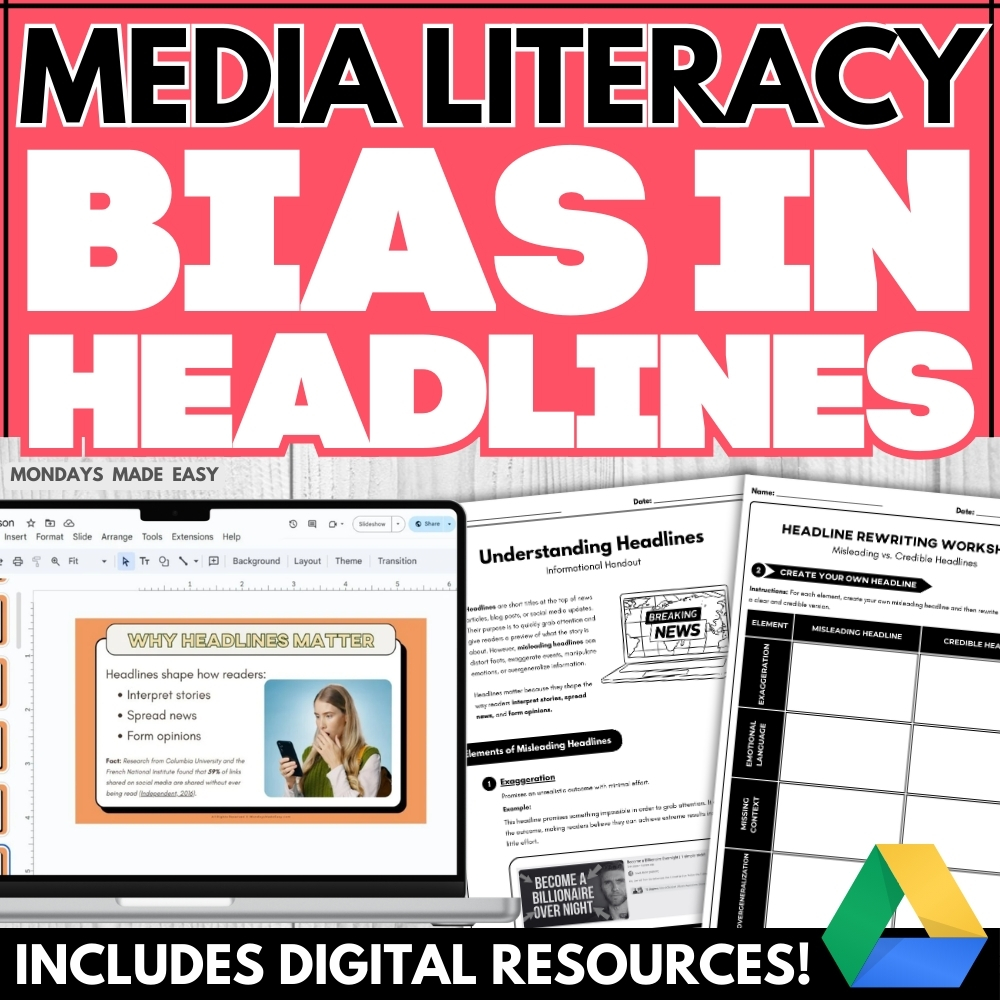
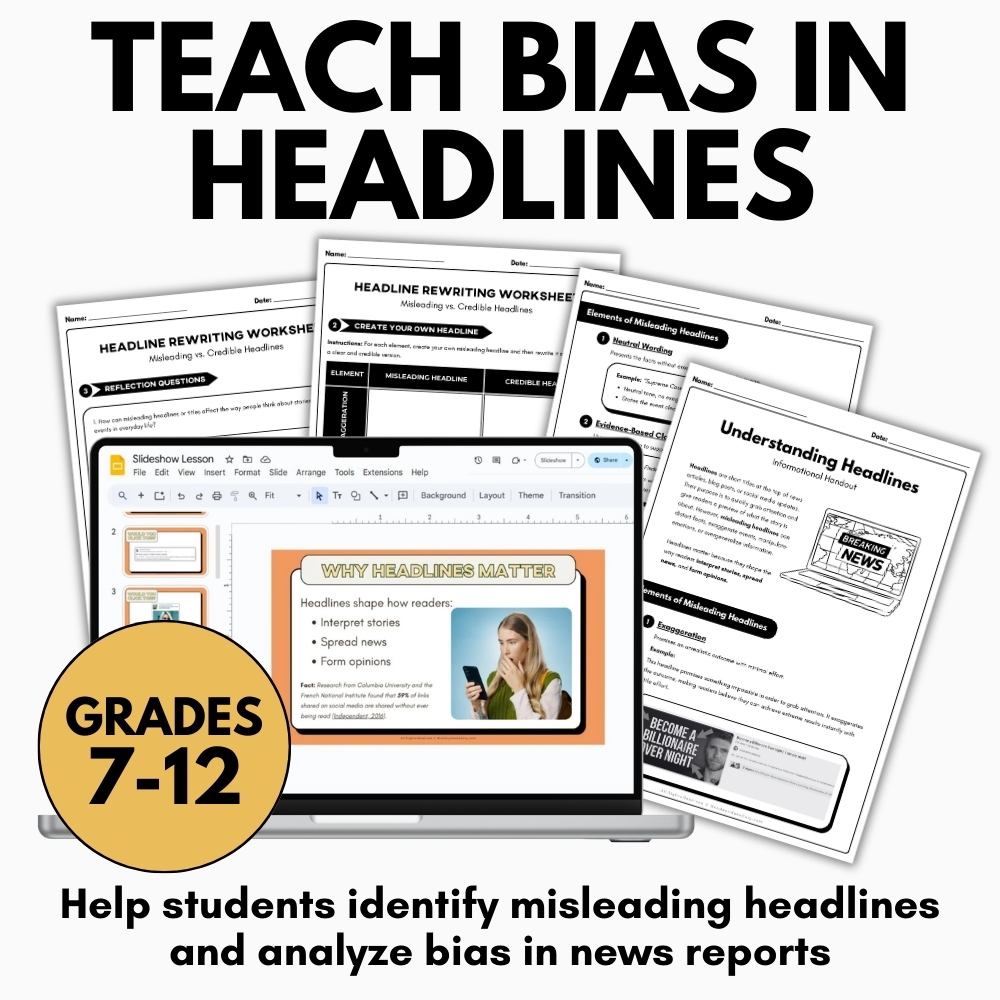
- Understanding Headlines Slideshow Lesson – Google Slides®, Powerpoint, and PDF
- Media Conventions and News Bias Informational Handout
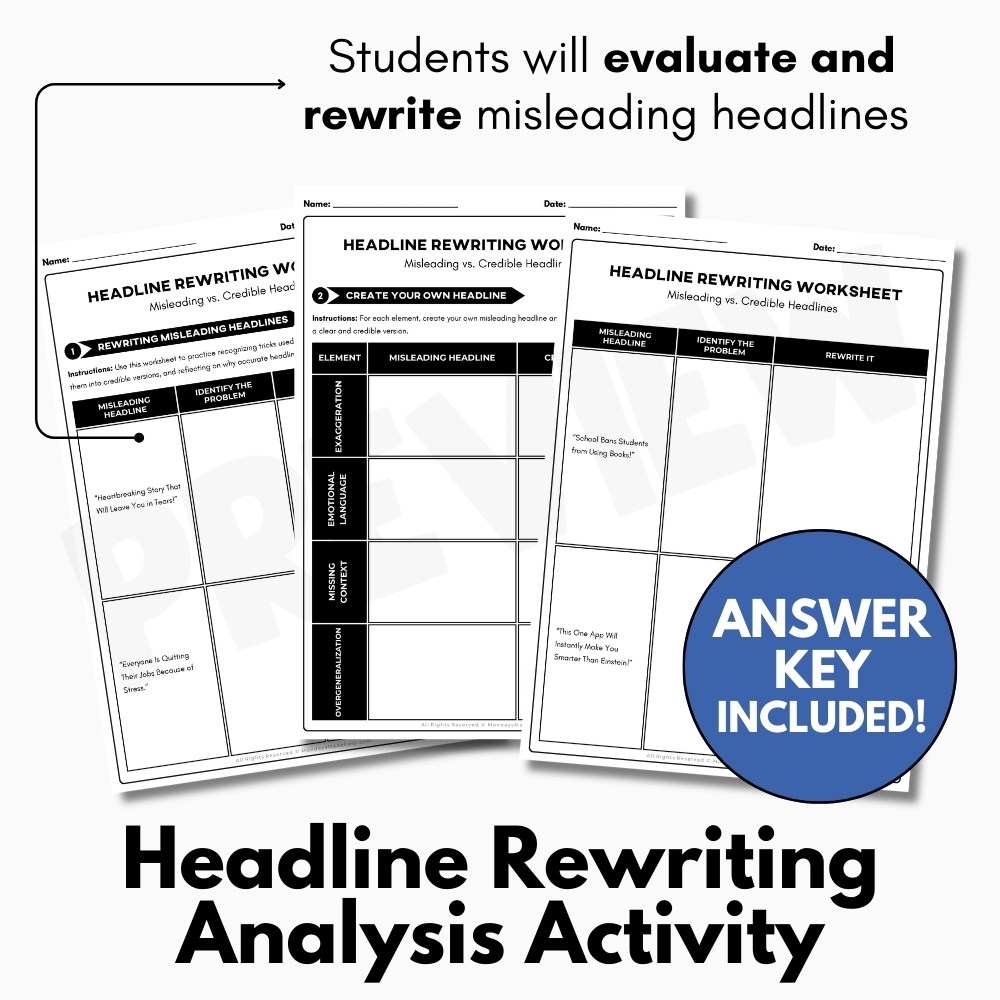
- Headline Rewriting Activity – Digital & Print
- Sample Answers to Model Student Responses
- Teacher Instructions for using these resources
How to Use This Misleading Headlines Lesson:
This resource offers a practical, hands-on approach to understanding bias and misinformation in everyday media. You can begin this lesson with the Understanding Headlines Slideshow Lesson. This slideshow lesson introduces the concept of headline bias, clickbait strategies, and common conventions used in online journalism. Teachers can guide students through examples and prompt discussion around how headlines shape reader perception and engagement with the news.
This introductory component establishes a strong foundation for analyzing Misleading Headlines by helping students recognize that headlines are not neutral summaries but purposeful constructions designed to attract attention. Through visual examples and guided questioning, students begin to notice how word choice, punctuation, and framing influence emotional responses before an article is even read. This phase of the lesson is especially effective for activating prior knowledge, as many students encounter headlines daily through social media and news apps. Teachers can pause the slideshow to ask predictive questions, encouraging students to reflect on how a headline shapes expectations and whether it accurately reflects the content that follows.
Next, distribute the Media Conventions and News Bias Informational Handout. This resource outlines various tactics used to sway readers, such as sensationalism, omission, and tone. Students can annotate this handout or turn to it as a reference when analyzing headlines and articles.
This handout serves as an anchor text throughout the lesson and gives students shared language for discussing Misleading Headlines. By clearly defining techniques such as selective omission or emotionally charged wording, the resource empowers students to move beyond vague claims like “this sounds biased” and instead identify specific strategies at work. Annotation encourages active engagement, allowing students to highlight examples, make connections to real-world media, and ask questions about intent. As a reference tool, the handout supports independent analysis later in the lesson, reinforcing that media literacy is a skill that relies on evidence and careful observation.
Then, assign the Headline Rewriting Activity. Students will evaluate misleading headlines and identify issues such as exaggeration, emotional language, missing context, and overgeneralization. They will rewrite each misleading headline to create a more credible and informative version. The second section challenges students to write their own examples, reinforcing their understanding of media literacy and digital citizenship.
This activity represents the core application of learning, where students actively deconstruct and revise Misleading Headlines rather than simply identifying them. By diagnosing specific problems within a headline, students practice critical reading and analytical reasoning. Rewriting tasks require them to apply journalistic principles such as accuracy, balance, and clarity, reinforcing the difference between sensationalism and responsible reporting. The extension portion, in which students generate their own examples, deepens understanding by asking learners to demonstrate mastery rather than recognition. This step also reinforces digital citizenship by highlighting students’ responsibility as both consumers and creators of online content.
Finally, use the Student Samples to model expectations. These sample answers provide clear examples of how to revise misleading headlines, making it easier for students to grasp the lesson objectives and practice skills independently or in groups.
Modeling is a crucial instructional strategy when teaching about Misleading Headlines, particularly because revisions can feel subjective to students. The student samples clarify expectations by showing what a strong revision looks like and how specific choices improve credibility. Teachers can analyze samples with the class, drawing attention to precise changes in tone, wording, and context. This guided analysis helps students internalize success criteria and builds confidence before independent practice. Samples are also valuable for differentiation, as students who need additional support can use them as references while more advanced learners can critique and refine them further.
Taken together, these lesson components form a cohesive instructional sequence that moves students from awareness to analysis and finally to application. The repeated focus on Misleading Headlines ensures that students are not only able to spot problematic media but also understand why such headlines are effective and potentially harmful. By revisiting the concept across multiple activities, students develop a deeper, more durable understanding of how misinformation spreads.
This resource also supports essential cross-curricular skills, including critical thinking, argumentation, and ethical reasoning. Students learn to question sources, examine intent, and recognize the broader impact of Misleading Headlines on public opinion and civic discourse. These skills are increasingly important in a digital landscape where information is shared rapidly and often without verification.
In classroom implementation, this lesson can be completed over one or two class periods, depending on the depth of discussion and writing expected. Teachers may choose to incorporate current events, allowing students to bring in real-world examples of Misleading Headlines for analysis. This real-time application increases relevance and engagement while reinforcing that media literacy skills are transferable beyond the classroom.
Ultimately, this resource equips students with practical tools to navigate modern media responsibly. By learning how to identify, analyze, and revise Misleading Headlines, students become more informed readers and more ethical communicators. The lesson emphasizes that understanding media is not just an academic skill but a lifelong competency essential for participation in a democratic and information-rich society.
✨ Kindly note that due to copyright restrictions, this resource is not editable, except for the files specifically labelled as editable. This is a common practice within the online marketplace in order to protect the clip artists and software providers that have authorized their intellectual property for the development of this resource.
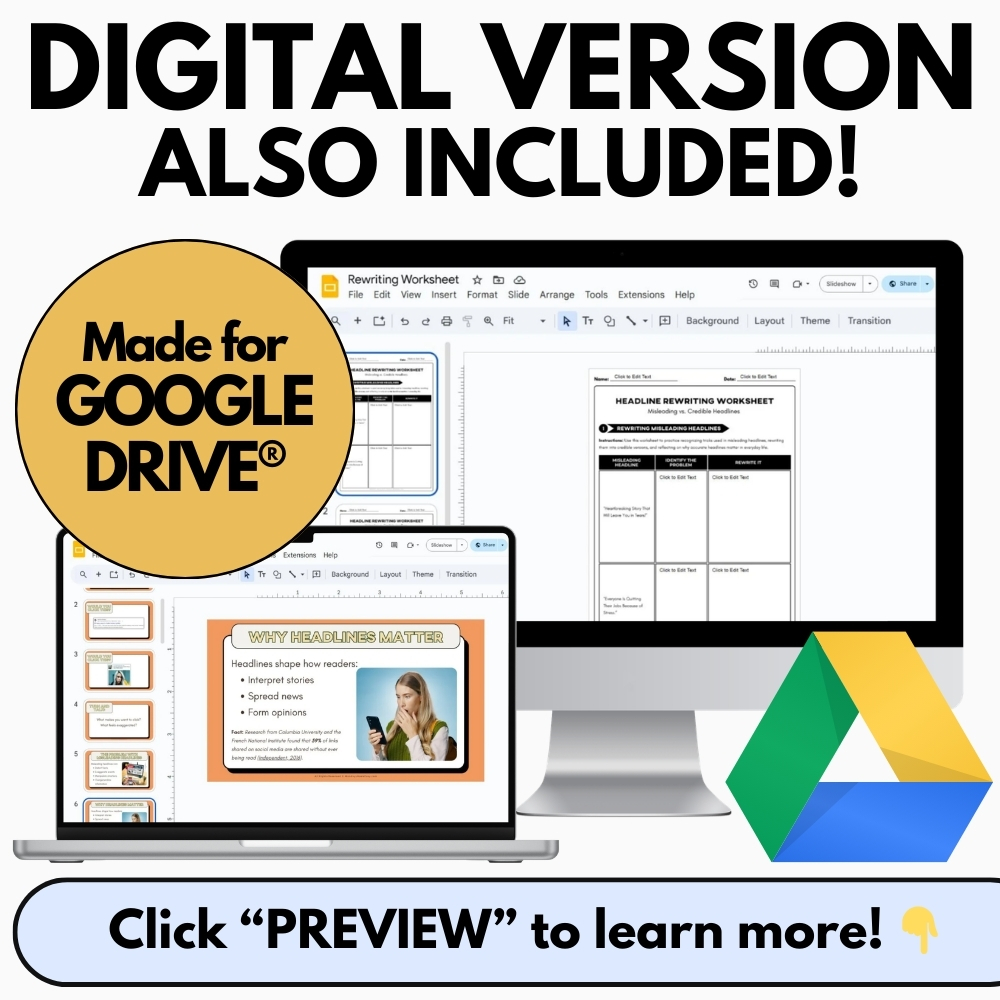
⭒ For classrooms utilizing Google Classroom® ⭒
To access the digital version of these worksheets, simply follow the instructions within the resource to copy the files directly to your Google Drive®.