
Description
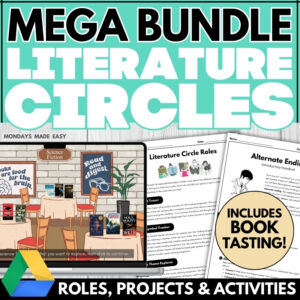
Lead independent book clubs in middle or high school! These literature circle roles explore seven insightful tasks for student-led book clubs. Includes graphic organizers for each role, along with a pacing guide and editable rubrics.
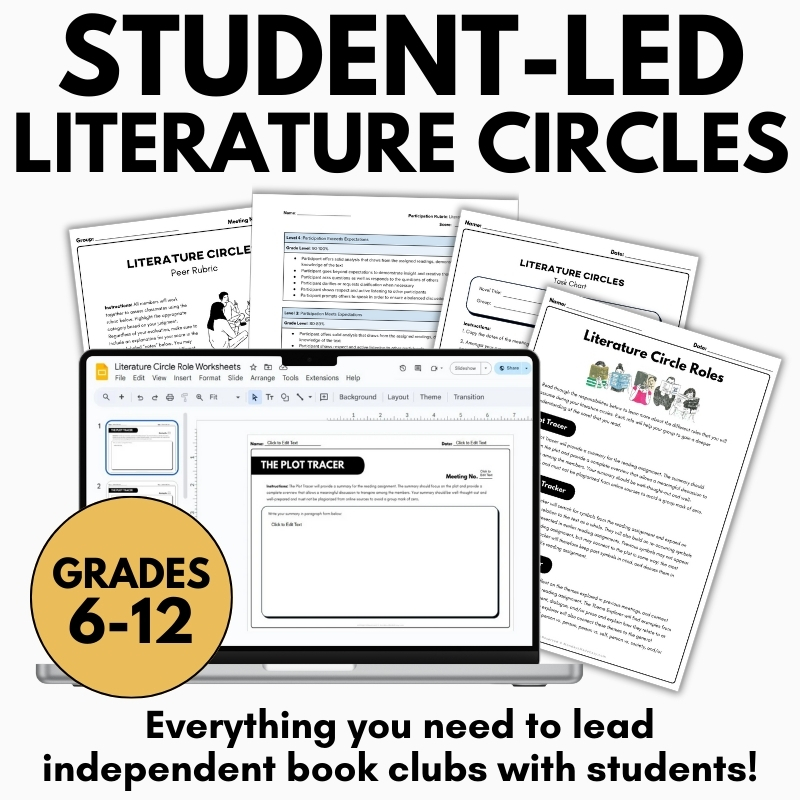
Included with these Literature Circles Roles and Responsibilities:
- Seven Literature Circle Role Descriptions
- Task Worksheets for Each Role – Digital & Print
- Pacing Guide and Task Graphic Organizer – Digital & Print
- Peer Rubrics – Editable + Ready-to-Print
- Teacher Rubric – Editable + Ready-to-Print
- Teacher Instructions for using these resources
How to use these Literature Circle Roles:
Foster student inquiry and promote meaningful peer-to-peer discussion and evaluation using the materials included in this literature circles unit!
This comprehensive unit is designed to support structured, student-led discussions that move beyond surface-level comprehension. By clearly defining expectations and providing consistent tools, students are empowered to engage thoughtfully with texts while building confidence in collaborative learning environments. The framework encourages active listening, respectful dialogue, and evidence-based responses, all of which are essential skills for successful literature study. When implemented effectively, Literature Circle Roles help transform reading groups into purposeful academic discussions rather than informal conversations.
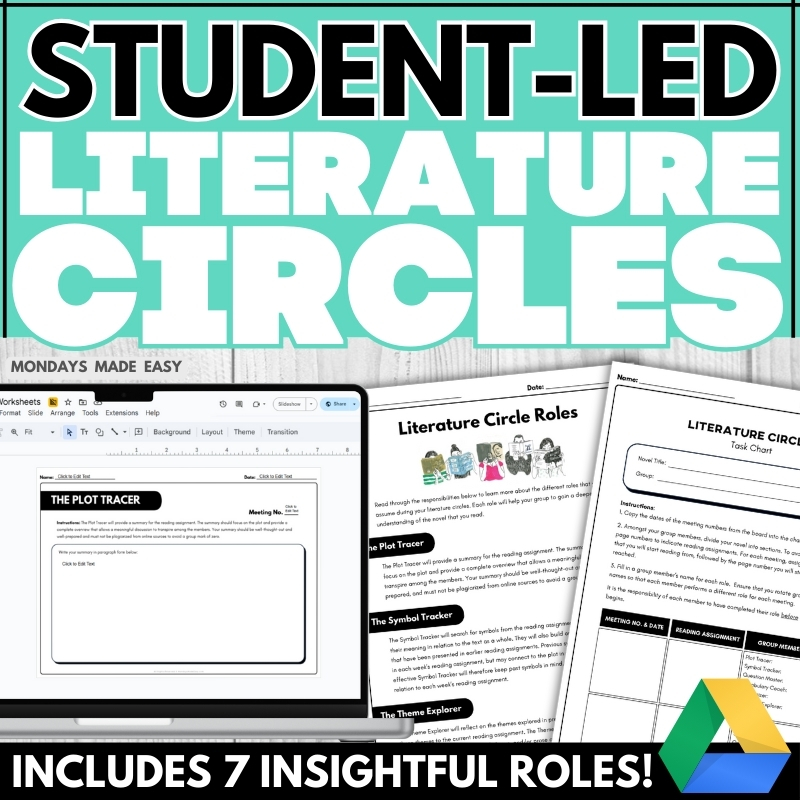
Begin by outlining the seven insightful literature circle roles and their responsibilities included. These roles are designed for middle and high school students and offer opportunities to practice analytical and practical reading strategies during group discussions.
Explicitly introducing each role ensures that students understand both their individual responsibilities and how their contributions support the group as a whole. Each role targets a specific literacy skill, such as summarizing, questioning, analyzing language, or making connections, allowing students to practice multiple strategies over time. Rotating Literature Circle Roles throughout the unit ensures balanced skill development and prevents students from becoming confined to a single way of thinking. This intentional structure supports differentiation while maintaining high academic expectations for all learners.
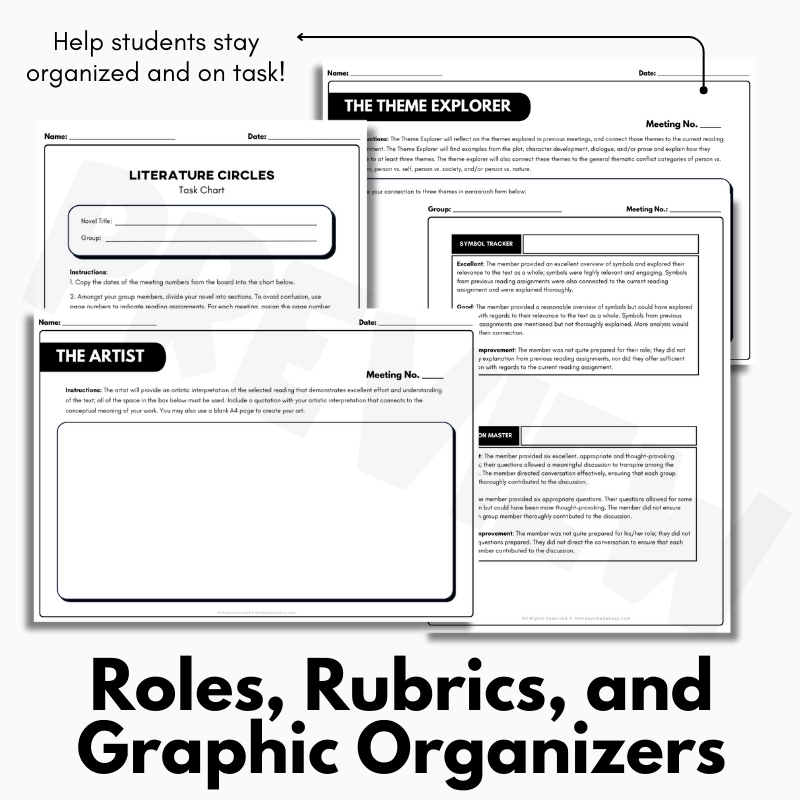
To help students stay organized and on task during literature circle meetings, a Task Chart Graphic Organizer is included. This tool allows students to assign roles, track responsibilities, and follow a clear meeting schedule.
Organization is a key factor in the success of collaborative learning, particularly for middle and high school students who are still developing executive functioning skills. The task chart provides a visual reference that reduces confusion and keeps discussions focused. By clearly outlining who is responsible for each role and what needs to be completed before and during meetings, students are better prepared to participate meaningfully. When paired with Literature Circle Roles, this organizer reinforces accountability and helps groups manage their time efficiently.
Each literature circle role is supported by a Task Worksheet that guides students in preparing for their discussions. These worksheets prompt students to engage deeply with the text and fulfill their assigned responsibilities with clarity and focus.
The task worksheets serve as both preparation tools and formative assessments, ensuring that students come to discussions ready to contribute. Prompts encourage close reading, text-based responses, and thoughtful reflection, helping students move beyond summary into analysis. These structured supports are especially beneficial for reluctant readers or students who struggle with open-ended tasks. By consistently using Literature Circle Roles alongside these worksheets, students develop stronger habits of preparation and a clearer understanding of academic discussion norms.
To encourage accountability and foster reflective feedback, a Peer Evaluation Form is also provided. Students can use this form to assess their classmates’ participation, which may inform adjustments to individual grades if necessary.
Peer evaluation promotes metacognition by asking students to reflect not only on others’ contributions but also on their own participation. This process encourages honesty, responsibility, and constructive feedback, all of which strengthen group dynamics. When students know their effort matters, they are more likely to engage actively and respectfully. Integrating peer feedback with Literature Circle Roles reinforces the idea that collaboration is a shared responsibility and that each role contributes to the group’s overall success.
A participation rubric is included for teacher use. The ready-to-print version assigns grade percentages to performance levels, while an editable version allows for alignment with specific curriculum expectations. Teachers can use this rubric to assess student engagement by observing literature circle meetings at random intervals.
This rubric provides a clear and consistent method for assessing discussion-based learning, which can often feel subjective without defined criteria. By focusing on observable behaviors such as preparation, engagement, collaboration, and use of textual evidence, teachers can confidently evaluate student performance. The editable format allows for flexibility across grade levels and instructional goals. When used alongside Literature Circle Roles, the rubric ensures that assessment aligns with instruction, reinforcing expectations while supporting student growth over time.
✨ Kindly note that due to copyright restrictions, this resource is not editable, except for the files specifically labelled as editable. This is a common practice within the online marketplace in order to protect the clip artists and software providers that have authorized their intellectual property for the development of this resource.
See what other teachers are saying about this Literature Circle Roles:
“Great way to encourage peer-to-peer discussion and evaluation! Thank you for such a comprehensive package- this will be very useful indeed!” – Karolina T.
⭒ For classrooms utilizing Google Classroom® ⭒
To access the digital version of these worksheets, simply follow the instructions within the resource to copy the files directly to your Google Drive®.