Description
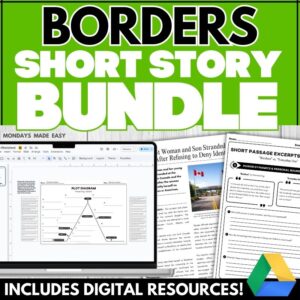
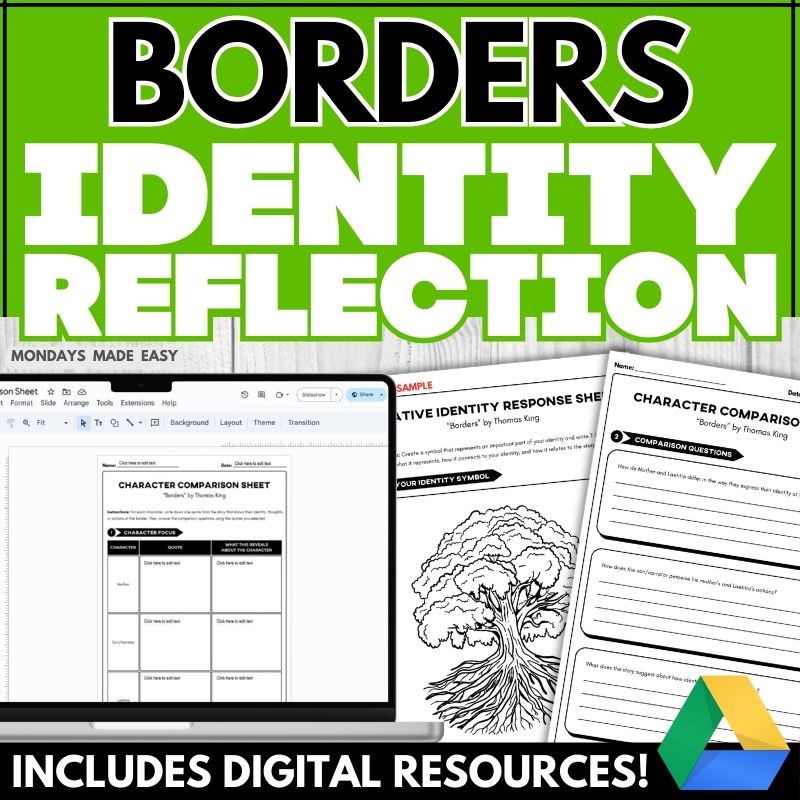
Deepen your students’ understanding of identity in “Borders” by Thomas King with this character comparison and reflection activity. Students will compare characters, reflect on personal identity, and create a symbolic visual response. Includes digital worksheets for Google Classroom®!
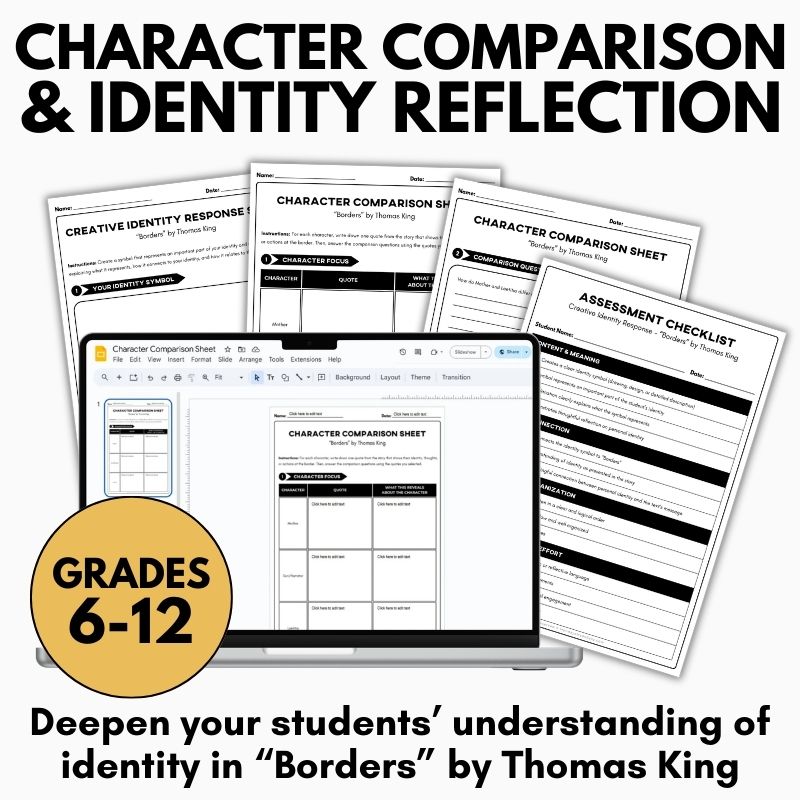
Included with this Character Comparison Activity:
- Character Comparison Graphic Organizer – Digital & Print
- Text-to-Self Reflection Journal – Digital & Print
- Creative Identity Response Worksheet – Digital & Print
- Assessment Checklist
- Student Example Mentor Texts
- Teacher instructions for using this resource
How to Use This Character Comparison Activity:
Begin with the Character Comparison Graphic Organizer to help students analyze the contrasting traits, motivations, and identities of the mother and narrator in “Borders.” This guided worksheet prompts students to record textual evidence and examine how each character responds to the story’s central conflict involving cultural identity and borders.
This Character Comparison activity encourages students to move beyond surface-level observations and toward a deeper understanding of how perspective shapes narrative meaning. By organizing their thinking visually, students can clearly identify similarities and differences between the two characters while grounding their ideas in specific quotations from the text. The structure of the organizer ensures that students consider not only what the characters do, but why they make certain choices and how those choices reflect larger themes. Through careful Character Comparison, learners begin to see how generational differences influence reactions to authority, belonging, and personal identity.
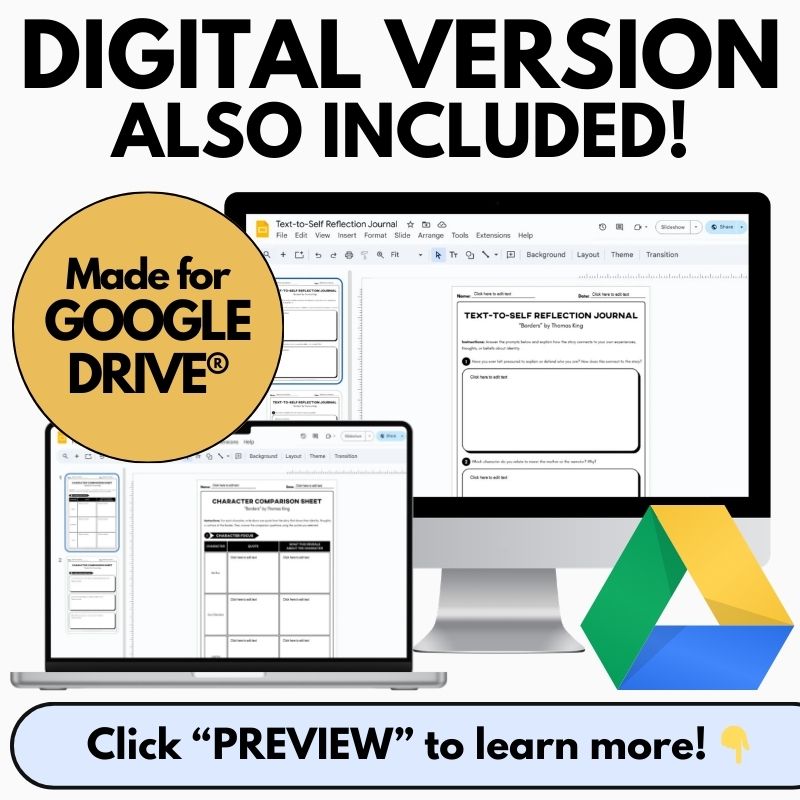
Next, students will complete the Text-to-Self Reflection Journal to connect their own experiences with the themes of the story. This journal invites students to explore their personal identities and consider how cultural, familial, or social influences shape who they are—just as the characters in the story grapple with questions of self and belonging. The reflection journal builds naturally from the Character Comparison by encouraging students to internalize the themes explored in the text. After analyzing the mother and narrator, students are better prepared to examine their own identities with honesty and insight. This step fosters empathy and self-awareness, helping students recognize that literature often mirrors real-world experiences. By connecting personal reflection to their earlier Character Comparison work, students strengthen both their analytical and introspective skills.
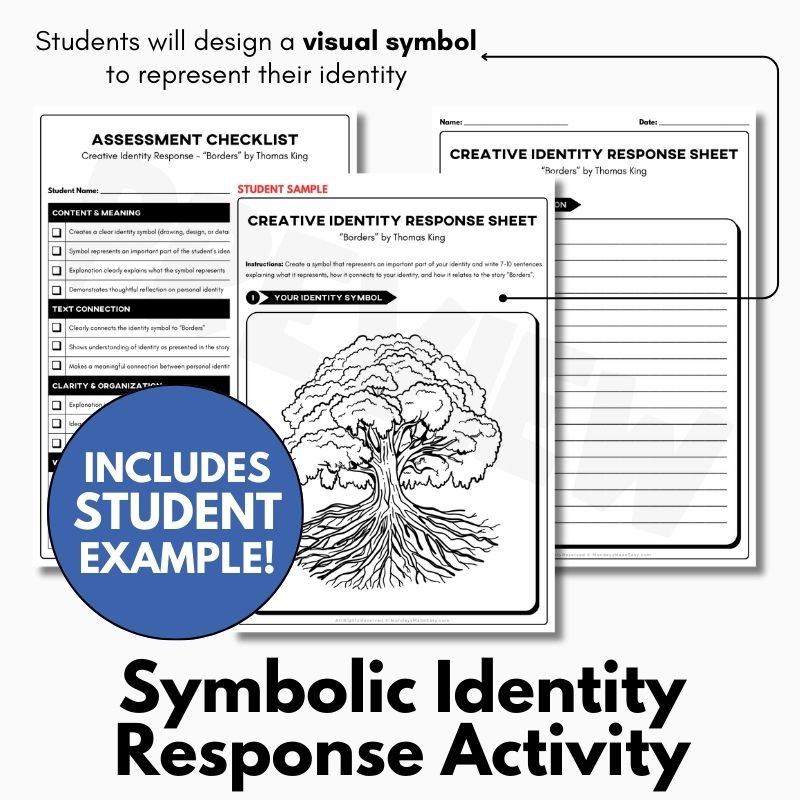
Then, assign the Creative Identity Response Worksheet. Students will design a visual symbol that represents an important aspect of their own identity. Alongside the image, they write a short explanation connecting their symbol to both their personal experiences and the themes in “Borders.” This creative response encourages students to think critically about the relationship between personal expression and cultural identity. This creative extension allows students to synthesize their learning in a meaningful and memorable way. Having completed a detailed Character Comparison, students understand how identity is communicated through actions, language, and personal conviction. Designing a symbolic representation challenges them to translate abstract ideas into visual form while articulating their reasoning in writing. The combination of art and analysis reinforces comprehension and supports diverse learning styles, making the lesson both inclusive and rigorous.
To evaluate this assignment, an Assessment Checklist has been provided. This checklist supports flexible assessment of both analytical and creative responses. Student sample responses are also included for modeling and differentiation. The checklist ensures that expectations are transparent and aligned with learning objectives. It evaluates students’ ability to reference textual evidence from their Character Comparison, demonstrate thoughtful reflection, and clearly explain their creative choices. Including sample responses provides clarity and support, particularly for students who benefit from concrete examples. This structured yet adaptable assessment approach helps maintain high standards while honoring student voice and creativity.
✨ Kindly note that due to copyright restrictions, this resource is not editable, except for the files specifically labelled as editable. This is a common practice within the online marketplace in order to protect the clip artists and software providers that have authorized their intellectual property for the development of this resource.
⭒ For classrooms utilizing Google Classroom® ⭒
To access the digital version of these worksheets, simply follow the instructions within the resource to copy the files directly to your Google Drive®.