


Description
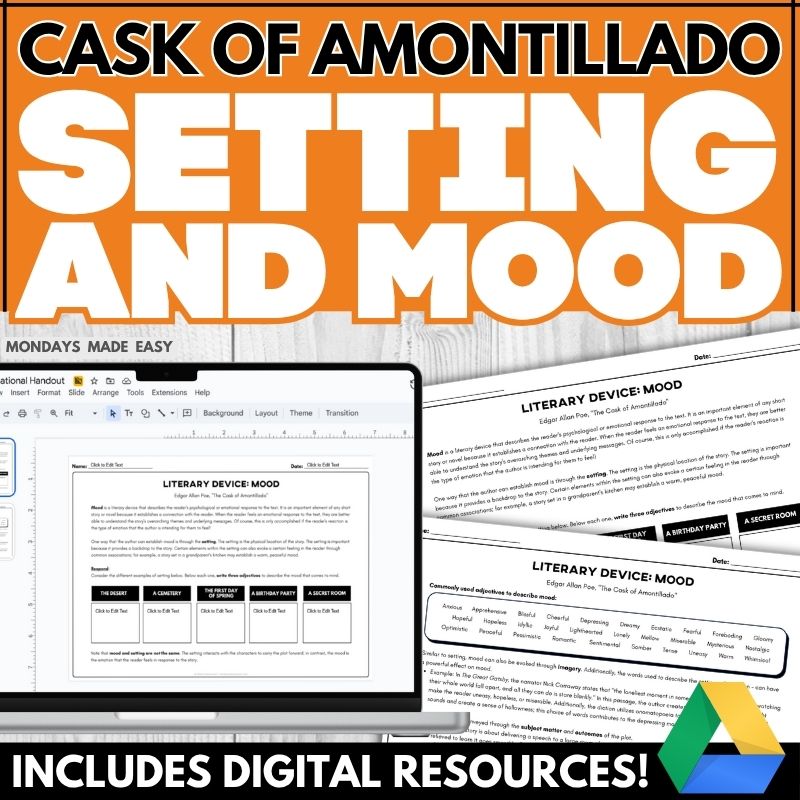
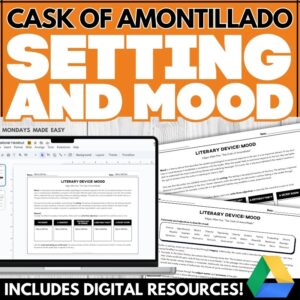
Differentiate between setting and mood in Edgar Allan Poe’s “The Cask of Amontillado” using this literary analysis activity! Includes information handouts and close reading quotations to explore the author’s illustration of setting and mood in this classic short story. Suitable for online learning with digital worksheets for Google Classroom®!
Included with this Analysis Activity for Setting and Mood in “The Cask of Amontillado”:
- Informational Handouts about Setting and Mood – Digital & Print
-
- Differentiate between setting and mood as literary devices
- Determine how an author establishes mood within a story
- Explore adjectives for describing mood and practice by applying them to common settings
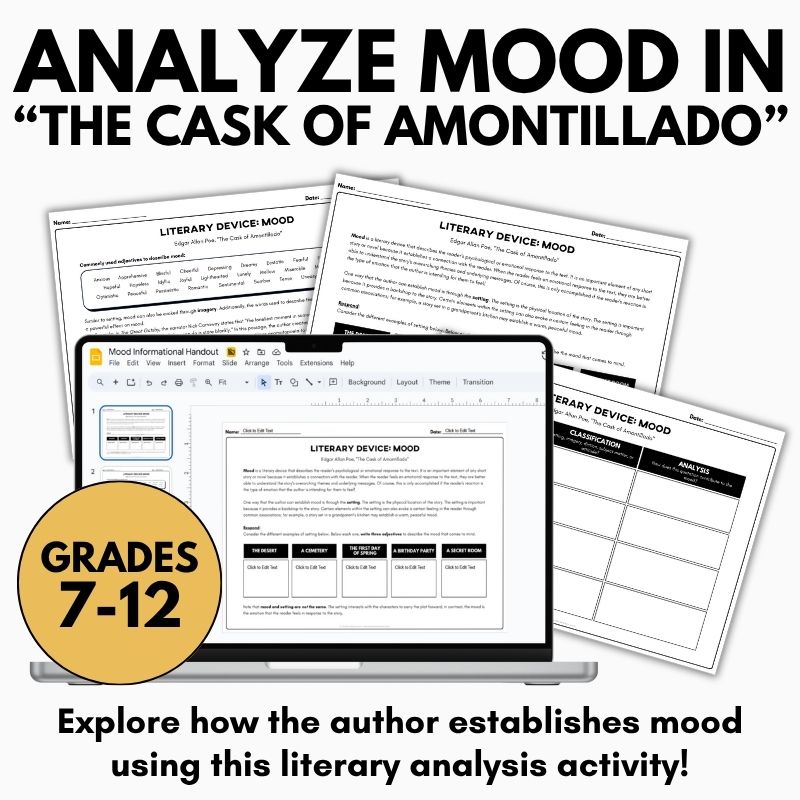
- Close Reading Quotations Graphic Organizer for Analyzing Mood – Digital & Print
-
- Analyze quotations from “The Cask of Amontillado”
- Locate quotations within the short story to explain the author’s illustration of mood
- Teacher Instructions for using this resource
How to use this Analysis Activity for Setting and Mood in “The Cask of Amontillado”:
Edgar Allan Poe’s “The Cask of Amontillado” is a chilling short story about revenge and retribution. Rich with literary devices and figurative language, this story is a fantastic model for teaching verbal irony, foreshadowing, setting, and mood. The dark tone and suspenseful pacing make it an ideal text for engaging students in critical reading and interpretation. With this analysis activity, students can closely examine how Poe builds atmosphere and tension through careful word choice and vivid imagery. This activity helps students see the connection between authorial decisions and reader experience, guiding them to understand how specific details within a story can evoke emotion and create an immersive mood. Teachers can use this as a standalone lesson or as part of a broader literary analysis unit focusing on Poe’s works or Gothic literature.
You can begin this lesson by distributing the Informational Handouts about setting and mood. These handouts define mood as a literary device and explore how an author establishes mood within a story. They introduce key concepts in accessible language, making them suitable for a range of grade levels. Through this analysis activity, students learn that setting describes where and when a story takes place, while mood reflects the emotional atmosphere that surrounds the reader. The handouts also provide guided examples drawn from familiar texts to reinforce understanding before students move on to Poe’s more complex style. By distinguishing between setting and mood early in the lesson, students are better prepared to identify how Poe’s descriptions of the catacombs—its darkness, dampness, and silence—contribute to the story’s chilling emotional impact.
Students will then practice interpreting mood by describing the mood of different types of settings. This portion of the analysis activity gives them a chance to apply their understanding in a hands-on way. They might be asked to describe the mood of settings such as a quiet forest, a crowded marketplace, or an abandoned house, using specific adjectives that capture each scene’s atmosphere. This practice encourages students to think critically about how language choices influence emotional tone. They begin to recognize that even small descriptive details—such as lighting, temperature, and sound—affect how readers feel about a story. This exercise is also a great opportunity for collaborative learning, as students can compare interpretations and see how multiple perspectives enrich literary analysis.
Students are then provided with 30 common adjectives for describing mood within literature. These adjectives range from “melancholic” and “ominous” to “serene” and “triumphant,” allowing students to articulate their responses to text with greater precision. In this portion of the analysis activity, students can use these descriptive words as a reference tool when analyzing the mood of Edgar Allan Poe’s “The Cask of Amontillado.” The activity also encourages vocabulary development by prompting students to match adjectives with textual evidence. As they examine Poe’s writing, they learn to justify their interpretations with direct quotations, deepening both comprehension and analytical reasoning. This vocabulary element strengthens their literary terminology while supporting critical writing skills.
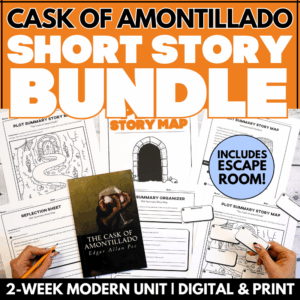
Students will complete the Graphic Organizer for Analyzing Mood. This analysis activity prompts them to explore eleven close reading quotations that illustrate how Poe establishes mood through descriptive language, sensory imagery, and pacing. Each quotation offers clues about how the author manipulates tone to keep readers engaged and uneasy. The first two quotations have been completed for students as examples, modeling how to identify descriptive words and connect them to specific emotional effects. Students will then analyze the remaining five quotations independently, applying their knowledge to draw connections between Poe’s language and the feelings it evokes. They will also locate four quotations of their own, encouraging them to engage deeply with the text and demonstrate independent critical thinking.
This analysis activity also reinforces essential reading comprehension strategies. By requiring students to justify their responses with textual evidence, the lesson aligns with key standards in both Common Core and provincial curriculum frameworks. It strengthens students’ ability to interpret, cite, and evaluate evidence—skills that are essential not only for literature classes but also for academic writing more broadly. Furthermore, the structured format of the graphic organizer supports differentiation, making the lesson accessible to students at varying levels of proficiency. Teachers can easily adapt the activity by adjusting the number of quotations or by offering additional sentence starters for students who need extra support.
To consolidate this activity, a detailed answer key has also been included with this resource. The answer key provides model responses that demonstrate how to connect text evidence to mood analysis effectively. Teachers can use it to facilitate class discussions, guide peer review, or check students’ work quickly and efficiently. It can also serve as a reference for modeling close reading techniques in future lessons. Through this comprehensive analysis activity, students gain a deeper appreciation for Edgar Allan Poe’s craft and learn how writers use mood to shape a reader’s emotional journey. By the end of the lesson, students will not only understand how setting and mood function as literary devices but also feel more confident applying these concepts to their own analytical writing.
✨ Kindly note that due to copyright restrictions, this resource is not editable, except for the files specifically labelled as editable. This is a common practice within the online marketplace in order to protect the clip artists and software providers that have authorized their intellectual property for the development of this resource.
See what other teachers are saying about this Analysis Activity:
“My students loved this. They were struggling with mood and setting connections. This helped tremendously.”
– Sherri M.
⭒ For classrooms utilizing Google Classroom® ⭒
To access the digital version of these worksheets, simply follow the instructions within the resource to copy the files directly to your Google Drive®.





Jo P. –
I used this for several students who were in quarantine, and it was amazingly helpful.
Jeris J. –
Thank you for this resource! It was very helpful!
Amanda H. –
This was very helpful to explain the difference between setting and mood, not only for this story but for others.
Desiree M. –
Great activity that went along with the Edgar Allen Poe story that the student were reading. I would definitely use this resource again.
Rosa C. –
My students understood this resource and it was helpful.
Sherri M. –
My students loved this. They were struggling with mood and setting connections. This helped tremendously.
Catherine S. –
My students loved this resource. It was engaging and creative. Thank you!
Melissa B. –
This was exactly what I needed! It was very easy to use, and my students were engaged the whole time. Saved me so much prep time. Thank you.