Description
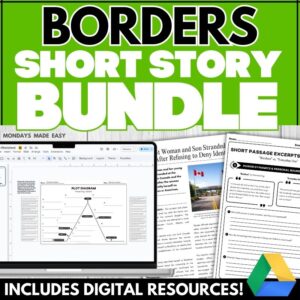
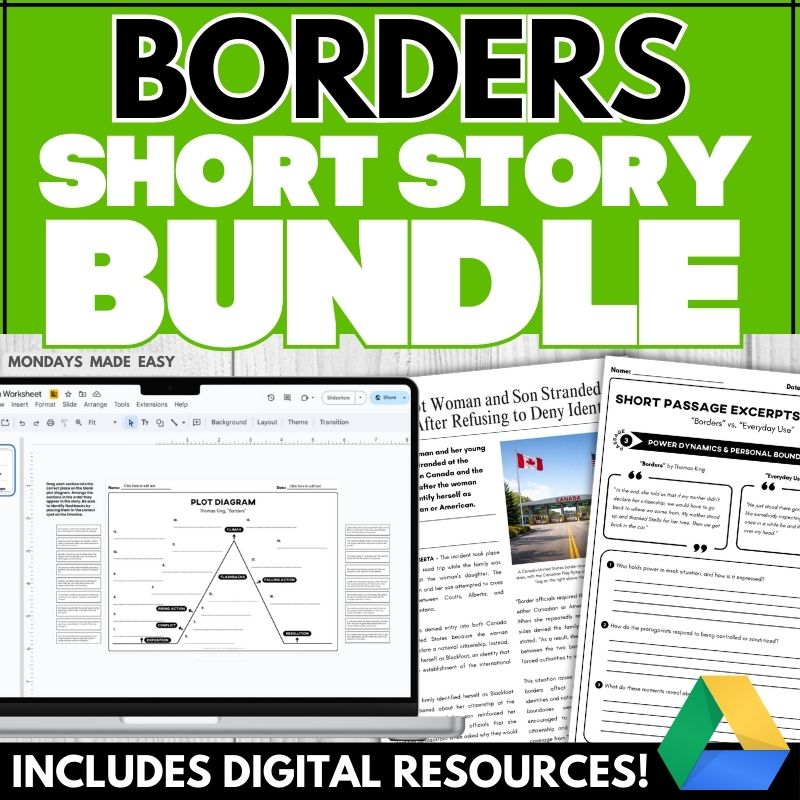
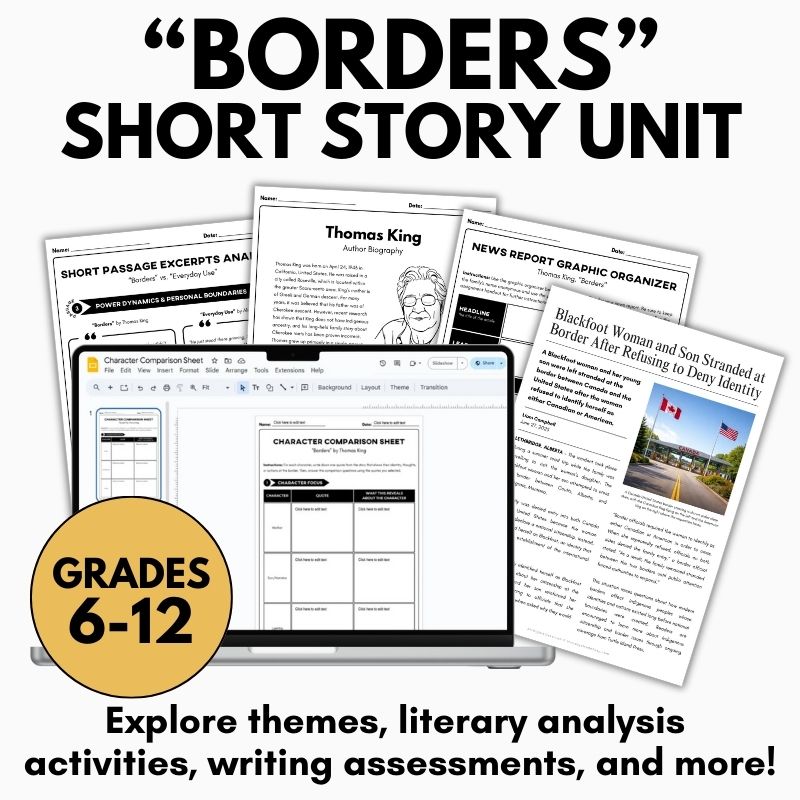
Updated for 2026 to reflect current scholarship on Thomas King’s identity. This short story unit explores themes, characterization, and plot structure in “Borders.” This bundle includes comprehension questions, literary analysis activities, assessment tools, an author biography, informational handouts, comparison activities, and more. Suitable for online learning and Google Classroom®!
The profits from this resource are donated to Indspire, a charity dedicated to investing in education for Indigenous people in Canada.
☄️ Save over 80% with this special bundle price and additional discounts!
Included with this “Borders” Short Story Unit:
- Author Biography for Thomas King – Digital & Print
- Guided Reading Questions for “Borders” – Digital & Print
- Plot Diagram Activity – Digital & Print
- Character Comparison and Identity Reflection – Digital & Print
- Theme Poster Assignment – Digital & Print
- “Borders” vs. “Everyday Use” Text Comparison Activity – Digital & Print
- News Report Writing Assignment – Digital & Print
- 4-Level Rubrics – Editable & Ready-to-Print
- Detailed Answer Keys and Example Answers
- Teacher instructions for using these resources
Resources included with this “Borders” Short Story Unit by Thomas King:
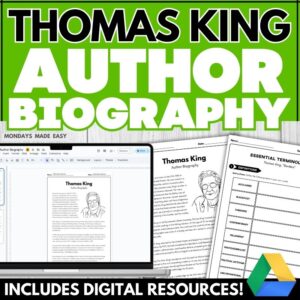
1. Author Biography for Thomas King
Updated for 2026 to reflect current scholarship on Thomas King’s identity. Explore the life and experiences of Thomas King, author of the short story “Borders.” This resource includes an author biography and comprehension questions to support students’ independent reading and understanding of the text.
This introductory component grounds students in the historical, cultural, and personal context behind the Borders Short Story, helping them better understand King’s perspectives on identity, borders, and belonging. By learning about Thomas King’s background, students gain insight into how lived experiences influence storytelling and thematic choices. The accompanying comprehension questions encourage active reading and accountability, guiding students to connect biographical details to the narrative itself. This resource works especially well as a pre-reading activity, setting a strong foundation before students engage deeply with the Borders Short Story in class discussions or written responses.
2. Comprehension Questions for “Borders” by Thomas King
These guided reading questions include prompts for comprehension and deeper discussion. The comprehension questions can be used alongside “Borders;” you can encourage students to answer these questions while they are reading to support their understanding.
Designed to scaffold comprehension, these questions help students track key events, clarify character motivations, and unpack subtle moments of meaning within the Borders Short Story. Teachers can use the questions flexibly—as independent work, partner discussions, or small-group checkpoints—to monitor understanding in real time. The mix of literal and inferential prompts encourages students to slow down and think critically about King’s language choices and narrative structure. This ongoing support is especially helpful for students encountering the Borders Short Story for the first time or those who benefit from guided reading strategies.
3. Plot Structure Lesson & Plot Diagram Activity
Students will also examine linear and non-linear storylines using these informational handouts. This lesson compares the two types of storylines to examine their unique strengths for storytelling. Visual diagrams for linear and non-linear storylines have also been provided.
This lesson helps students situate the Borders Short Story within a broader understanding of narrative structure. By comparing linear and non-linear storytelling, students learn that authors make deliberate structural choices to shape meaning and reader experience. The visual diagrams provide clear, accessible models that support visual learners and reinforce abstract concepts. This instruction prepares students to analyze how King structures events and why that structure matters in conveying themes related to identity and borders.
Next, assign the Plot Structure Activity to guide students through key events in the story. This worksheet supports comprehension by prompting students to identify and sequence events in the short story. This step-by-step activity ensures students fully grasp the progression of the Borders Short Story, from exposition through resolution. Sequencing events helps students recognize cause-and-effect relationships and understand how tension develops throughout the narrative. The worksheet also encourages discussion about which moments are most significant and why, reinforcing close reading skills and collaborative analysis.
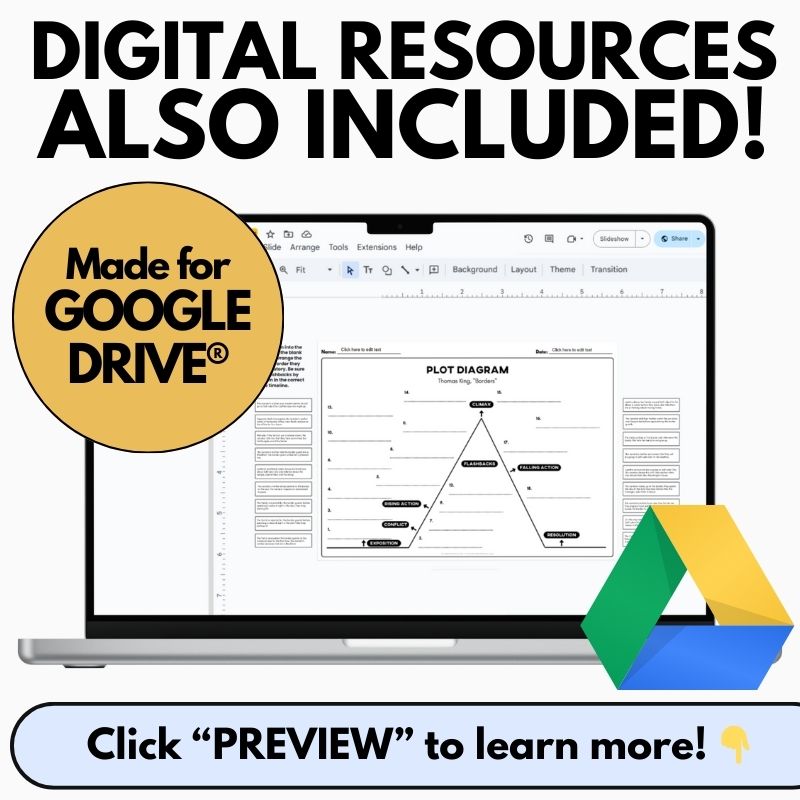
Then, students will complete the Plot Diagram Worksheet. Using the story’s major plot events, they map out the narrative arc from exposition to resolution. The visual format helps solidify their understanding of narrative structure and theme. Mapping the Borders Short Story visually allows students to see how plot, theme, and character development intersect. This activity is particularly effective for reinforcing academic vocabulary related to plot structure while giving students a concrete reference they can return to during later analysis or writing tasks.
4. “Borders” Character Comparison and Identity Reflection
Deepen your students’ understanding of identity in “Borders” by Thomas King with this character comparison and reflection activity. Students will compare characters, reflect on personal identity, and create a symbolic visual response.
This activity encourages students to move beyond comprehension and into personal and thematic reflection centered on the Borders Short Story. By comparing characters, students examine how identity is shaped by personal choice, cultural heritage, and external systems. The reflective component invites students to make meaningful connections between the text and their own experiences, while the symbolic visual response allows for creative expression and deeper engagement with abstract ideas.
5. “Borders” Theme Poster – Citing Text Evidence Activity
Practice citing text evidence and analyzing themes with this poster activity for “Borders” by Thomas King! This engaging activity challenges students to analyze the short story and visually communicate a central theme using textual evidence, images, and the author’s perspective.
Through this activity, students practice essential analytical skills while working collaboratively. Selecting and justifying evidence from the Borders Short Story helps students strengthen their ability to support claims with textual proof. The visual format reinforces understanding by requiring students to translate abstract themes into concrete symbols, promoting both critical thinking and creativity.
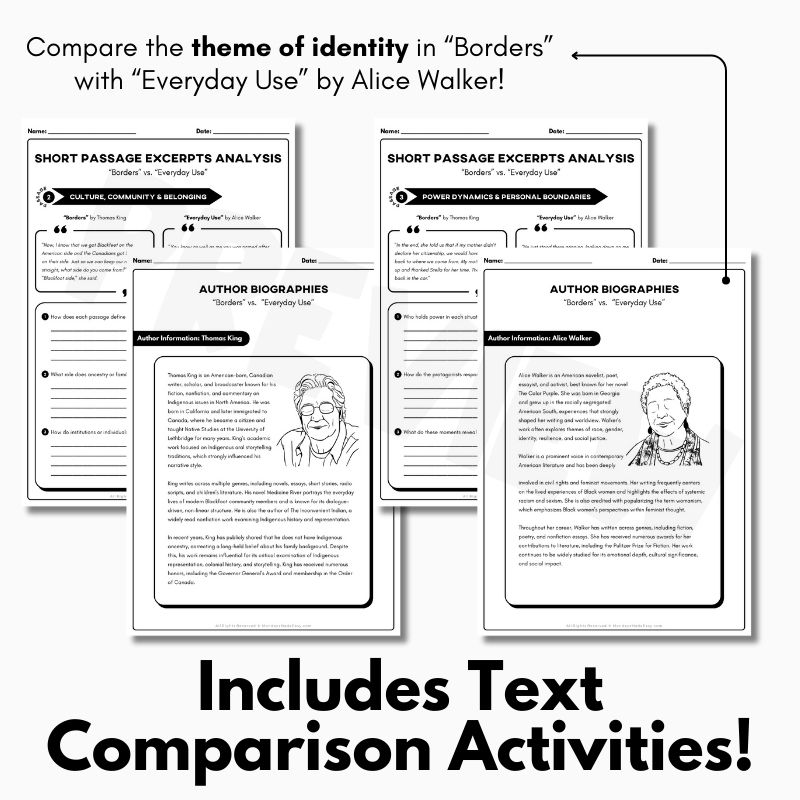
6. “Borders” vs. “Everyday Use” by Alice Walker – Comparison Activity
How do stories about family, pride, and heritage reflect different understandings of identity? This compare and contrast activity uses the short stories “Borders” by Thomas King and “Everyday Use” by Alice Walker to help students explore personal and cultural identity through literary analysis. This resource includes author background, comparative tools, and reflection prompts to guide students through a rich analysis of both stories.
Pairing these texts encourages students to analyze the Borders Short Story in conversation with another powerful narrative about identity and heritage. Students compare characters, themes, and author perspectives, developing higher-order thinking skills and a deeper appreciation for diverse voices. The structured tools support clear organization while still allowing for thoughtful interpretation and discussion.
7. Expository Writing Assignment – Writing a News Article
Practice expository article writing while assessing students’ understanding of “Borders” using this news article assignment! Includes a news report graphic organizer, news article template, editable assignment instructions and an editable 4-level rubric.
This final assessment invites students to demonstrate their understanding of the Borders Short Story through an authentic, real-world writing task. By transforming narrative events into a news article, students practice objective tone, organization, and clarity while reinforcing comprehension of key events and themes. The structured supports and editable rubric make expectations transparent and assessment efficient, providing a strong culminating task that brings together reading, writing, and critical thinking skills.
✨ Kindly note that due to copyright restrictions, this resource is not editable, except for the files specifically labelled as editable. This is a common practice within the online marketplace in order to protect the clip artists and software providers that have authorized their intellectual property for the development of this resource.
See what other teachers are saying about this Borders Short Story:
“This was an excellent resource for teaching this powerful story to my 12th grade students. The materials were thoughtful, well-organized, and encouraged deep analysis of both literary elements and cultural themes. It sparked rich classroom discussions and helped students connect meaningfully with the text. A valuable, ready-to-use bundle that made planning and instruction easy—highly recommend!” – Cortney K.
⭒ For classrooms utilizing Google Classroom® ⭒
To access the digital version of these worksheets, simply follow the instructions within the resource to copy the files directly to your Google Drive®.