
Description
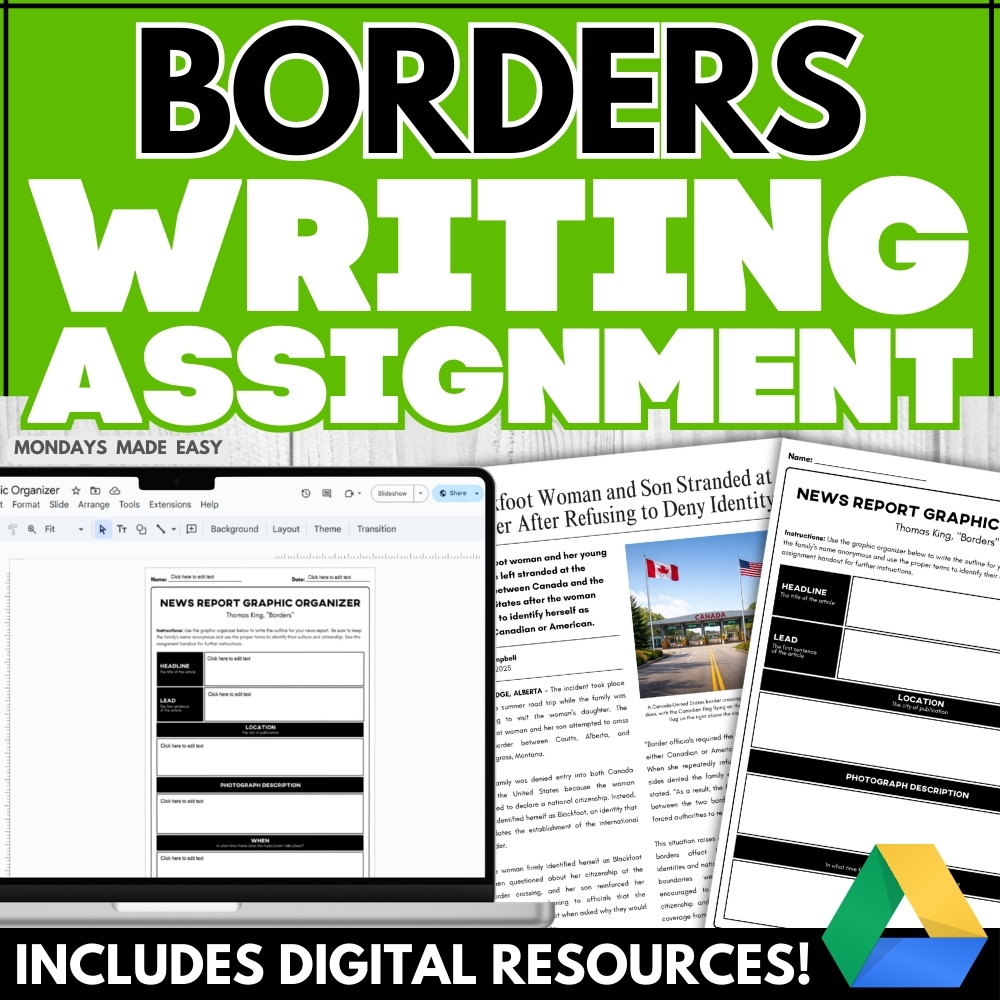
Practice expository article writing while assessing students’ understanding of “Borders” by Thomas King using this news article assignment! Includes a news report graphic organizer, news article template, editable assignment instructions and an editable 4-level rubric. Suitable for online learning with digital worksheets for Google Classroom®!
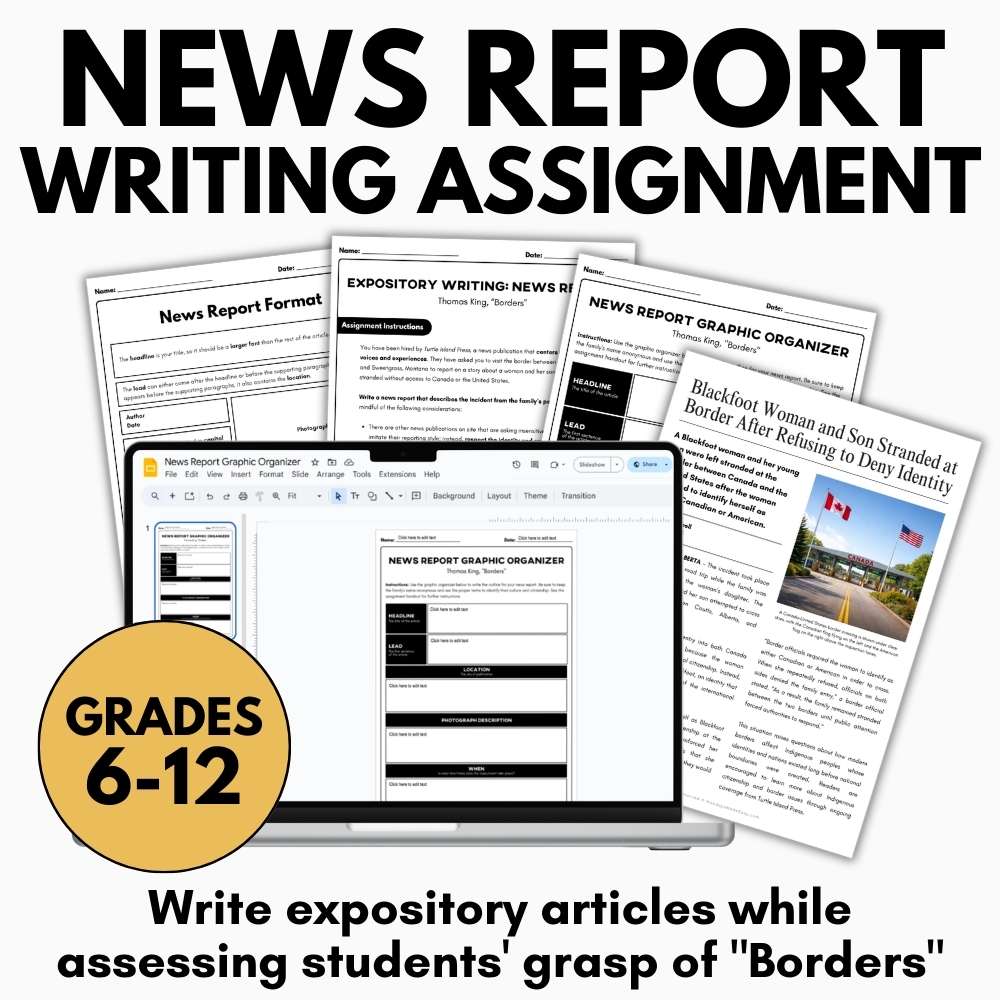
Included with this Expository Writing Assignment:
- Expository Writing Assignment Handout – Editable and Ready-to-Print
- Graphic Organizer for Writing a News Report – Digital & Print
- News Report Format Informational Handout
- 4-Level Rubric – Editable & Ready-to-Print
- Example News Report Mentor Text
- Teacher Instructions for using this resource
How to use this Expository Writing Task:
This assignment invites students to retell the events of the narrator’s family in “Borders” by Thomas King through the lens of a news report. Expository writing is scaffolded with clear instructional materials, graphic organizers, and an editable rubric to support student success.
This task introduces students to Expository Writing by asking them to transform a literary narrative into an objective, informational format. By reframing the events of Borders as a news report, students must shift from interpretive storytelling to factual, structured reporting. This reinforces the core purpose of expository texts: to inform clearly and accurately. The scaffolds provided ensure that students at varying skill levels can access the assignment while still being challenged to apply precise language, logical organization, and evidence-based recounting of events.
Begin with the News Report Assignment Handout, which guides students in writing a news article that recounts the events of Borders from the family’s point of view. The handout also prompts students to approach the short story with cultural sensitivity, particularly in how they refer to Indigenous characters. Students are reminded to avoid fictitious names and language that reflects colonial or non-Indigenous perspectives.
This initial step grounds students in both purpose and responsibility. In Expository Writing, accuracy and respect are essential, particularly when reporting on real-world cultures and identities. The handout explicitly teaches students that word choice matters and that reporting should avoid assumptions or biased framing. By emphasizing cultural sensitivity, the assignment helps students understand that informative writing is not value-neutral and must be handled with care. This approach supports ethical literacy while reinforcing that strong expository texts are built on credibility, respect, and factual integrity.
The handout outlines the key components required in the news report, including a headline, lead, dateline, and location of publication. These expectations help students practice the conventions of informational writing while staying grounded in the context of the story.
Learning and applying these components strengthens students’ command of Expository Writing conventions. Each required element serves a specific function: the headline summarizes the event, the lead captures essential information, and the dateline situates the report in time and place. By applying these conventions to a fictional but realistic scenario, students gain transferable skills they can later use in nonfiction writing tasks. Clear expectations also reduce ambiguity, allowing students to focus on clarity, organization, and accuracy rather than guessing what the final product should include.
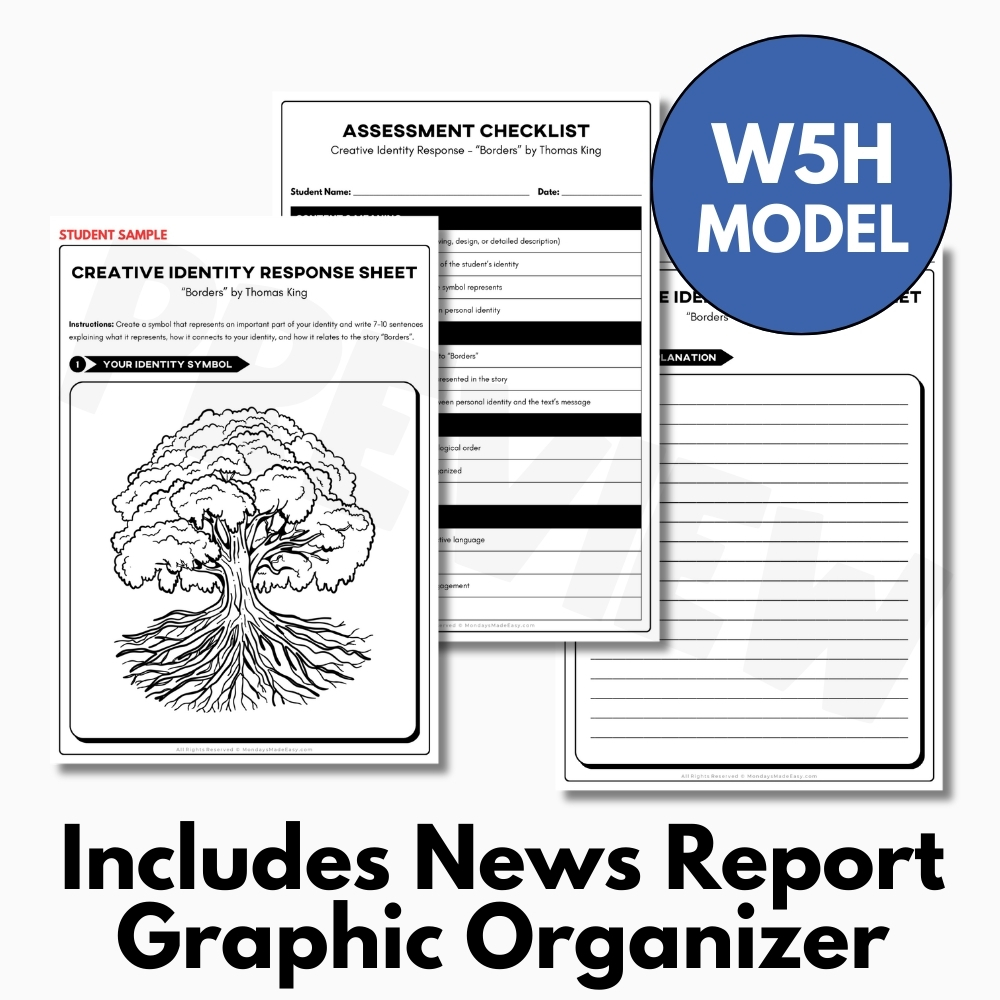
To support the writing process, use the included News Report Graphic Organizer. This organizer uses the Five Ws and How (W5H) model to help students plan text features, structure body paragraphs, and develop a conclusion. A separate News Report Format Handout provides additional guidance for formatting the final published version of the article.
The planning stage is critical to successful Expository Writing, and the W5H model provides a reliable framework for organizing information logically. By answering who, what, when, where, why, and how, students ensure their reports are complete and coherent. The graphic organizer helps students sequence ideas before drafting, which is especially helpful for developing writers. The format handout further reinforces expectations by showing how content and structure work together, preparing students to produce polished, publication-style writing.
To evaluate student work, a 4-level rubric is provided in both editable and print-ready formats. You can edit the success criteria to meet the specific learning goals and curriculum expectations of your classroom.
Assessment in Expository Writing benefits from transparent, clearly defined criteria. The rubric breaks down expectations for content accuracy, organization, language use, and adherence to news-report conventions. Because the rubric is editable, teachers can align it with grade-level standards or emphasize particular skills such as objectivity or clarity. Sharing the rubric with students before drafting promotes self-assessment and accountability, helping learners understand how strong informational writing is evaluated.
A News Report Example is also included to model success criteria and expectations for students.
Providing a model is a powerful instructional strategy in Expository Writing instruction. The example allows students to see how all components—headline, lead, factual tone, and structured paragraphs—come together in a cohesive piece. Teachers can analyze the example with the class, highlighting effective techniques and discussing why the report is successful. This modeling supports confidence and independence, enabling students to apply what they observe to their own writing with greater clarity and purpose.
✨ Kindly note that due to copyright restrictions, this resource is not editable, except for the files specifically labelled as editable. This is a common practice within the online marketplace in order to protect the clip artists and software providers that have authorized their intellectual property for the development of this resource.
⭒ For classrooms utilizing Google Classroom® ⭒
To access the digital version of these worksheets, simply follow the instructions within the resource to copy the files directly to your Google Drive®.