Description
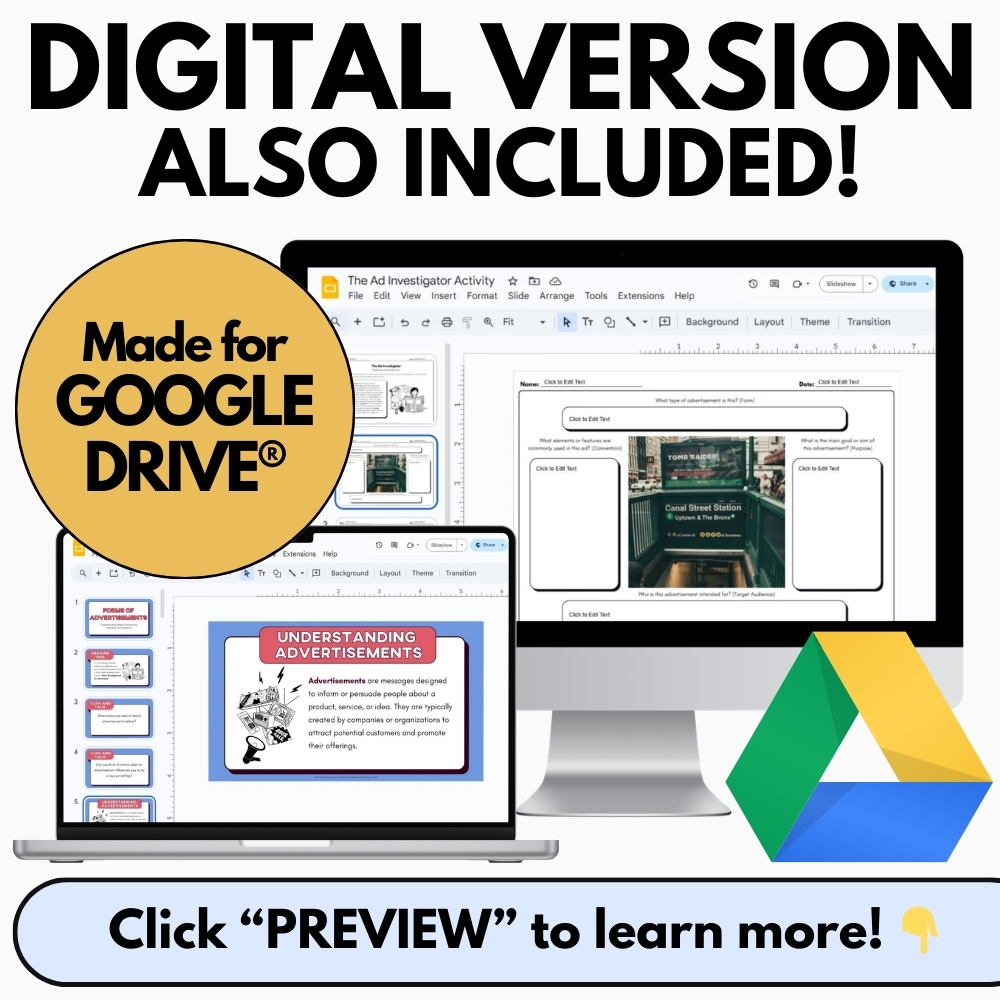
Teach types of advertisements with this media literacy lesson! Students will identify ad forms, explore target audiences, and analyze media messages through interactive activities and visuals. Includes digital resources for Google Classroom®!
Included with this Types of Advertisements Lesson:
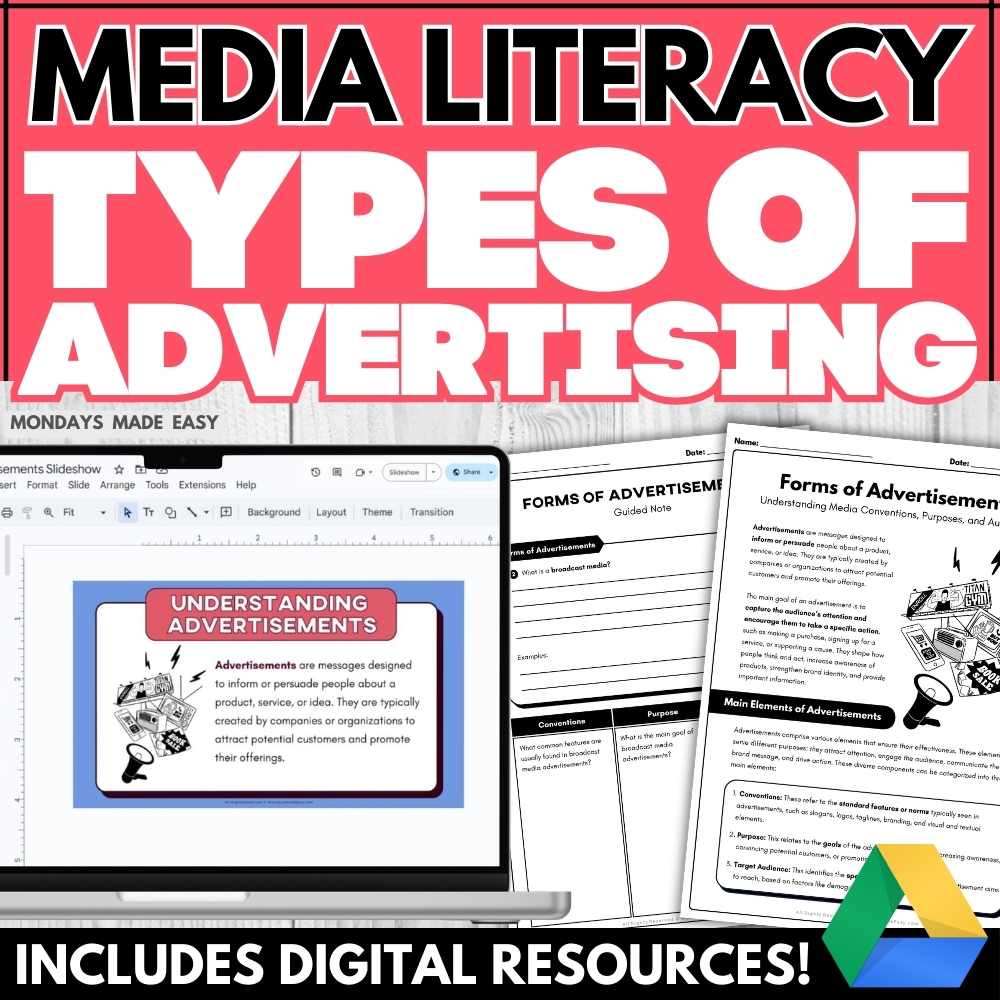
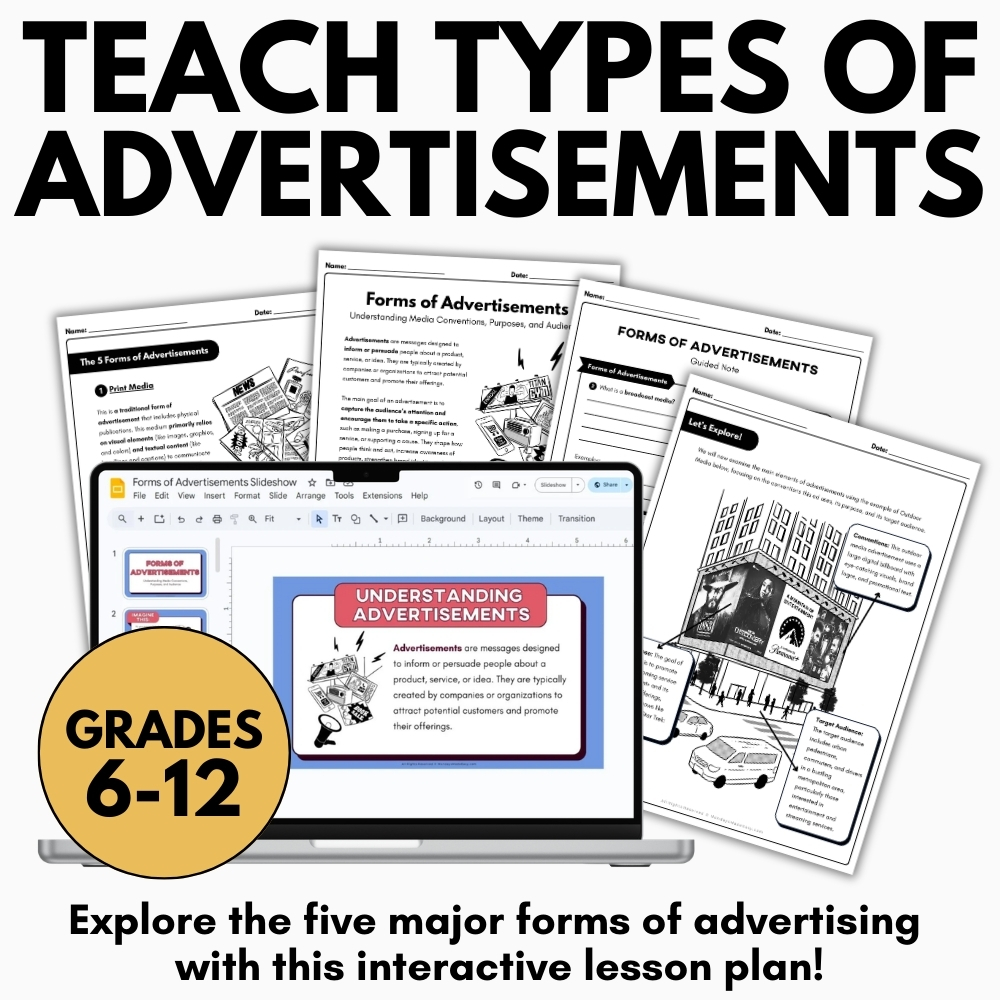
- Forms of Advertisement Slideshow Lesson – Google Slides®, Powerpoint, and PDF
- Forms of Advertisement Informational Handbook
- Slideshow Lesson Guided Note
- Ad Investigator Activity
- Ad Quest Sorting Activity
- Detailed Answer Keys
- Teacher Instructions for using these resources
How to Use This Types of Advertisements Lesson:
You can begin this lesson with the Forms of Advertisements Slideshow, which introduces five major forms of advertising: print, broadcast, digital, outdoor, and informational. Use this as a visual guide to discuss how advertisers tailor media to reach specific audiences across different platforms.
This introductory slideshow provides a strong starting point for teaching students about the Types of Advertisements they encounter in everyday life. By presenting multiple formats side by side, students begin to recognize that advertising is not limited to television commercials or online banners but exists across many different media environments. The slideshow encourages students to think critically about how advertisers select particular platforms to reach specific audiences. For example, digital ads may target younger users through social media, while outdoor ads such as billboards reach commuters in public spaces. As students explore the Types of Advertisements, they begin to understand that each format has unique characteristics, limitations, and strategies that shape how messages are delivered.
Students can work through the Slideshow Lesson Guided Note as you explore the types of advertisements and examples in the slideshow.
The guided notes provide a structured way for students to actively engage with the lesson while learning about the Types of Advertisements. Rather than simply watching the presentation, students record key ideas, examples, and observations as they move through each section of the slideshow. This note-taking process helps students identify defining features of each advertisement format and recognize patterns in how different ads communicate with audiences. Teachers may pause periodically to discuss examples or ask students to share observations, reinforcing their understanding of how various Types of Advertisements operate in real-world contexts.
Next, distribute the Forms of Advertisement Informational Handbook to help students solidify their understanding. This handbook defines each advertisement type and notes characteristics, examples, and key media conventions.
The informational handbook acts as a reference guide that supports deeper exploration of the Types of Advertisements introduced in the slideshow. Each section of the handbook explains the defining features of a particular advertisement format and highlights common techniques used to attract attention and persuade audiences. For instance, students may learn how print advertisements rely heavily on imagery and slogans, while digital advertisements often incorporate interactive elements and data-driven targeting. By studying these details, students develop a clearer understanding of how the Types of Advertisements differ in both design and strategy. Encouraging students to annotate or highlight important sections can help reinforce key concepts and make the handbook a useful study tool throughout the unit.
Then, engage your class with two hands-on activities:
Hands-on learning plays an important role in helping students apply what they have learned about the Types of Advertisements. Interactive activities allow students to analyze real examples, identify patterns, and practice categorizing advertisements based on their features and intended audience. By shifting from direct instruction to active exploration, students gain a deeper appreciation for how advertising strategies operate in different contexts. These activities also encourage collaboration and discussion, helping students compare perspectives and refine their understanding of how various Types of Advertisements function.
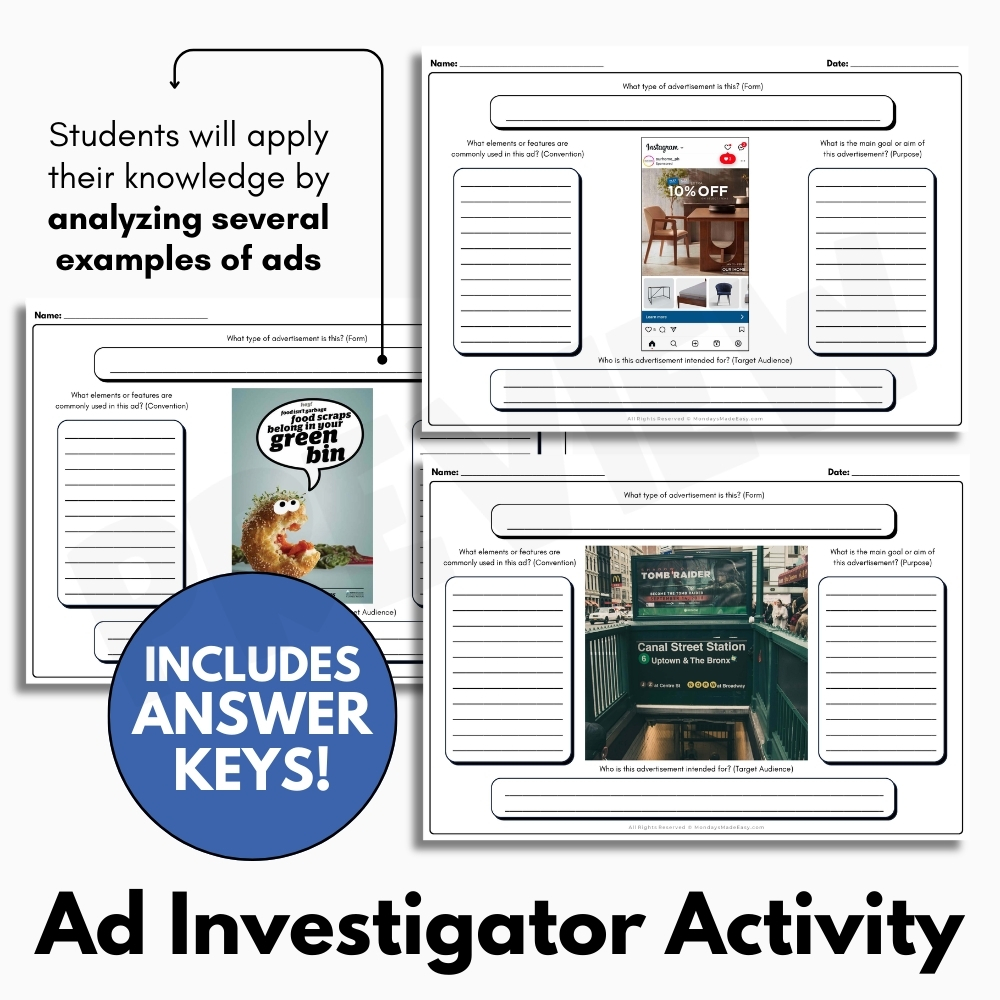
Ad Investigator Activity: Students analyze a variety of advertisements and categorize them by type, while also noting their conventions, the target audience, and the purpose of each ad.
In the Ad Investigator Activity, students take on the role of media analysts as they examine real or simulated advertising examples. This task encourages students to look beyond surface-level impressions and focus on the specific characteristics that define different Types of Advertisements. As they categorize each example, students identify visual elements, persuasive techniques, and messaging strategies that signal the advertisement’s purpose and intended audience. For example, a digital advertisement might include interactive features or personalized messaging, while a broadcast advertisement may rely on sound, motion, and storytelling. Through this process, students develop stronger analytical skills and gain a deeper understanding of how advertisers design messages to appeal to specific groups.
Ad Quest Sorting Activity: Students cut and sort illustrated advertisements into five media categories using cut-and-paste worksheets. They then complete a short-answer reflection to compare ad strategies and explain how they appeal to specific audiences using different media conventions.
The Ad Quest Sorting Activity reinforces students’ understanding of the Types of Advertisements through a creative and tactile approach. By physically sorting advertisement examples into categories, students engage in a form of visual analysis that helps them recognize patterns more clearly. This activity encourages students to pay attention to design elements such as layout, imagery, and messaging style. After sorting the ads, students reflect on how different advertisement formats influence audience engagement. For instance, an outdoor billboard must capture attention quickly with minimal text, while a digital ad may include interactive elements or links for further engagement. Through this reflection, students deepen their understanding of how various Types of Advertisements use different strategies to communicate effectively.
To consolidate this activity, detailed answer keys have been provided. The answer keys help teachers review the lesson and reinforce key concepts related to the Types of Advertisements. After students complete the activities, the answer keys can be used to facilitate class discussion and ensure that students correctly understand how each advertisement was categorized. Teachers may ask students to explain their reasoning, encouraging them to justify their choices based on specific features or conventions observed in the advertisements. This discussion reinforces analytical thinking and helps students refine their ability to identify the Types of Advertisements they encounter in everyday media.
Overall, this lesson provides a comprehensive approach to helping students understand how advertising functions across multiple media platforms. By combining visual instruction, guided note-taking, informational reading, and interactive analysis, the activities support multiple learning styles and encourage active participation. Students gradually develop the ability to recognize the Types of Advertisements that shape consumer culture and media environments.
As students progress through the lesson, they become more aware of how advertisements influence perceptions, choices, and behaviors. This awareness helps them become more thoughtful consumers of media and better equipped to analyze persuasive messages. Ultimately, learning about the Types of Advertisements helps students develop critical media literacy skills that will remain valuable throughout their academic and personal lives.
✨ Kindly note that due to copyright restrictions, this resource is not editable, except for the files specifically labelled as editable. This is a common practice within the online marketplace in order to protect the clip artists and software providers that have authorized their intellectual property for the development of this resource.
⭒ For classrooms utilizing Google Classroom® ⭒
To access the digital version of these worksheets, simply follow the instructions within the resource to copy the files directly to your Google Drive®.