

Description
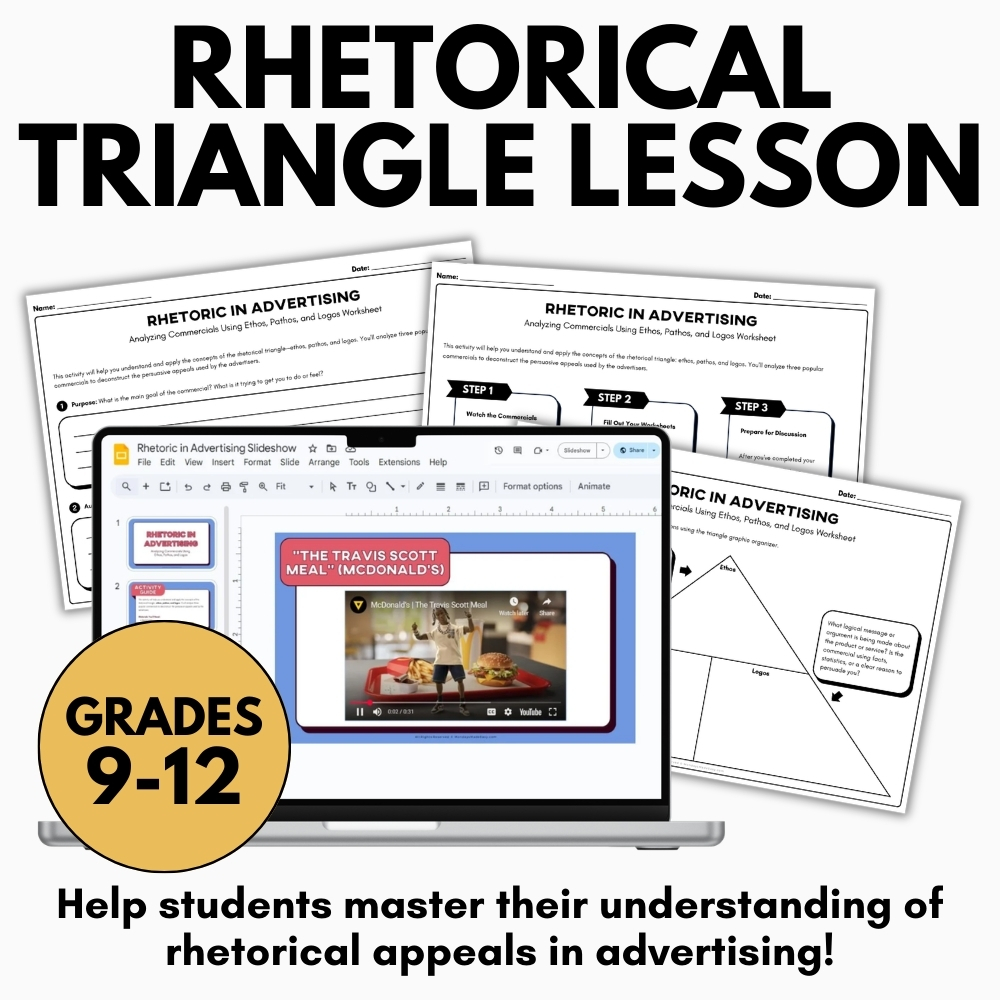
Help students master their understanding of rhetorical appeals in advertising with this lesson! Students will apply the rhetorical triangle to advertisements and analyze how ethos, logos, and pathos impact messaging in commercials. Includes digital worksheets for Google Classroom®!
Included with this Rhetorical Triangle Lesson:
- Rhetoric in Advertising Slideshow Lesson – Google Slides®, Powerpoint, and PDF
- Rhetoric in Advertising Worksheets – Digital & Print
- Rhetorical Triangle Graphic Organizer – Digital & Print
- Teacher Instructions for using these resources
How to Use This Rhetorical Triangle Lesson:
Use this resource as part of your media literacy, persuasive writing, or advertising unit. Perfect for middle and high school classrooms, this lesson supports standards on analyzing persuasive techniques and understanding media messages.
This Rhetorical Triangle Lesson provides a structured way for students to understand how persuasion operates across different types of media. In today’s digital environment, students encounter persuasive messaging constantly—through commercials, social media posts, sponsored content, and brand campaigns. By introducing the rhetorical triangle, this lesson helps students break down persuasive messages into understandable components. The goal of the Rhetorical Triangle Lesson is to help students move from passive viewing to active analysis, allowing them to recognize the strategies used to influence audiences.
You can begin your lesson with the Rhetoric in Advertising Slideshow Lesson. This presentation introduces students to the rhetorical triangle and helps them identify how ethos, pathos, and logos function in persuasive media. Use this lesson to spark discussion and provide clear examples before students begin their independent analysis.
The slideshow serves as the instructional foundation for the Rhetorical Triangle Lesson, introducing the key concepts that students will apply throughout the activity. Students learn that persuasive communication often relies on three primary appeals: credibility, emotion, and logic. By examining real advertising examples, the slideshow demonstrates how these appeals work together to shape audience perception. Teachers can pause throughout the presentation to encourage discussion and ask students to identify where they see ethos, pathos, or logos in familiar advertisements. This interactive approach helps students begin recognizing how the rhetorical triangle operates in everyday media.
Next, guide students through the 3-step Rhetoric in Advertising Worksheets. They’ll watch three commercials (provided in the slideshow lesson), identify the speaker’s intent, analyze the ad’s audience, and determine which rhetorical appeal is most dominant. Students will also evaluate the overall effectiveness of each commercial, making this a great activity for applying critical thinking to real-world media.
This activity allows students to apply the principles introduced in the Rhetorical Triangle Lesson to authentic media examples. As students watch each commercial, they must think carefully about the purpose behind the advertisement and the audience it aims to influence. By identifying the dominant rhetorical appeal in each ad, students begin to see how advertisers strategically combine credibility, emotion, and logic to persuade viewers. The evaluation component encourages students to think critically about whether the ad successfully achieves its goal. Through this process, the Rhetorical Triangle Lesson helps students develop stronger analytical skills that can be applied to many forms of persuasive communication.
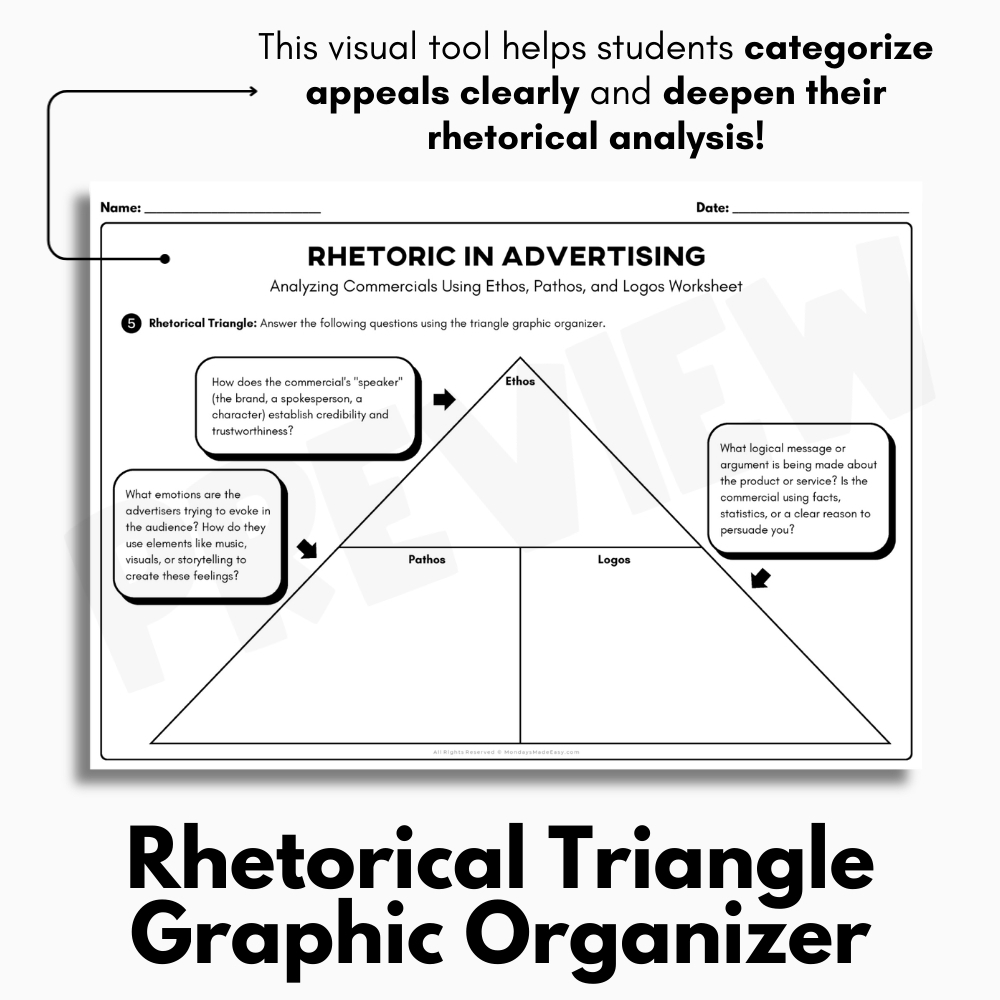
Then, students will complete the Rhetorical Triangle Graphic Organizer. This worksheet breaks down each appeal with scaffolded questions:
The graphic organizer serves as a visual framework that supports deeper analysis within the Rhetorical Triangle Lesson. By organizing ideas around ethos, pathos, and logos, students can clearly see how each appeal contributes to the overall persuasive message. The scaffolded questions guide students step by step, helping them think more carefully about the strategies used in each advertisement. This structured approach is especially helpful for students who are new to rhetorical analysis, as it provides clear prompts that encourage detailed responses. Through this process, the Rhetorical Triangle Lesson reinforces the importance of analyzing persuasive communication in a systematic and thoughtful way.
Ethos: How is credibility or trustworthiness established?
Pathos: What emotions are targeted and how?
Logos: What logical argument or evidence supports the ad’s message?
These guiding questions help students focus on the three core components of persuasion that define the Rhetorical Triangle Lesson. When examining ethos, students consider how the advertisement establishes credibility, such as through expert endorsements, brand reputation, or trustworthy messaging. When analyzing pathos, students identify emotional appeals that may evoke excitement, empathy, nostalgia, or urgency. For logos, students evaluate the logical reasoning or evidence used to support the message, such as statistics, demonstrations, or product comparisons. By answering these questions, students gain a clearer understanding of how persuasive messages are constructed and how the rhetorical triangle operates in real-world advertising contexts.
This visual tool helps students categorize appeals clearly and deepen their rhetorical analysis.
The graphic organizer functions as an important scaffold within the Rhetorical Triangle Lesson, helping students translate abstract rhetorical concepts into concrete observations. As students complete the organizer, they begin to see patterns in how advertisers combine different appeals to influence audiences. This activity encourages students to look closely at language, visuals, and tone, recognizing that each element contributes to the persuasive impact of the advertisement. By organizing their ideas visually, students can better understand how ethos, pathos, and logos interact within a single message.
Beyond the worksheet activity, teachers can extend the Rhetorical Triangle Lesson by encouraging students to bring in their own examples of persuasive media. Students might analyze advertisements from social media, television, or digital platforms to identify rhetorical appeals in contemporary marketing campaigns. This extension helps students connect classroom learning to real-world media experiences and reinforces the relevance of rhetorical analysis in everyday life.
Through repeated practice, students develop the ability to recognize persuasive strategies more quickly and accurately. The Rhetorical Triangle Lesson equips them with a vocabulary and framework for discussing persuasive communication in academic and real-world contexts. These skills are particularly valuable in media literacy education, where students must evaluate messages critically and consider the motivations behind them.
Ultimately, this lesson helps students understand that advertisements and persuasive messages are carefully designed rather than accidental. By analyzing the rhetorical triangle in action, students gain insight into how communication influences audience perception and decision-making. The Rhetorical Triangle Lesson empowers learners to become more thoughtful consumers of media and more effective communicators themselves.
✨ Kindly note that due to copyright restrictions, this resource is not editable, except for the files specifically labelled as editable. This is a common practice within the online marketplace in order to protect the clip artists and software providers that have authorized their intellectual property for the development of this resource.
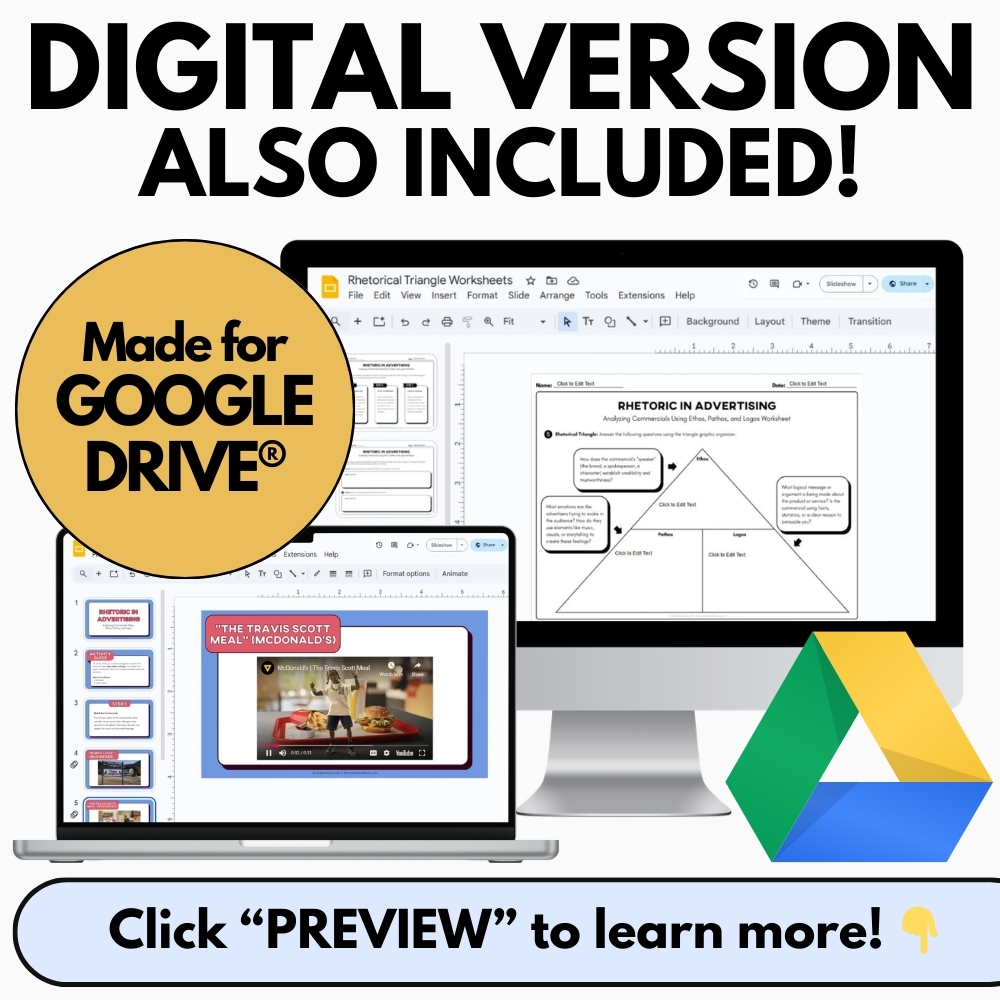
⭒ For classrooms utilizing Google Classroom® ⭒
To access the digital version of these worksheets, simply follow the instructions within the resource to copy the files directly to your Google Drive®.