
Description
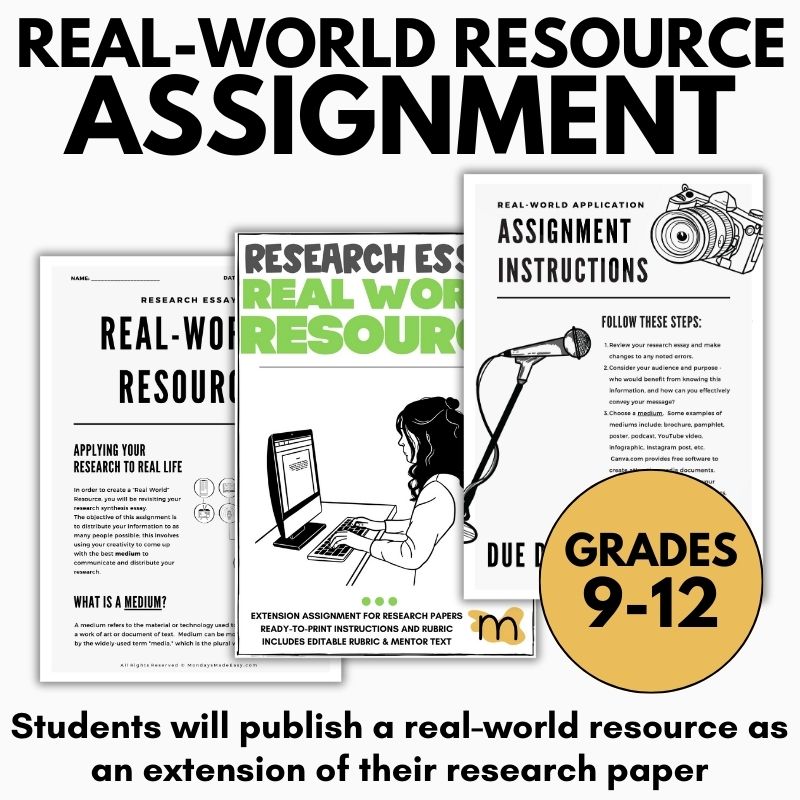
This authentic assessment has students create a real-world resource as an extension of their research paper. Students can publish an infographic, pamphlet, brochure, documentary, or another medium of their choice. This project makes an engaging end-of-year activity for English Language Arts classes.
Included with this Research Paper Extension Project:
- Real-World Resource Assignment Outline & Instructions
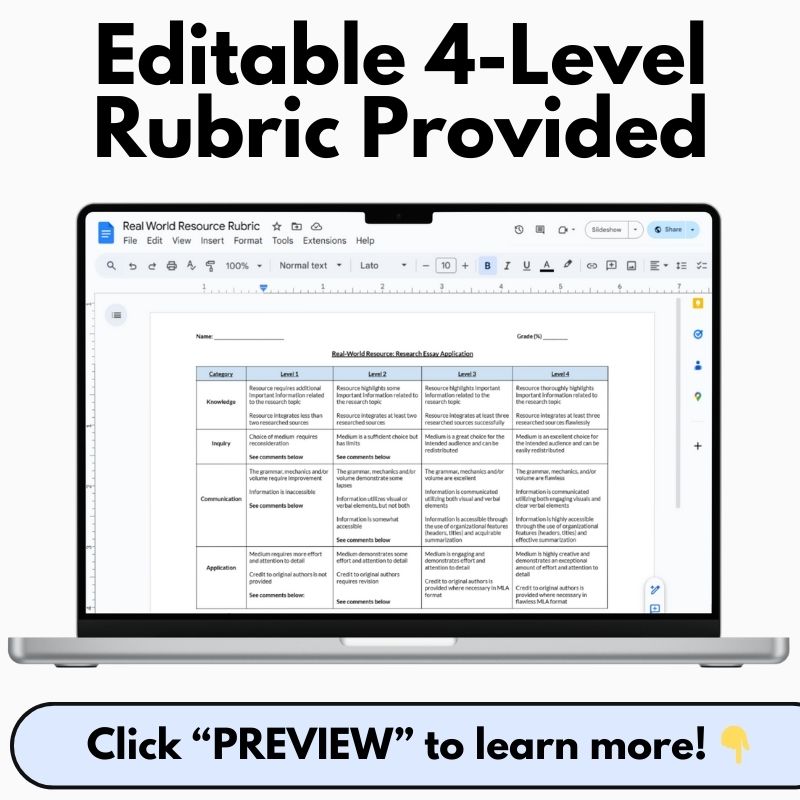
- 4-Level Rubric – Editable & Ready-to-Print
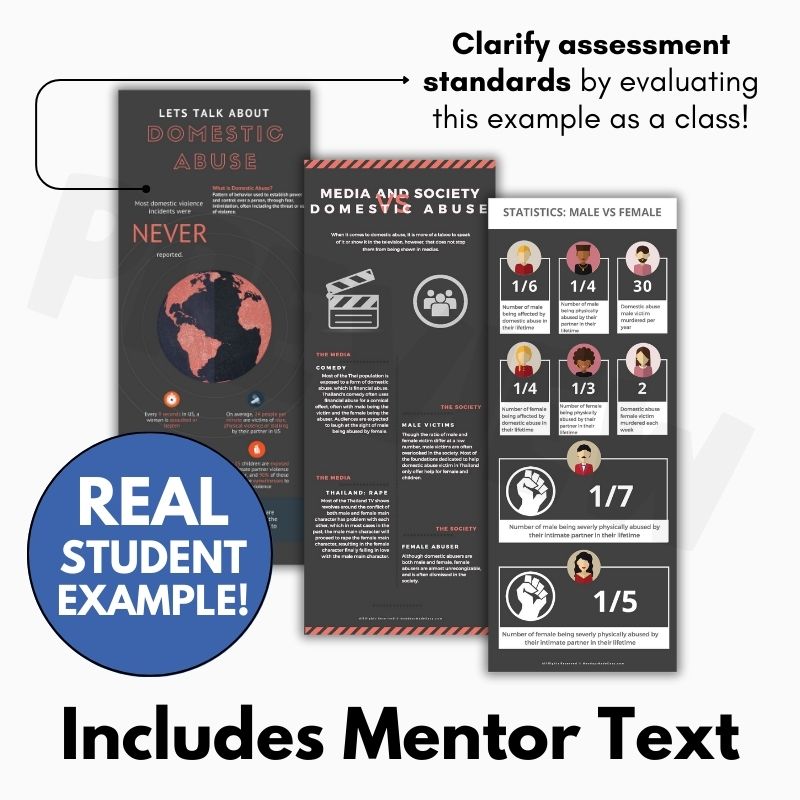
- Student Example Mentor Text
- Teacher Instructions for using these resources
How to use this Research Paper Extension Project:
Authentic assessments are designed to measure a student’s ability to apply their knowledge and skills in real-world, meaningful contexts. They often require students to demonstrate their understanding by completing tasks or projects that are similar to what they might encounter in their future careers or in practical situations.
This Research Paper Extension activity exemplifies the value of authentic learning by bridging the gap between academic writing and practical application. Instead of merely summarizing their ideas in an essay, students take their research further, transforming it into a project with real-world relevance. This encourages higher-order thinking and creative problem-solving, allowing them to translate theory into practice. Authentic assessments like this Research Paper Extension also promote student autonomy, as learners are asked to take ownership of their work, make choices about presentation formats, and adapt their ideas to different audiences or purposes—all essential 21st-century skills.
In the case of this Real-World Resource assignment, students are taking academic research and applying it to create practical, real-world documents. This project is designed to be used as an extension assignment for a research essay that students have already completed.
The Research Paper Extension serves as an ideal continuation of the learning process, transforming a traditional essay into something that feels relevant and meaningful. Students go beyond academic conventions by exploring how their research can influence or educate others in authentic contexts. For instance, a student who wrote a paper on climate change might create an infographic for public awareness, while another who studied social media literacy could produce a brochure or podcast educating peers about online safety. This project transforms abstract concepts into tangible products that demonstrate both comprehension and application. By engaging in the Research Paper Extension, students strengthen their understanding of audience, purpose, and format—skills that extend far beyond the classroom.
You can begin assigning this project by distributing the Real-World Resource Assignment Instructions. These handouts provide an overview of this assignment, as well as a definition of the term “medium,” which students will need to understand in order to distribute their research in a real-world context.
These instructions serve as the foundation for the Research Paper Extension project, helping students navigate the process from academic essay to creative production. Clarifying what “medium” means—whether it’s a visual presentation, printed resource, or digital product—ensures that students make intentional design choices that align with their message. Teachers can also use the provided assignment instructions to model examples of how research topics can evolve into real-world artifacts. By setting clear expectations and providing exemplars, educators can scaffold the Research Paper Extension experience so students understand that the purpose of this activity is not just to repeat information but to communicate it in a new and impactful way.
The instructions for this assignment are broken down into four steps. In the first step, students will then be given the opportunity to revisit their research essay; I find this process most effective if their essay has already been graded. This enables them to utilize the writing process by editing, revising, and improving their assignment.
This reflective revision step is essential to the Research Paper Extension process because it reinforces growth mindset and metacognitive learning. By reviewing feedback and reexamining their research essay, students gain deeper insight into their strengths and areas for improvement. This stage encourages them to treat writing as an iterative process—something that evolves through self-reflection and refinement. Revisiting their essay before beginning the creative extension also ensures that their new product is built on a strong, accurate, and thoughtful foundation. The Research Paper Extension therefore acts as both a summative and formative experience, reinforcing the writing process as a continuous cycle of improvement.
Next, students will consider their audience and select a medium to distribute their information. In order to encourage students to create a resource that is inspiring and widely applicable, I prompt them to consider the mediums they most often engage with—would they rather read a paper brochure, or watch a video? Are they more drawn to text, or to audio and visual forms of media? To further encourage students, a section of the rubric indicates the requirement to demonstrate effort and appeal in order to score high on this assignment.
The Research Paper Extension project empowers students to think critically about how form and function intersect in communication. By selecting an appropriate medium, they must analyze their target audience and determine the most effective way to convey their message. This step mirrors real-world professional communication—advertisers, journalists, and educators all adapt their content for different audiences. In this way, the Research Paper Extension builds media literacy alongside academic literacy. It also cultivates design thinking as students consider layout, color, tone, and language. The emphasis on effort and appeal in the rubric ensures that students balance creativity with professionalism, producing resources that are not only informative but also polished and engaging.
Students can create their resources using a digital platform in order to complete this assignment. Canva software, Adobe Photoshop, Google Slides, Piktochart, iMovie, and Microsoft PowerPoint are all great options that can be suggested to students—or let them get creative and research their own tool!
This resource includes an editable 4-level rubric and a student example to serve as a mentor text. You may choose to grade the student example as a collaborative class activity to highlight its strengths and areas for improvement. This approach also helps clarify your assessment standards and expectations for the assignment.
Technology integration is a defining feature of the Research Paper Extension. Allowing students to choose from various digital tools encourages exploration, innovation, and technical fluency. This flexibility ensures inclusivity, as students with different strengths—visual, verbal, or technical—can select platforms that showcase their abilities best. The editable rubric provided in the Research Paper Extension helps teachers align grading criteria with learning goals while promoting transparency and fairness. Using the mentor text as a class activity also creates a shared understanding of quality work, helping students internalize standards for excellence. In the end, this assignment equips students with the skills to adapt research for real-world audiences while fostering creativity, collaboration, and digital literacy—making it a truly comprehensive capstone project.
✨ Kindly note that due to copyright restrictions, this resource is not editable, except for the files specifically labelled as editable. This is a common practice within the online marketplace in order to protect the clip artists and software providers that have authorized their intellectual property for the development of this resource.
See what other teachers are saying about this Research Paper Extension:
“Definitely going to start using this activity with all research essays. It was nice to see some of my students’ real-world communication skills shine through.”
– Anna J.
⭒ For classrooms utilizing Google Classroom® ⭒
To access the digital version of these worksheets, simply follow the instructions within the resource to copy the files directly to your Google Drive®.


 Verified owner


Alana T. (verified owner) –
Great resource! Everything I needed to run this assignment smoothly.
Todd B. (verified owner) –
Absolutely loved this!
Brooke E. (verified owner) –
Fantastic way to engage students at the end of the year. We used this as an extension assignment for essays they had written back in January.
Vivian A. (verified owner) –
Thank you!
Anna J. (verified owner) –
Definitely going to start using this activity with all research essays. It was nice to see some of my students’ real-world communication skills shine through.
Zoe S. (verified owner) –
This was an engaging research project for the end of the semester.
Meghan M. (verified owner) –
This real life application after the research paper made our research unit so much more valuable!
Samantha M. (verified owner) –
I am working on trying to add more real word extension ideas for my Grade 9 classes and this helped to guide my thinking. Awesome resource.