
Description
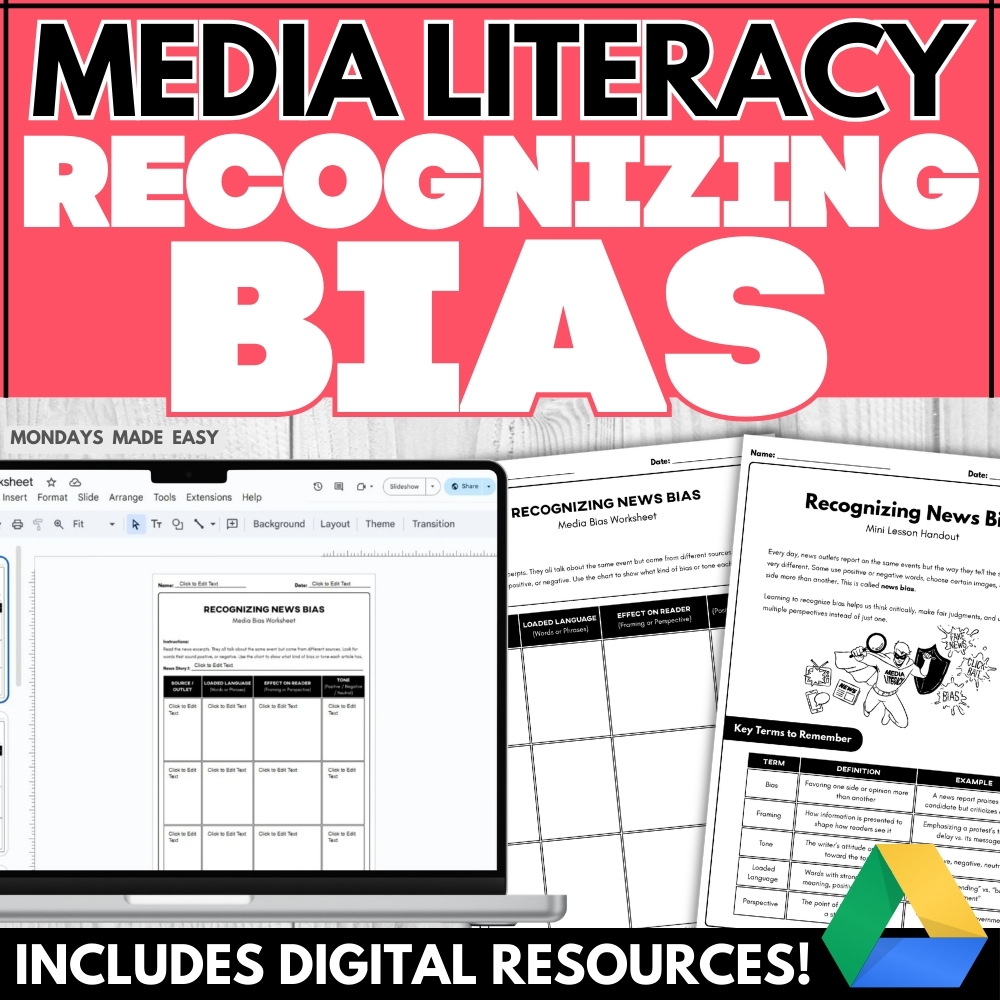
Teach students how to detect media bias with this engaging media literacy lesson. Through article comparisons, students will evaluate tone, word choice, and framing across news outlets to build digital citizenship skills and identify misinformation. Includes digital worksheets for Google Classroom®!
Included with this Media Bias Lesson:
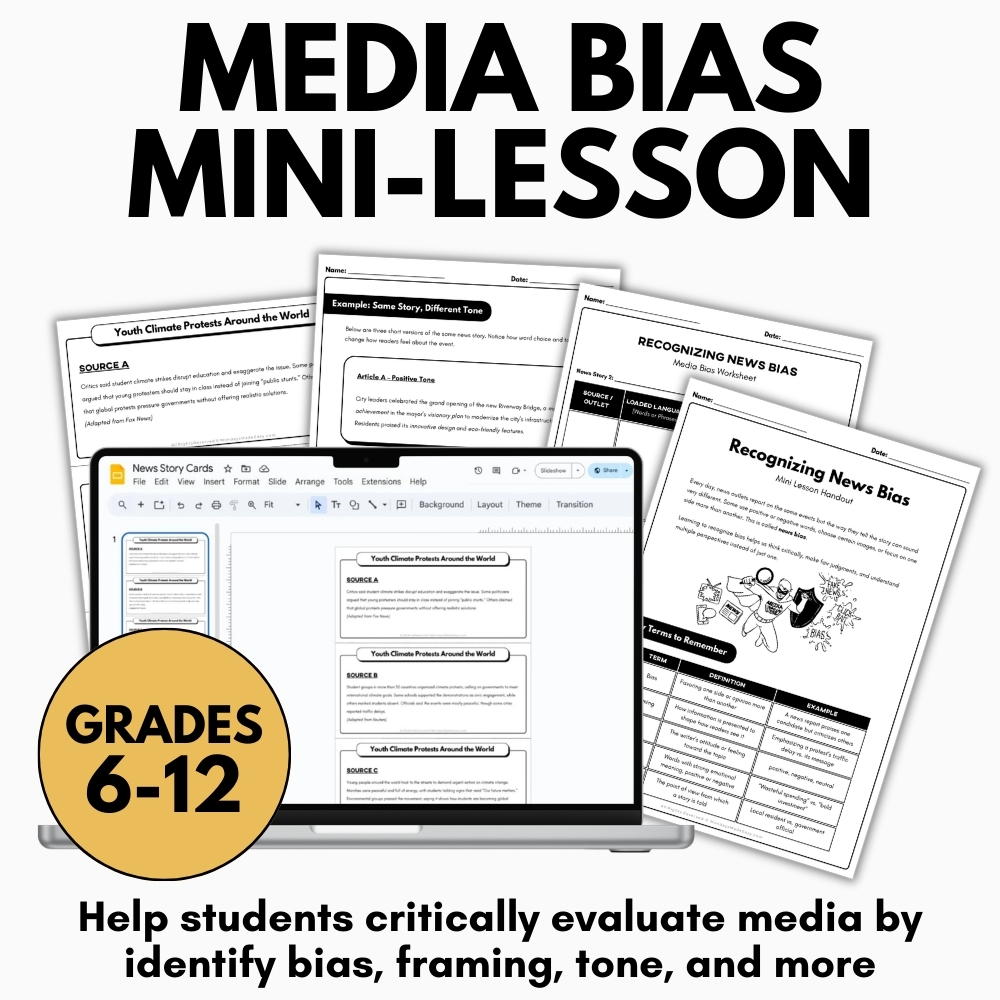
- Recognizing News Bias Mini-Lesson Informational Handout
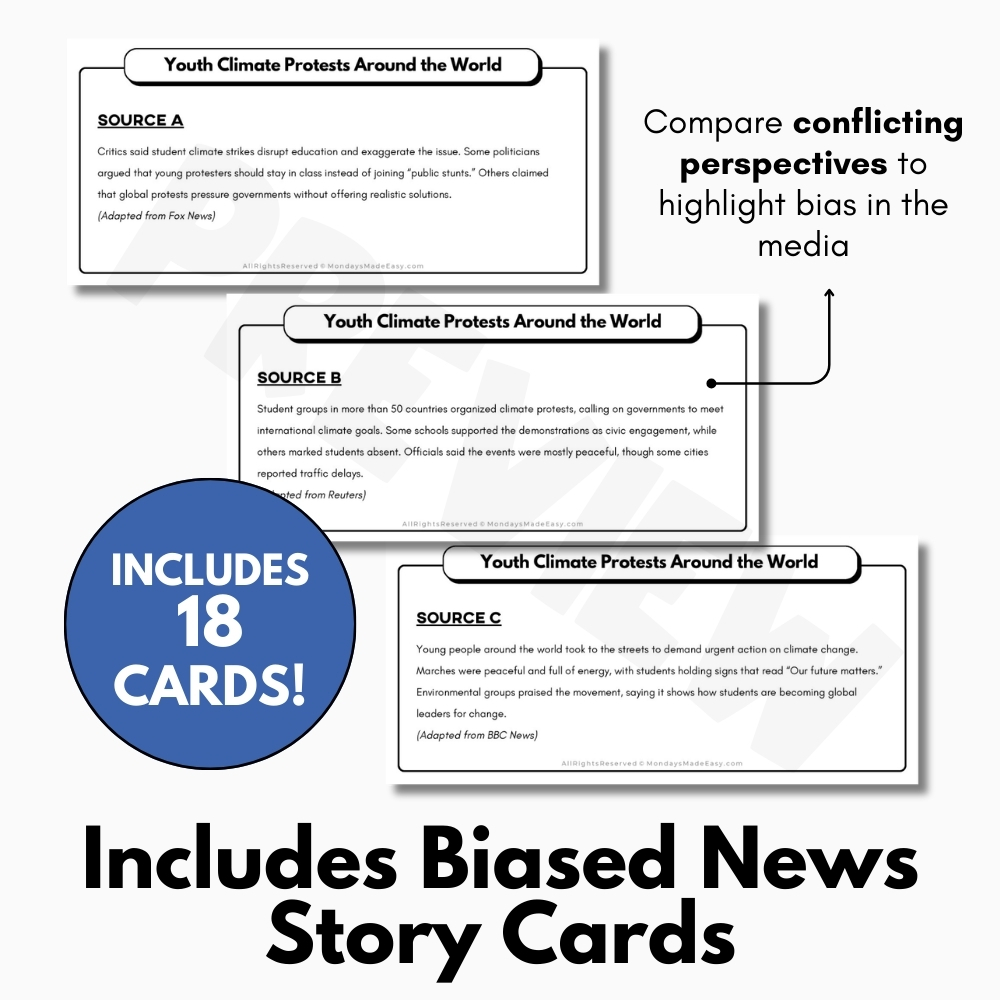
- 18 News Story Cards – Digital & Print
-
- Includes multiple news sources per topic
- Compare conflicting perspectives to highlight bias in the media
- News Bias Analysis Graphic Organizer
- Student Sample Answers to Model Responses
- Teacher Instructions for using these resources
How to Use This Media Bias Lesson:
This lesson builds essential digital citizenship and media literacy skills by helping students critically evaluate the reliability and tone of media sources in an age of misinformation.
At its core, this Media Bias Lesson equips students with the tools needed to navigate an increasingly complex information landscape. In a time when headlines circulate rapidly across digital platforms, students must learn to question not only the content of a news story but also how it is presented. This lesson emphasizes that tone, word choice, and framing significantly influence how audiences interpret events. By teaching students to evaluate reliability and detect subtle bias, the lesson reinforces the importance of thoughtful media consumption as a cornerstone of responsible digital citizenship.
You can begin by reviewing the Recognizing News Bias Mini-Lesson Informational Handout. This handout introduces the concept of media bias, providing definitions and examples of tone, loaded language, and framing. Use it to lead a discussion on how different news sources can present the same event in distinct ways.
This introductory handout provides the conceptual foundation for the Media Bias Lesson, ensuring that students share a common vocabulary before moving into analysis. Clear definitions of terms like “loaded language” and “framing” help students move beyond vague impressions and toward specific, evidence-based observations. Teachers can guide students through sample sentences, asking them to identify emotionally charged words or omissions that shape reader perception. The discussion component is especially important, as it encourages students to consider how perspective influences storytelling and how two reports about the same event can differ without necessarily being factually incorrect.
Next, distribute the News Story Cards. These cards contain short excerpts from multiple outlets (e.g., Fox News, Reuters, BBC News) covering the same event. Topics include climate protests, AI in classrooms, and health regulations. Each source is carefully selected to highlight subtle differences in language and perspective.
The News Story Cards serve as the comparative core of the Media Bias Lesson, allowing students to examine real examples of how language choices affect meaning. By analyzing excerpts from Fox News, Reuters, and BBC News, students can directly observe variations in tone, emphasis, and framing. These side-by-side comparisons make abstract concepts tangible, demonstrating that bias is often subtle rather than overt. The selected topics are relevant and engaging, helping students connect classroom analysis to issues they may already encounter in daily media consumption.
Then, students will complete the News Bias Analysis Graphic Organizer. They will analyze word choice, describe the effect on readers, and determine whether each article conveys a positive, negative, or neutral tone. This worksheet reinforces critical thinking and media literacy by guiding students to identify underlying bias and misinformation across sources.
This structured analysis is where students actively apply the principles of the Media Bias Lesson. The graphic organizer encourages close reading by prompting students to identify specific phrases and explain their impact. Rather than simply labeling an article as biased, students must articulate how particular language shapes perception. Determining tone—whether positive, negative, or neutral—requires careful consideration of context and intent. This process strengthens analytical reasoning and reinforces that media literacy involves evidence-based judgment rather than personal preference.
To support classroom modeling or peer review, sample student answers are included. These annotated examples illustrate how to examine source tone and framing with evidence from the text.
Modeling is essential to the success of the Media Bias Lesson, especially because identifying bias can initially feel subjective or overwhelming. The sample responses demonstrate how to cite textual evidence and explain its significance clearly and logically. Teachers can use these annotated examples to highlight strong reasoning, clarify expectations, and address common misconceptions. During peer review, students can compare their analyses to the samples, fostering self-assessment and revision. This reflective practice reinforces growth and deepens understanding of how tone and framing influence interpretation.
Taken together, these components create a cohesive and scaffolded instructional experience. The Media Bias Lesson intentionally moves students from foundational knowledge to comparative analysis and independent reasoning. By revisiting key concepts across multiple activities, students develop a deeper and more nuanced understanding of how media operates. They begin to see that bias exists on a spectrum and that evaluating reliability requires attention to sourcing, context, and language.
Beyond immediate analytical skills, this lesson supports broader educational goals such as civic awareness and ethical decision-making. Students learn that recognizing bias is not about dismissing all media but about engaging thoughtfully and seeking multiple perspectives. The Media Bias Lesson encourages intellectual curiosity and open-mindedness, helping students approach news with a balanced and informed mindset.
Teachers may choose to extend this lesson by having students locate additional articles on the same event, compare headlines alone, or examine how stories evolve over time. These extensions deepen the impact of the Media Bias Lesson by connecting classroom activities to real-world media habits. The lesson can also be adapted across grade levels by adjusting the complexity of the texts or the depth of analysis required.
Ultimately, this lesson empowers students to become discerning readers and responsible digital citizens. By strengthening their ability to analyze tone, framing, and reliability, the Media Bias Lesson equips learners with essential tools for navigating misinformation and participating thoughtfully in public discourse. Rather than accepting information at face value, students learn to question, compare, and evaluate—skills that are vital in today’s media-saturated world.
✨ Kindly note that due to copyright restrictions, this resource is not editable, except for the files specifically labelled as editable. This is a common practice within the online marketplace in order to protect the clip artists and software providers that have authorized their intellectual property for the development of this resource.
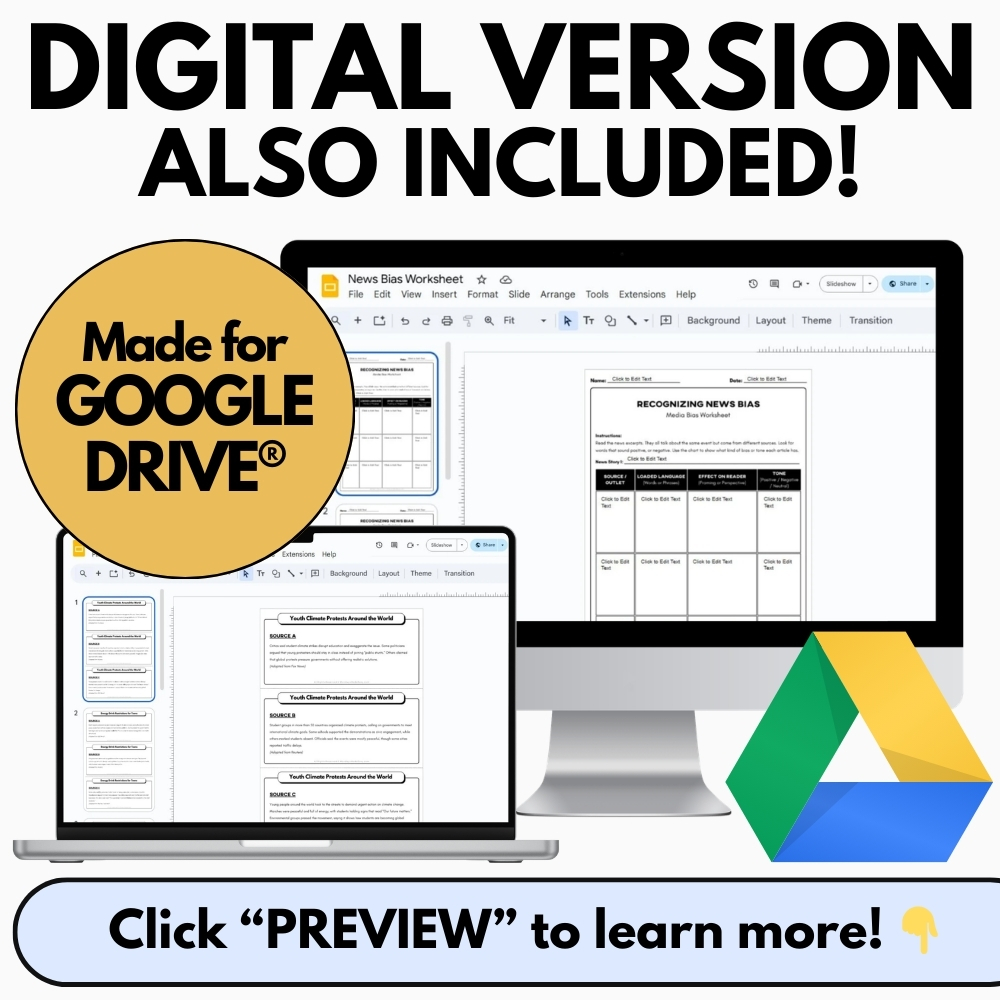
⭒ For classrooms utilizing Google Classroom® ⭒
To access the digital version of these worksheets, simply follow the instructions within the resource to copy the files directly to your Google Drive®.