

Description
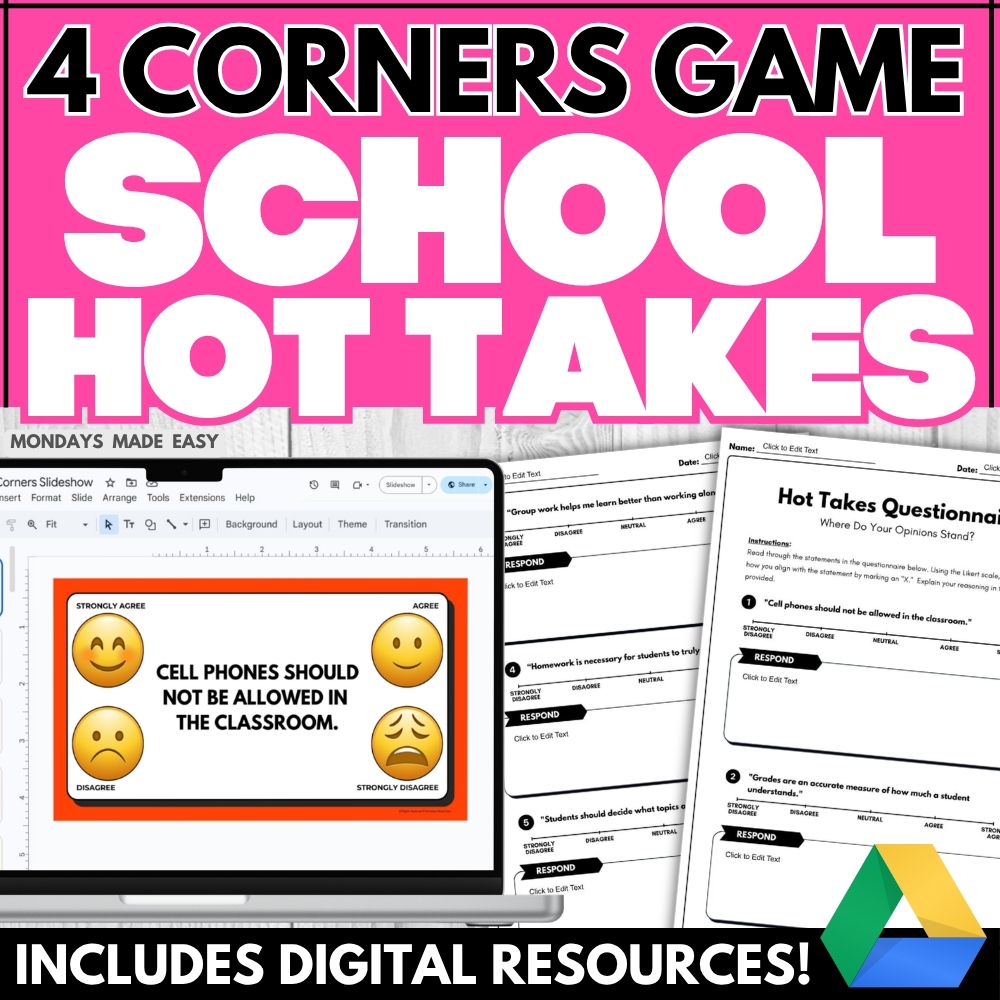
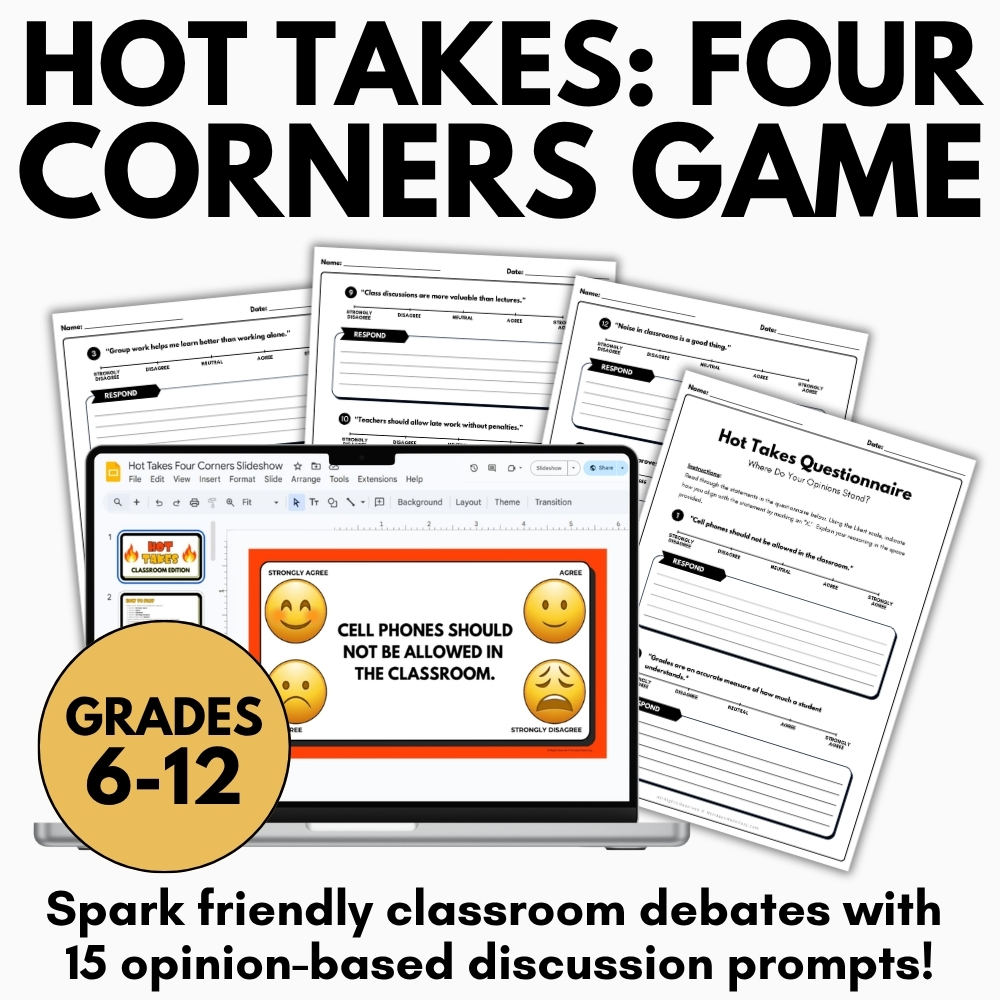
Your students have opinions about homework, cell phones, and whether tests actually measure anything. This four corners activity gives them a reason to say so out loud! Hot Takes: Classroom Edition pairs a written Likert scale questionnaire with a physical agree/disagree game built around 15 school-themed statements. This game is a crowd-pleaser as a back-to-school icebreaker, a pre-writing warm-up before an opinion or persuasive writing unit, or an energy-shifting lesson for the end of year. Includes digital resources for Google Classroom®!
Included with this Four Corners Activity:
- “Hot Takes” 4 Corners Game Slideshow – Google Slides®, Microsoft PowerPoint® & PDF
-
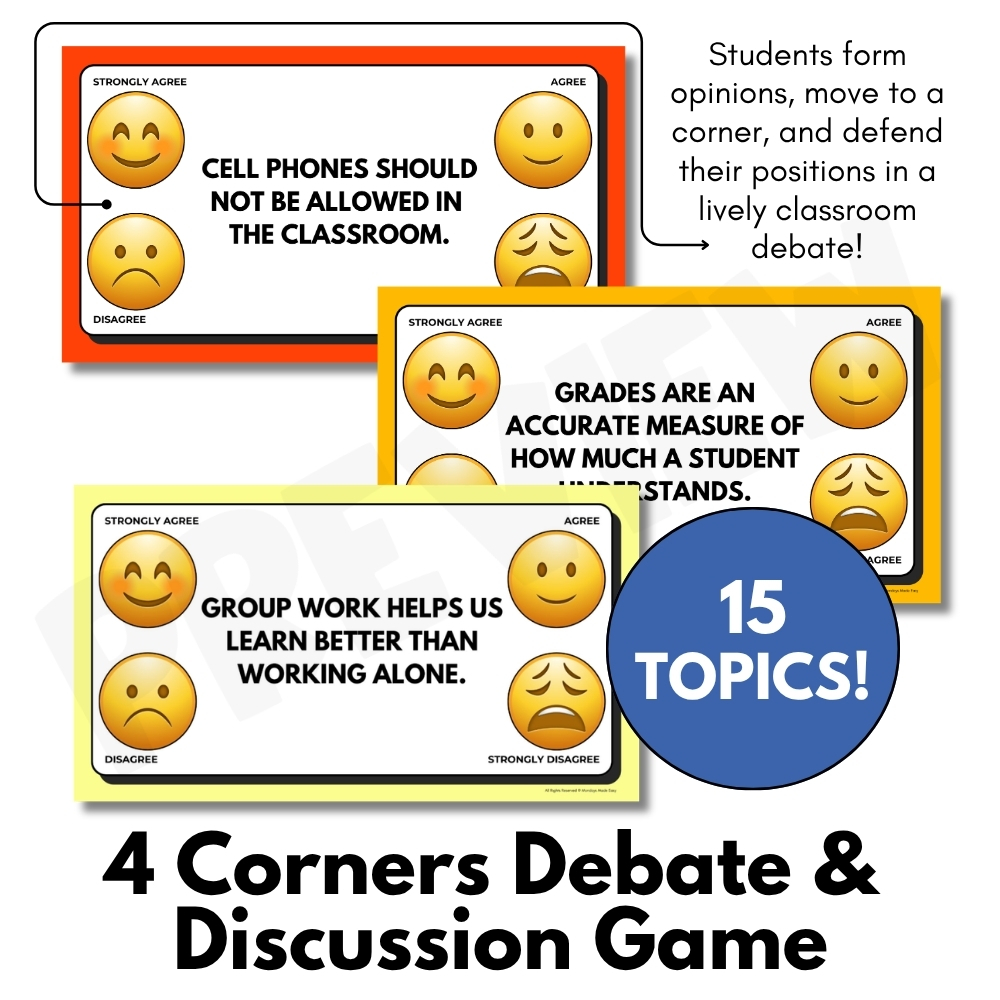
- Challenge students with 15 debatable school-related topics
- Hot Takes Survey Questionnaire – Digital & Print
- Likert Scale Posters – Digital & Print
- Teacher Instructions for Using These Resources
How to Use This Four Corners Activity:
This resource works in two parts: a written phase where students record and justify their opinions individually, and a physical game phase where they move to corners of the room based on how strongly they agree or disagree. Both components are built around the same 15 statements, covering homework, grading, AI tools, cell phones, late work, school rules, and more, so students arrive at the game having already formed a position they can defend. The Four Corners Activity is designed to combine reflection, discussion, and movement so that students engage with ideas in multiple ways. By beginning with written responses, the Four Corners Activity ensures that every student has an opportunity to think independently before being influenced by their peers. This step is particularly helpful for quieter students who may need time to organize their thoughts before participating in a discussion. Once students transition into the physical component of the Four Corners Activity, the classroom environment becomes energetic and interactive. Students quickly see that opinions within the class vary widely, which naturally sparks curiosity and debate. Because both phases of the Four Corners Activity revolve around the same statements, students enter the discussion prepared to explain and defend their viewpoints with reasoning and examples.
First, set up the room by printing and posting the five Likert Scale Posters in each corner and the center before students arrive: Strongly Agree, Agree, Disagree, and Strongly Disagree in the four corners, with Neutral designated for the center of the room. The posters are large-format and emoji-coded, so students can identify their position at a glance without needing to read signage while they’re deciding where to stand. Proper setup plays an important role in the success of the Four Corners Activity. By clearly labeling each corner of the room, students can quickly move to the area that represents their opinion without confusion. The emoji-coded design of the posters helps make the Four Corners Activity visually engaging and accessible, particularly for students who process visual information more quickly than written text. The Neutral option placed in the center ensures that students are not forced into positions they do not fully agree with, which encourages honesty and authenticity in the Four Corners Activity. Teachers may also choose to briefly review the meaning of each position before starting so that students understand the difference between “Agree” and “Strongly Agree,” for example. With the room organized in advance, the Four Corners Activity can begin smoothly and maintain its fast-paced momentum.
Open the Hot Takes Four Corners Slideshow to the “How to Play” slide to walk the class through the rules before the activity begins; the slideshow handles the introduction so you don’t have to, which keeps the energy high from the first statement. Using the slideshow to introduce the Four Corners Activity allows teachers to provide clear instructions without interrupting the flow of the lesson. The visual format helps students quickly understand how the activity works and what is expected of them during each round. Because the slideshow guides the explanation, the Four Corners Activity can start quickly and keep students focused on the discussion rather than the logistics. Teachers may also use this moment to emphasize respectful discussion and remind students that disagreement is part of healthy conversation. Establishing these expectations helps ensure that the Four Corners Activity remains a positive and productive experience for everyone involved. Once students understand the structure of the activity, they are ready to begin exploring the statements and sharing their perspectives.
Next, distribute the Hot Takes Questionnaire for the individual written phase before running the physical game. Students read all 15 statements, mark their position on the Likert scale from Strongly Disagree to Strongly Agree, and write a written response explaining their reasoning in the space provided. This written phase strengthens the Four Corners Activity by encouraging students to think critically before responding publicly. When students write down their reasoning first, they are more prepared to explain their ideas during the movement portion of the Four Corners Activity. The written responses also provide teachers with insight into students’ thinking and perspectives on topics that directly affect their school experiences. Statements about homework policies, grading systems, and technology in the classroom often prompt thoughtful responses during this stage of the Four Corners Activity. Additionally, this step gives every student a voice, even if they are hesitant to speak during the group discussion. By the time the class transitions into the movement portion of the Four Corners Activity, students have already developed opinions supported by reasoning.
Then, run the Hot Takes Four Corners Slideshow to launch the physical game. Each of the 15 statements appears on its own full-screen slide with the four emoji-coded positions displayed in the corners, mirroring the posters on the wall. Students listen to the statement, make their decision, and move to the corner or center that represents their level of agreement. This stage transforms the Four Corners Activity into a dynamic classroom experience. The physical movement helps re-energize students and keeps them actively engaged throughout the lesson. As students look around the room and see where their classmates have gathered, the Four Corners Activity immediately reveals patterns of agreement and disagreement within the class. Sometimes students will find themselves standing with many classmates, while other times they may be one of only a few people in a corner. These moments create natural opportunities for conversation and curiosity during the Four Corners Activity, encouraging students to ask why others feel differently about the same statement.
Once students have gathered, give groups a minute to discuss with others in their area before calling on a few students to share their reasoning with the class. The classroom discussion format naturally reveals how differently students interpret the same statement, which is most of what makes the conversation worth having. The discussion stage is where the Four Corners Activity truly becomes a platform for critical thinking and respectful debate. By allowing students to briefly talk with peers who share the same position, the Four Corners Activity helps them clarify their reasoning before presenting it to the entire class. This small-group discussion also builds confidence for students who might feel nervous about speaking in front of everyone. When groups share their ideas aloud, the Four Corners Activity often uncovers surprising perspectives or interpretations of the statement being discussed. These moments demonstrate how complex even simple questions can become when multiple viewpoints are considered.
Finally, advance to the Discussion slide after each statement to extend the thinking with two targeted follow-up questions. The discussion prompts push students past “I agreed because I agreed” and into actual reasoning: questions like “Do grades reflect true learning?” and “Are there better alternatives to tests?” give students something specific to push back on or defend. These follow-up prompts deepen the learning that occurs during the Four Corners Activity. Rather than stopping at a simple show of agreement or disagreement, the Four Corners Activity encourages students to examine the underlying ideas behind their choices. The prompts often challenge students to reconsider their assumptions, evaluate evidence, or explore alternative viewpoints. In many cases, students may even change their positions after hearing new arguments during the Four Corners Activity, which demonstrates how discussion can influence thinking. Teachers can use these prompts to guide the conversation while still allowing students to take ownership of the discussion.
Collect the written questionnaires at the end of class for a quick formative check, or use them as a jumping-off point for an opinion paragraph, a persuasive essay, or a Socratic seminar on a statement the class couldn’t agree on! The written responses from the Four Corners Activity provide valuable insight into students’ thinking and can easily extend into future lessons. Teachers may review the questionnaires to identify patterns in student opinions or areas where further discussion might be beneficial. Because the Four Corners Activity encourages students to explain and defend their reasoning, the responses can serve as strong starting points for more formal writing assignments. For example, students might expand their written responses into a persuasive essay or participate in a structured debate about one of the statements. The flexibility of the Four Corners Activity allows it to function both as an engaging class discussion and as a foundation for deeper academic work.
✨ Kindly note that due to copyright restrictions, these resources are not editable, except for the files specifically labelled as editable. This is a common practice within the online marketplace in order to protect the clip artists and software providers that have authorized their intellectual property for the development of this resource.
⭒ For classrooms utilizing Google Classroom® ⭒
To access the digital version of these worksheets, simply follow the instructions within the resource to copy the files directly to your Google Drive®.