Description
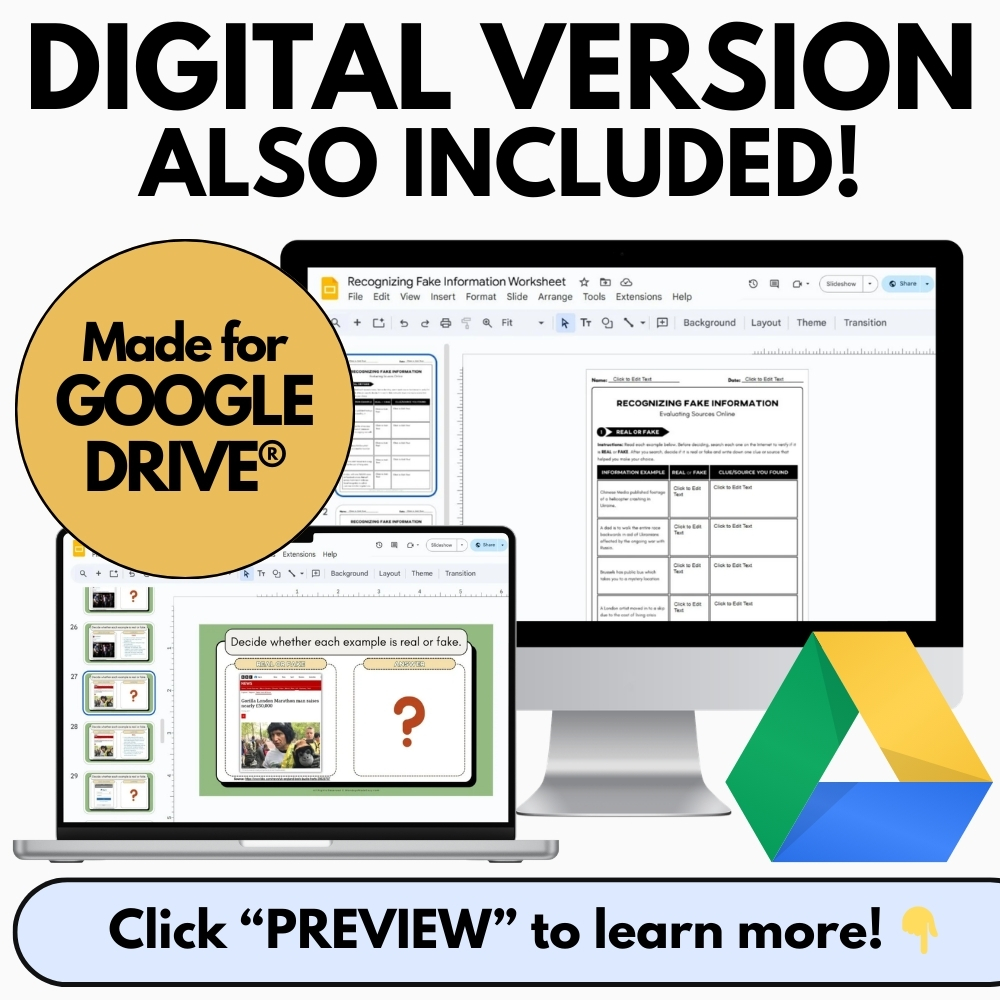
Help students distinguish credible sources from fake news with this misinformation and media literacy activity. Teach fact-checking, online research, and digital source evaluation. Includes digital worksheets for Google Classroom®!
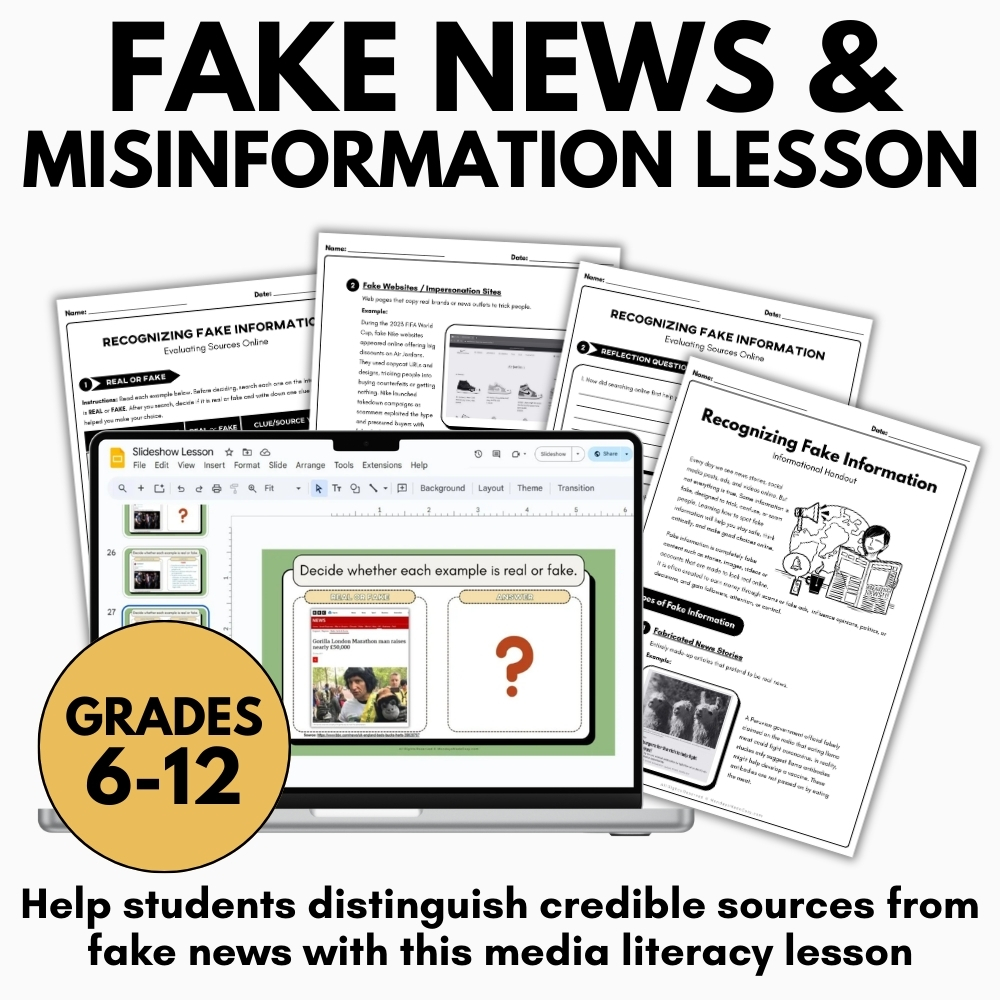
Included with this Fake News & Misinformation Lesson:
- Recognizing Fake Information Slideshow Lesson – Microsoft PowerPoint®, Google Slides® & PDF
- Mini-Lesson Informational Handout
- Misinformation Identification Activity – Digital & Print
- Reflection Questions – Digital & Print
- Detailed Answer Key
- Teacher Instructions for using these resources
How to Use This Fake News & Misinformation Lesson:
At its core, this Misinformation Lesson is designed to help students develop the habits of mind necessary to critically engage with the vast amount of information they encounter every day. In an era where news, opinions, and advertising often blur together, students must learn how to pause, question, and verify before accepting information as true. This resource emphasizes that media literacy is not only an academic skill but a lifelong competency tied to responsible citizenship, informed decision-making, and ethical participation in digital spaces. By engaging with structured activities and guided analysis, students build confidence in their ability to recognize unreliable information and respond thoughtfully rather than reactively.
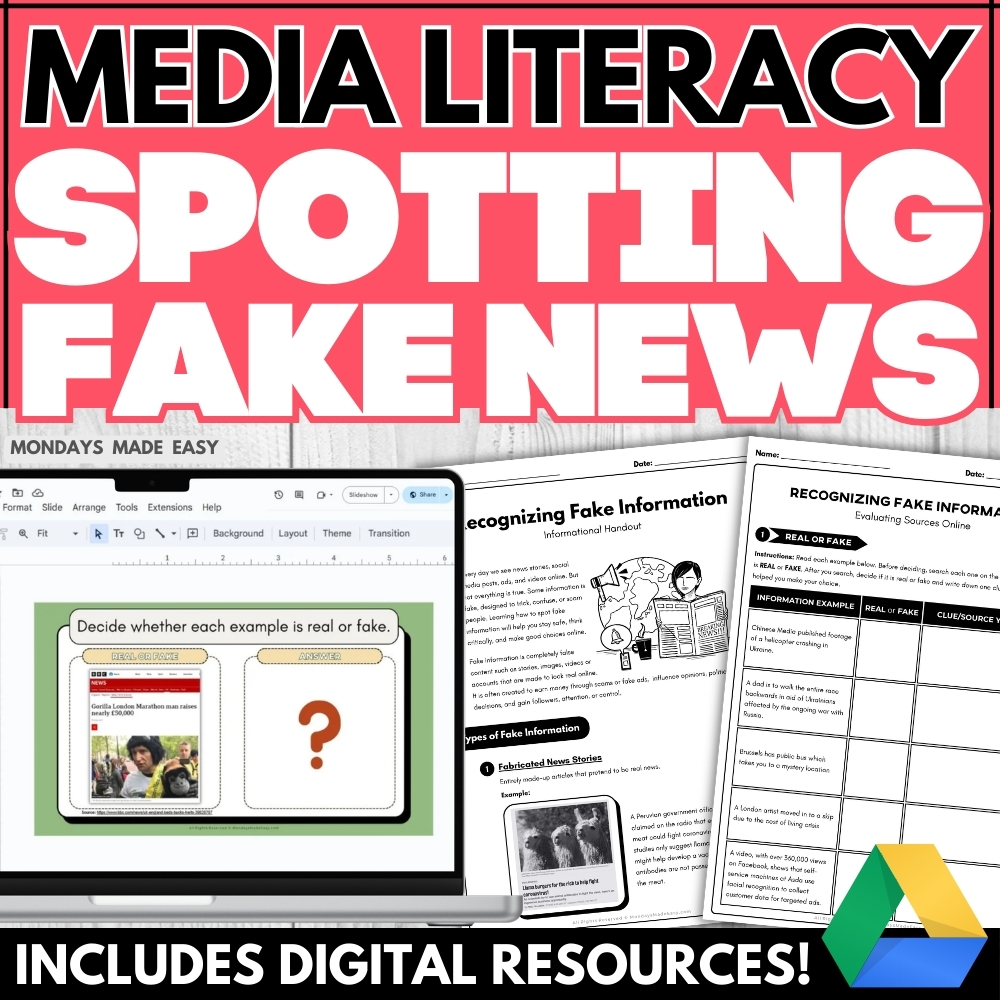
You can begin with the Recognizing Fake Information Slideshow Lesson. This overview explains what fake news and misinformation are, how they spread, and why it’s important to verify online content. Use this slideshow to introduce digital literacy concepts and spark discussion about the role of media and trust in the digital age.
This opening slideshow sets the foundation for the Misinformation Lesson by establishing shared definitions and concepts that students will rely on throughout the unit. Visual examples and concise explanations help demystify how misinformation circulates, particularly through social media algorithms and rapid sharing. Teachers can pause the presentation to invite discussion, asking students where they typically encounter information online and how they decide what to trust. These conversations encourage students to reflect on their own media habits and recognize that trust in media is constructed, not automatic. The slideshow also reinforces the idea that verification is an active process, not an optional step.
Next, distribute the Mini-lesson Informational Handout to introduce critical thinking questions for evaluating credibility. Students learn to assess details such as the publication source, date, author credentials, and use of emotional or misleading language. This resource supports students as they begin examining real-life claims in digital environments.
The handout functions as a practical toolkit within the Misinformation Lesson, giving students concrete questions they can apply to any online claim. By focusing on identifiable features such as authorship and publication context, students learn to move beyond surface impressions and examine credibility systematically. Encouraging students to annotate or highlight key criteria reinforces active engagement and helps internalize the evaluation process. As students begin applying these questions to real examples, they develop a more skeptical and informed approach to digital content, understanding that emotional appeal or professional appearance does not guarantee accuracy.
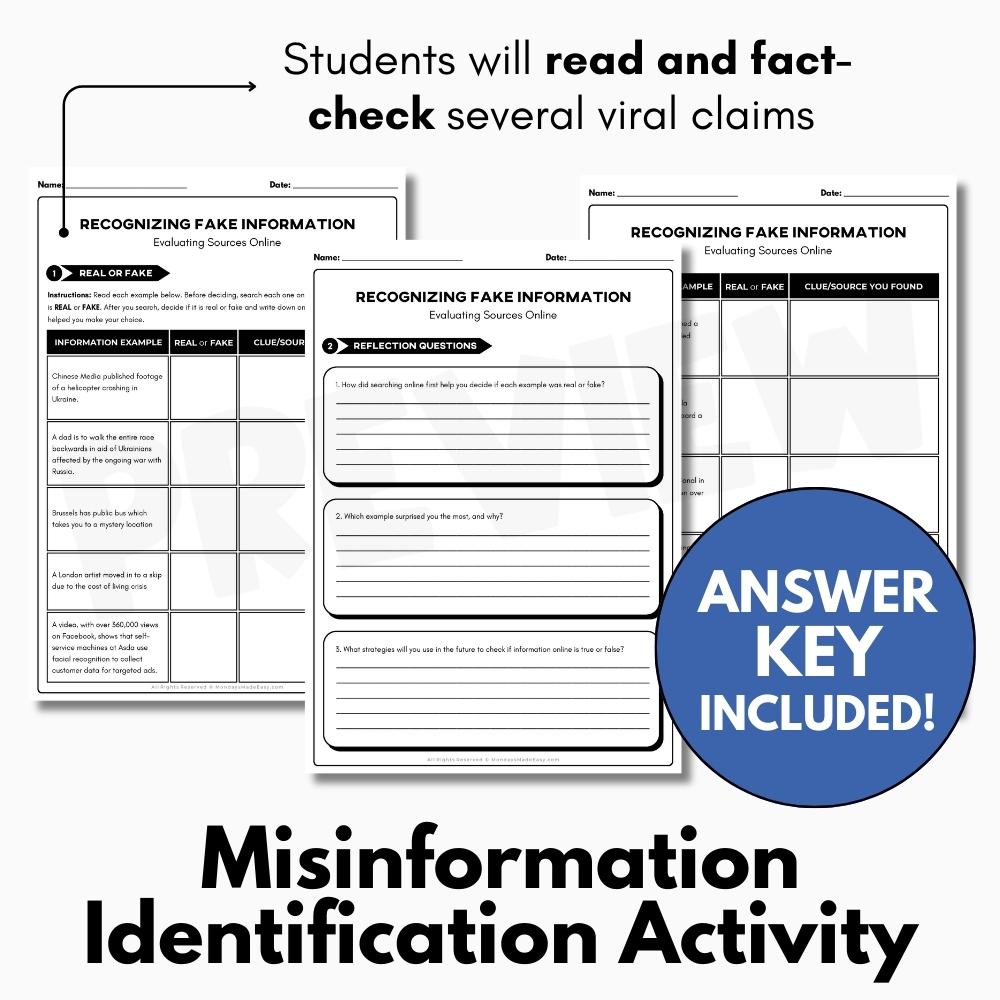
Then, assign the Misinformation Identification Activity. Students read several unusual or viral claims and investigate their accuracy through online research. For each item, they determine if the claim is real or fake, citing the clues or fact-checking sources that informed their decision. Tasks include identifying photoshopped images, clickbait pop-ups, and misleading headlines.
This activity is the central application component of the Misinformation Lesson, where students actively practice verification skills in a controlled, supportive environment. By researching viral or surprising claims, students experience firsthand how easily misinformation can appear convincing. Requiring students to cite evidence or fact-checking sources emphasizes accountability and reinforces the importance of transparent reasoning. The inclusion of varied formats—images, pop-ups, and headlines—reflects the diverse ways misinformation appears online. This task helps students understand that misinformation is not limited to articles alone but can take many forms across digital platforms.
To consolidate learning, students complete a brief reflection exercise to consider how their research process shaped their conclusions and how they will apply these strategies in the future. Reflection plays a key role in reinforcing the goals of the Misinformation Lesson by encouraging metacognition. Students are asked to think about not just what they concluded, but how they reached those conclusions. This helps them recognize effective strategies, such as cross-checking sources or identifying emotional language, and consider how these strategies can be transferred to new contexts. Reflection also encourages students to acknowledge challenges they encountered during research, normalizing uncertainty and reinforcing that careful evaluation takes time and effort.
To consolidate learning, a detailed answer key is included. The inclusion of an answer key strengthens the instructional value of the Misinformation Lesson by providing clarity and consistency. Teachers can use the answer key to facilitate discussion, compare student reasoning with accurate conclusions, and address common misconceptions. Reviewing answers collectively allows students to refine their thinking and see multiple pathways to accurate verification. The answer key also supports teacher efficiency and ensures that discussions remain focused on evidence-based reasoning rather than guesswork.
Together, these components form a coherent and scaffolded learning experience that moves students from awareness to analysis and application. The Misinformation Lesson is structured to build skills incrementally, ensuring that students are not overwhelmed but are continually challenged to think critically. By revisiting key concepts across slides, handouts, activities, and reflection, students develop a deeper and more durable understanding of how misinformation operates.
This resource also supports broader instructional goals related to inquiry, argumentation, and ethical digital participation. Students learn that identifying misinformation is not about cynicism but about responsibility and care. The Misinformation Lesson emphasizes that informed individuals play an essential role in maintaining healthy information ecosystems, both online and offline.
Ultimately, this lesson empowers students to become more discerning consumers and sharers of information. By strengthening their ability to question, verify, and reflect, the Misinformation Lesson equips students with tools they can apply across subjects, platforms, and real-world situations. In doing so, it reinforces the importance of critical thinking as a cornerstone of digital citizenship in an increasingly complex media environment.
✨ Kindly note that due to copyright restrictions, this resource is not editable, except for the files specifically labelled as editable. This is a common practice within the online marketplace in order to protect the clip artists and software providers that have authorized their intellectual property for the development of this resource.
⭒ For classrooms utilizing Google Classroom® ⭒
To access the digital version of these worksheets, simply follow the instructions within the resource to copy the files directly to your Google Drive®.