

Description
Get to know your students using this Enneagram Personality Test designed for the classroom! Includes slideshow lesson, celebrity enneagram types, enneagram informational handbook, a 36-question enneagram quiz, reflection worksheets, and enneagram posters for your bulletin board.
Included with this Enneagram Personality Test:
- Enneagram Slideshow Lesson
- Introduce students to the history, purpose, and structure of the Enneagram framework
- Explore each Enneagram personality type, including examples of famous figures
- 36-Question Personality Test and Scoring Sheet – Digital & Print
- Enneagram Informational Handbook
- Reflection Workbook for Each Enneagram Type
- Enneagram Type Posters – Vibrant & Printer-Friendly Versions
How to Use This Enneagram Personality Test:
This Enneagram Personality Test Unit is a great activity for back to school, advisory class, or SEL-focused lessons. It provides students with language to reflect on their identity, build empathy, and foster positive classroom relationships.
Begin with the Enneagram Slideshow Lesson, which introduces students to the history, purpose, and structure of the Enneagram framework. Through guided discussion and relatable examples – including famous figures and fictional characters – students learn how different personality types think, feel, and relate to others.
An Informational Handbook has also been provided. Use this handbook in combination or in place of the slideshow lesson. This handbook outlines the core fears, desires, key strengths and challenges, and how each type may show up in student life.
Next, distribute the Printable Personality Test to help students discover their Enneagram type. This assessment includes 36 thought-provoking statements rated on a 5-point scale. Students then use the scoring guide to calculate their core type and optional “wing” type, giving them insight into their motivations and behaviors.
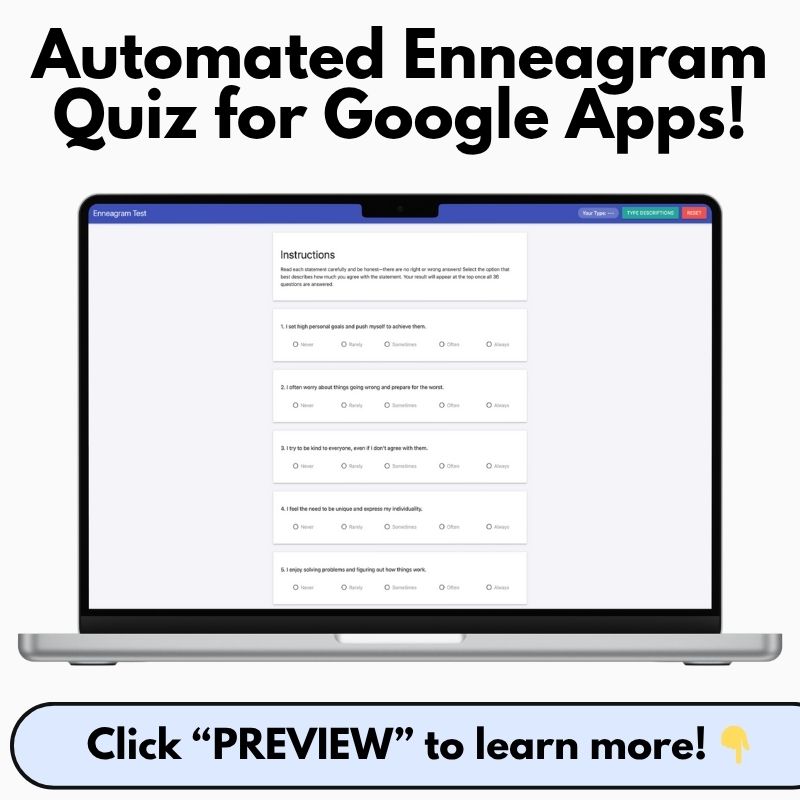
This resource also includes an Automated Enneagram Quiz for Google Apps! When students are finished answering the questions in this Web App quiz, their results will be generated instantly. No student sign-in required!
Please note that this quiz tool is hosted through a secure Google Apps Script web app and will open in a new tab. Because it’s hosted externally through Google Apps Script, some school networks may block it. If the page doesn’t load, try accessing it from a personal network or ask your IT department to whitelist the link.
After identifying their type, students use the Informational Handbook to learn more about their Enneagram number.
Students can then complete the Reflection Workbook for their individual type. These worksheets prompt self-exploration through tailored questions about communication, self-care, goal setting, and emotional regulation. This activity supports social-emotional learning while helping students better understand themselves and their peers.
Finally, display the Enneagram Type Posters in your classroom. These visually engaging prints highlight each type’s core traits and are a great tool for classroom discussion, bulletin boards, or personality corners. Two unique poster sets are included to give you styling options, as well as the option for a printer-friendly design.
The Enneagram Personality Test goes beyond a simple classroom activity—it’s a tool for building lasting relationships and increasing emotional literacy among students. By encouraging self-awareness and curiosity about others, this resource aligns with key SEL goals and promotes a growth mindset.
You can integrate the Enneagram Personality Test into various parts of your curriculum. For example, it pairs well with reading and writing assignments focused on character analysis or personal narrative. As students explore their type, they gain vocabulary for describing inner motivations and emotional experiences—skills that translate into richer writing and deeper literary discussions.
Teachers have found that incorporating the Enneagram Personality Test early in the school year helps create a more compassionate classroom culture. Students often show increased patience and understanding when they realize that their peers think and react in different, predictable ways based on their type. This builds trust and reduces unnecessary conflict in group work or partner activities.
Additionally, counselors and advisory leaders can use this resource during one-on-one student meetings, small groups, or classroom guidance lessons. Because the Enneagram Personality Test focuses on core fears, desires, and behavioral patterns, it offers insight that can help with goal setting, conflict resolution, and social-emotional development.
The Enneagram Personality Test is also ideal for older students who are preparing for life beyond school. High school students, in particular, can benefit from exploring their tendencies around stress, relationships, leadership, and decision-making. This can lead to valuable conversations around college readiness, career interests, and lifelong learning strategies.
Whether you use the Enneagram Personality Test as a standalone lesson, part of an advisory sequence, or an integrated tool across subject areas, it offers meaningful benefits for students and educators alike. With flexible components, clear instructions, and student-friendly language, this resource helps learners understand themselves—and each other—with greater empathy and insight.
✨ Kindly note that due to copyright restrictions, this resource is not editable, except for the files specifically labelled as editable. This is a common practice within the online marketplace in order to protect the clip artists and software providers that have authorized their intellectual property for the development of this resource.
⭒ For classrooms utilizing Google Classroom® ⭒
To access the digital version of these worksheets, simply follow the instructions within the resource to copy the files directly to your Google Drive®.





 Verified owner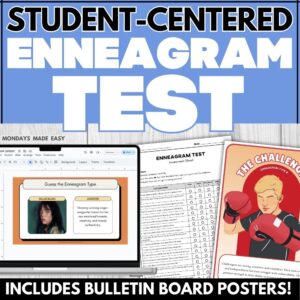
Angie B. (verified owner) –
This is so fun! Well organized, easy to read and follow, good for kids!
Angie B. (verified owner) –
This is so fun! Well organized, easy to read and follow, good for kids!
Kaycee M. –
This was such a great way to introduce my students to the Enneagram and help them see why they do things they way they do and how we can use that to help better support each other.
Jayme B. –
This was a great resource that really had my students engaged. There was a lot of great and well organized information to help them understand the enneagram.
CrissCrossCorner –
I used this at the end of last year and my students were very interested in learning more about the personality types. The resource includes everything you need and is well-crafted!
Caren P. –
This was a fantastic activity for my classes to complete at the beginning of the school year. They learned so much about their core personality types.
The Blue Backpack –
This was a fun beginning-of-the-year activity. It was cool to see the kids learn things about themselves while simultaneously introducing themselves to me.
Dawn P. –
This was a perfect resource to use helping students identify their strengths and weaknesses.
Graeson R. –
This was a fun way for students to get thinking about themselves.
Nancy T. –
My original Enneagram material has disappeared. I had very little time to create new items. The slides with the different types of enneagram types has been a life saver. Thank you for posting this activity on TpT.
Meghan S. –
Planning to use this resource for return after winter break and possibly at the beginning of the year for students to learn more about their personalities.
Get Your Ducks in a Row –
This was a great way to gather information on the students and what works best for them
Jessica C. –
They loved doing this test and seeing the results and then thinking about how they move though life with their Enneagram type personality traits. It was also interesting for them to see how others in class they may not be “friends with” have similar traits or how people they are bff’s with have opposite traits.
Language Arts and Sundry –
I teach a class where working in groups is an essential and required component. We did this as the beginning of the year and referred to it often as we were working in groups. Each time groups changed or made group norms, I had them refer back to their personality tests.
Sarah G. –
My all girls fitness and wellness class enjoyed learning about the personality styles. The paper version was easy to use.
Alexandra B. –
I used this activity with my 6th graders. They struggled a little but it was highly engaging for them.
Elena O. –
Purchased this resource and I am very impressed with everything included. Will lead to some great discussions during the first week of school.