
Description
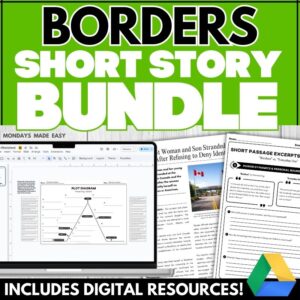
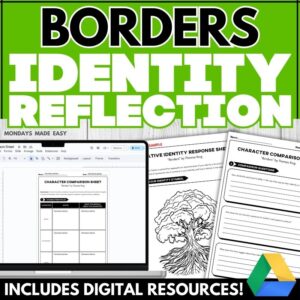
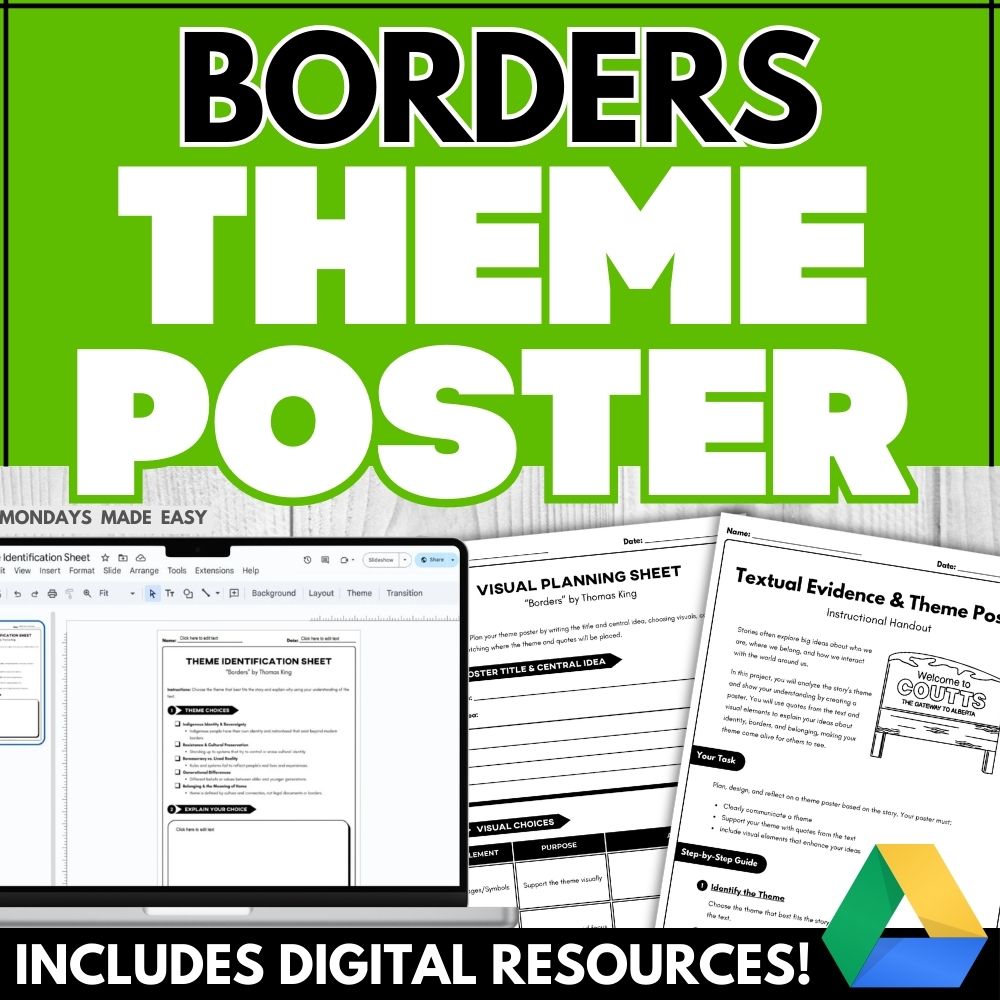
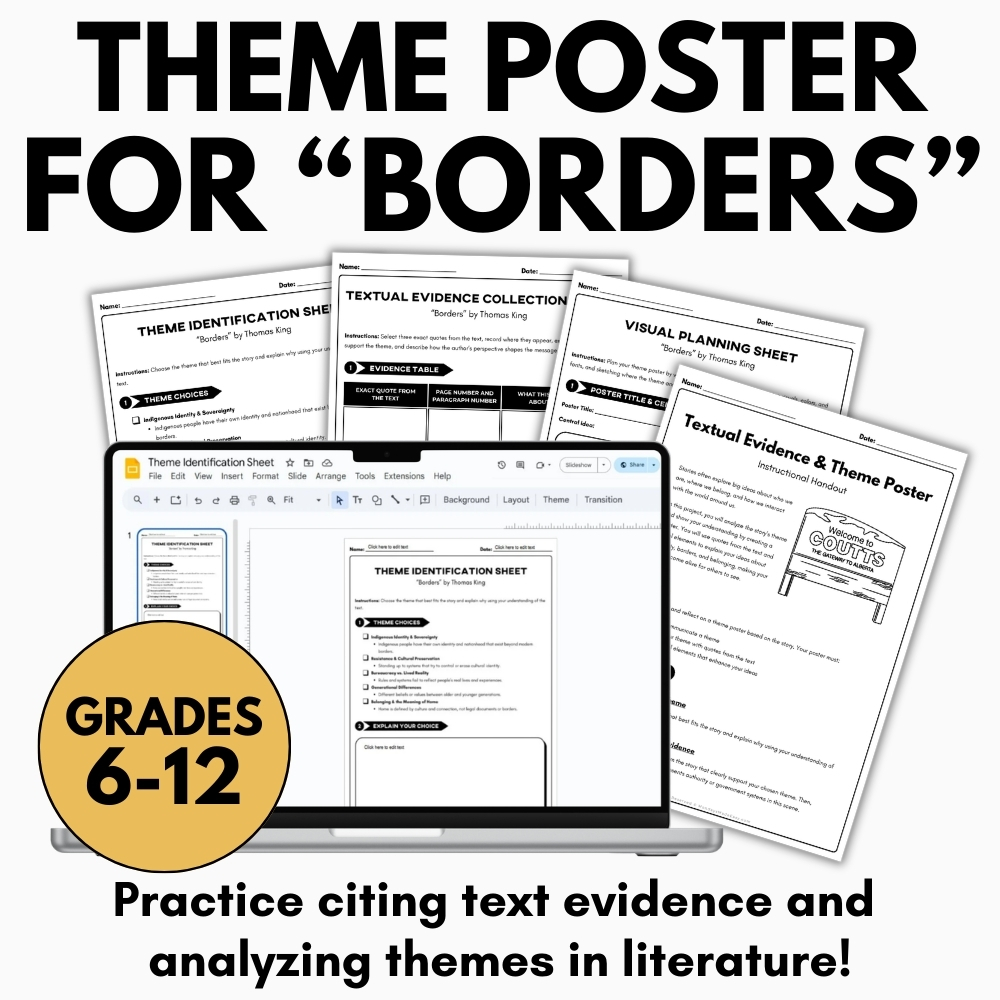
Practice citing text evidence and analyzing themes with this poster activity for “Borders” by Thomas King! This engaging activity challenges students to analyze the short story and visually communicate a central theme using textual evidence, images, and the author’s perspective. Includes digital worksheets for Google Classroom®!
Included with this Theme Poster Activity for “Borders” by Thomas King:
- Textual Evidence & Theme Poster Instructional Handout – Digital & Print
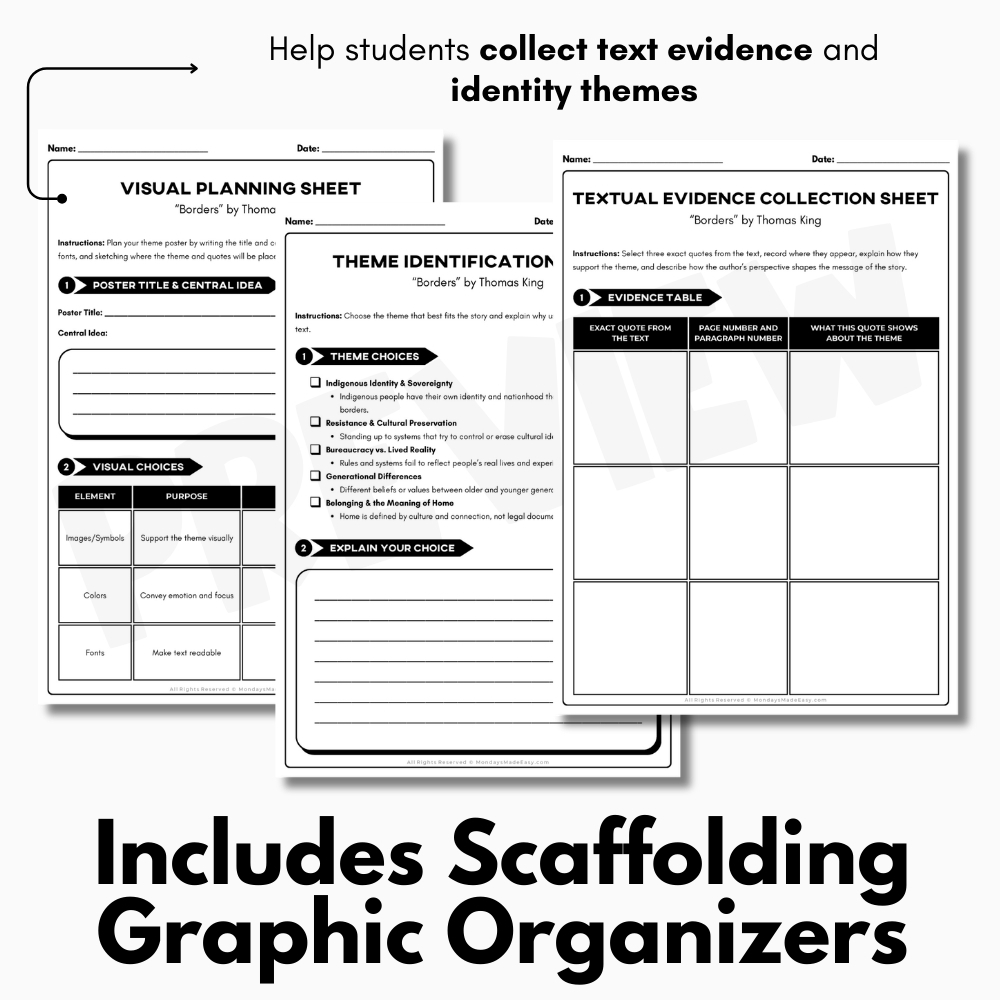
- Theme Identification Worksheet – Digital & Print
- Textual Evidence Collection Graphic Organizer – Digital & Print
- Visual Planning Graphic Organizer – Digital & Print
- Reflection Analysis Worksheet – Digital & Print
- Editable 4-Level Rubric – Digital & Print
- Student Example Mentor Texts
- Teacher instructions for using this resource
How to Use this Citing Textual Evidence & Theme Poster Activity:
This poster-based assignment emphasizes the importance of citing textual evidence while exploring deeper messages of identity, culture, and borders. Begin by introducing “Borders” by Thomas King and guiding students through a discussion about identity and cultural boundaries.
This opening stage of the Theme Poster Activity is designed to ground students in both the literary and conceptual framework of the short story before they begin analytical work. By foregrounding identity, culture, and borders, students are encouraged to think beyond surface-level plot events and instead consider how social and political boundaries influence personal identity. During the class discussion, teachers may prompt students to reflect on real-world examples of borders—both physical and symbolic—to help them connect the text to lived experiences. This shared conversation establishes a common understanding and prepares students to approach the text with a critical lens, ensuring that all learners, regardless of background knowledge, are ready to engage meaningfully with the story.
Once students have read the short story, assign the Theme Identification Worksheet. This worksheet will help students determine a central theme of the text and justify their selection with preliminary ideas.
At this stage of the Theme Poster Activity, students begin the transition from guided discussion to independent analysis. The Theme Identification Worksheet serves as a scaffold that supports students as they practice articulating abstract ideas such as theme. Rather than simply naming a theme, students are prompted to explain their reasoning, encouraging thoughtful engagement and discouraging vague or unsupported claims. This process helps students recognize that themes are developed through patterns, conflicts, and character experiences, not isolated moments. Teachers may choose to conference with students during this step to ensure their proposed themes are appropriate, defensible, and clearly connected to the text.
Next, students will complete the Textual Evidence Collection Graphic Organizer to gather quotations that support their chosen theme. This step helps students practice identifying relevant evidence and interpreting its significance in relation to the story’s message.
This component of the Theme Poster Activity places strong emphasis on close reading and evidence-based reasoning. Students must carefully revisit the text to locate quotations that directly support their thematic claim, reinforcing the essential literacy skill of citing textual evidence. In addition to selecting quotations, students are asked to explain how each passage contributes to the development of the theme, which deepens comprehension and analytical thinking. This step also provides an opportunity to differentiate instruction, as teachers can guide students toward stronger evidence or model how to analyze complex passages for meaning.
Then, students will move to the Visual Planning Graphic Organizer to sketch ideas for a theme-based poster. Here, students will pair each quote with a corresponding image or symbol to visually express their understanding of the theme. The layout encourages creativity and reinforces the connection between visual literacy and textual interpretation.
The visual planning phase of the Theme Poster Activity allows students to synthesize their thinking by transforming abstract ideas into concrete visual representations. By pairing quotations with images or symbols, students must consider how meaning can be communicated visually as well as verbally. This process strengthens visual literacy skills and encourages creative problem-solving, as students decide which symbols best represent complex themes such as identity or belonging. The planning organizer also helps students organize their ideas before creating the final poster, reducing cognitive overload and supporting students who benefit from structured planning tools.
Finally, students will reflect on their choices using the Reflection & Analysis Worksheet, where they will explain how their selected quotes, visuals, and layout communicate the story’s central theme. These questions will also prompt students to consider the author’s perspective and how it shapes the story’s message about cultural identity.
Reflection is a critical component of the Theme Poster Activity, as it asks students to articulate their thinking and justify their creative decisions. Through written responses, students demonstrate metacognitive awareness by explaining how their visual and textual elements work together to communicate meaning. This step reinforces the idea that literary interpretation is intentional and purposeful. Additionally, by addressing the author’s perspective, students deepen their understanding of how personal, cultural, and historical contexts influence storytelling, further enriching their analysis of the text.
This activity includes student exemplars to help model success criteria and guide students through the process with clear expectations.
Providing exemplars within the Theme Poster Activity supports transparency and equity by showing students what high-quality work looks like. Exemplars help demystify expectations, particularly for visual assignments that may feel subjective to students. Teachers can use these samples to facilitate discussion about effective theme development, strong evidence selection, and meaningful visual symbolism. Reviewing exemplars also helps students self-assess their work and make improvements before submission.
To evaluate this assignment, a 4-level rubric has been provided. This rubric is provided in both editable and ready-to-print formats; you can modify the success criteria in order to meet the needs of your unique classroom and curriculum expectations.
The rubric used to assess the Theme Poster Activity ensures consistent, fair, and standards-aligned evaluation. By breaking performance into clear levels, the rubric communicates expectations for theme clarity, evidence use, visual design, and written reflection. The editable format allows teachers to tailor criteria to specific grade levels or learning goals, while the printable version supports easy classroom use. Sharing the rubric with students in advance further promotes student ownership and accountability, helping learners understand how their analytical and creative skills will be assessed.
✨ Kindly note that due to copyright restrictions, this resource is not editable, except for the files specifically labelled as editable. This is a common practice within the online marketplace in order to protect the clip artists and software providers that have authorized their intellectual property for the development of this resource.
⭒ For classrooms utilizing Google Classroom® ⭒
To access the digital version of these worksheets, simply follow the instructions within the resource to copy the files directly to your Google Drive®.