Quick Takeaways
- End of year depletion in secondary teachers is systemic: the institutional demands of May and June increase, while available support and student compliance both decrease.
- Low-prep, high-engagement resources are the pedagogically sound response to this context: the goal is sustainable instruction using materials that will actually land with your students.
- Secondary teachers need end of year resources that require minimal setup, run independently once assigned, and keep students engaged without constant facilitation.
May arrives with a specific type of tired that teachers who work in secondary schools know all too well. The grading backlog has not cleared. The transition documentation is mounting. The IEP final notes are due. Student motivation is at its seasonal floor, which means the classroom management demands are peaking at exactly the moment your reserves are running lowest.
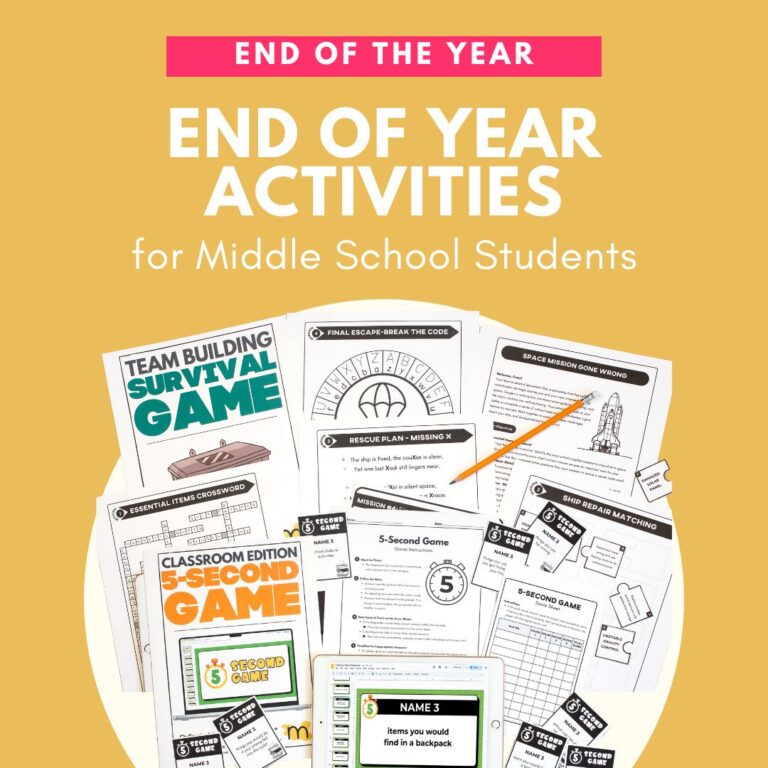
In this blog post, I’ll share practical resources and sequencing choices that make the last three to four weeks manageable and pedagogically worthwhile. All of the resources mentioned in this post are included in my End of the Year Activity Bundle, but these ideas are easily adaptable without purchasing anything at all! The goal is for you to leave this post with fun, meaningful ways for you to close out your year with your students.
Why the Last Weeks Are Harder for Secondary Teachers Specifically
The demands on secondary teachers at the end of the year compound in ways that do not occur at other grade levels. Final assessments, departmental obligations, graduation requirements, course selection processes, and the administrative weight of multiple classes all concentrate in the same window when student motivation and behavioral compliance are at their annual low. Secondary teachers are simultaneously managing the emotional weight of students facing significant transitions while navigating their own adult responsibilities.
The correct response to this is not to push harder with the same expectations you’ve held all year. The last thing teachers deserve is to whiteknuckle their way to the end of the year, just because their hard-earned summer is around the corner: you deserve to end on a high note without burning yourself out to get there!
The Case for Having a Plan Before May Arrives
The teachers who finish the year with their energy intact are rarely the ones who are better at managing stress. They are the ones who made decisions about the final weeks in March or April, when they still had the cognitive bandwidth to make good ones. By the time May feels urgent, there is no bandwidth left for resource research, decision fatigue sets in, and the result is improvised planning that costs more time than it saves.
A single planning session made in advance can help you approach the end of year with ease. Sit down with some colleagues in your department and plan a resource swap with the expectation that materials are shared before the end of year chaos begins. You can also grab this End of Year Activity Bundle, which is packed with engaging activities for older students. Both methods remove the end of year planning problem entirely.
Literary Projects That Run Independently
The highest-leverage end of year resources for avoiding burnout are the ones that are highly structured and run without constant facilitation. Literary projects meet this mark when they are thoughtfully-designed: clear instructions, student-facing materials, scaffolding graphic organizers, and student examples that keep students on test without requiring you to manage every transition.
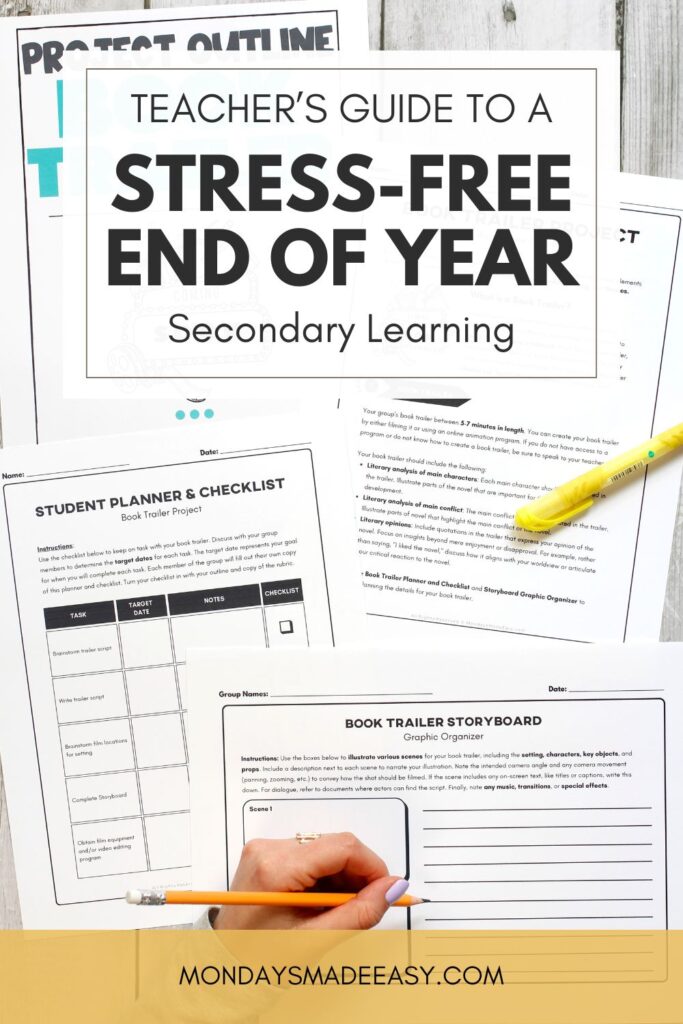
This Book Jacket Project asks students to redesign a cover for their chosen text with written analytical justification. Once assigned, this runs independently across multiple class periods with minimal input required from you. The Book Trailer Project similarly occupies students for multiple periods while producing high-quality creative work. Both are designed so that your students are the ones working harder than you; you can circulate and check in rather than standing at the front actively teaching, which is a meaningful reduction in facilitation demand during a hectic time of year.
“I, along with my students, really enjoyed this project. Bonus: you can use it with any book! I will continue to use this for many books to come!”
Bobbi W.
Middle School Teacher
Brain Break Activities for High-Energy Periods
Secondary students in late May carry a restless energy that traditional seat work cannot contain, and fighting it costs more than working with it. Brain breaks redirect that energy in productive ways without requiring you to manage resistance throughout your class period.
This Hot Takes 4 Corners Game explores students’ opinions on controversial (yet classroom-friendly) topics. Students will physically move to a corner of the room to express where they stand on each topic; each corner will then argue their opinion.
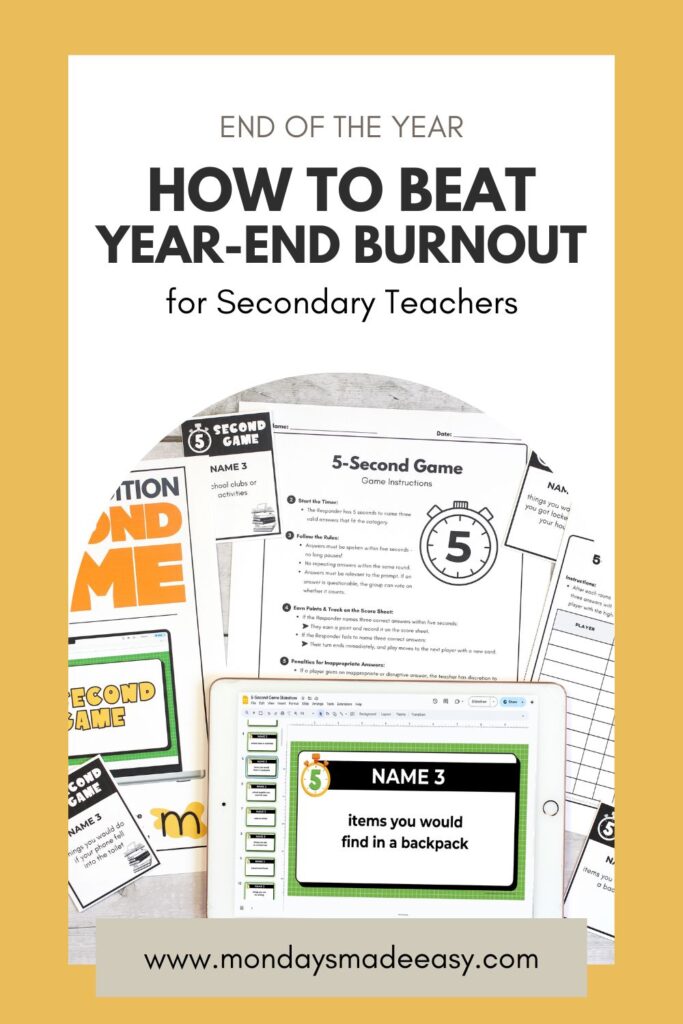
This 5-Second Game is a quick brain break – you only need five to ten minutes to play. It serves as a reliable classroom reset between heavier activities. It’s also perfect for those last few minutes before the bell!
Reflection Work That Won’t Make Students Cringe
End of year reflection resources need to actually challenge older students with prompts that aren’t surface level. The End of Year Memory Book and End of Year Playlist Activity are both designed with older students in mind. The reflection prompts direct attention to specific domains, like academic growth, relational contributions, and personal realizations. This encourages students to dig deeper than they would with open-ended prompts.
These work particularly well when assigned as sustained independent work in the final week, freeing class time for one-on-one student check-ins, feedback conferences, or the administrative obligations that inevitably accumulate in the close-out stretch.
Celebration Activities That Cost You Almost Nothing
These End of Year Awards work perfectly for secondary students because it sidesteps the comparison trap of traditional academic awards and goes straight to something more interesting: who this person might actually become. With 30 categories spanning creative, entrepreneurial, scientific, athletic, humanitarian, and entertainment futures, there’s enough range that most classes can match every student to an award that genuinely fits. This resource is for any secondary grade level, in any subject area, and requires no advance prep beyond a few minutes of thoughtful matching.
The Motivational Student Bookmarks are the perfect option for secondary teachers looking for meaningful student gifts. They require minimal prep, cost almost nothing per student, and include inspirational quotes from public figures that teenagers love.
A Practical Approach to the End of Year
Want to lift the burden of planning your last few weeks in the classroom? Here’s a week-by-week approach you can take. During week 1, you can assign a literary project that occupies students independently for multiple class periods. This creates a sustained work window that reduces your facilitation load, and ensures that your students are working just as hard as you are (if not harder!). During week 2, you can introduce a higher-energy activity (Hot Takes, Survival Scenario Escape Room, or a review game) to reset the room before students present their literary projects. For week 3, you can move into reflection work that helps students make meaning of the year. The final days can include class awards, gifting bookmarks, and some unstructured quality time to close out the year.
I hope this blog post has inspired you to finish your school year on a high note – without burning yourself out to get there!