The end of the school year has a way of contracting. The logistics of grading, transition documentation, and room packing crowd out the possibility of real closure, and before you know it, the last week is a collection of loose ends rather than an intentional conclusion. Most secondary teachers know this feeling. Many of them are wondering how to make the end of the school year meaningful for their older students.
The final days of school are worth being intentional about. Edutopia makes the case that year-end activities work best when they help students leave feeling accomplished, connected, and ready for what’s next (Edutopia), and that’s as true for your eighth graders as it is for your seniors. Meaningful doesn’t have to mean heavy. It means purposeful: activities that ask students to reflect on what they learned, engage with each other genuinely, and close the year with something worth remembering.
for Secondary Students
What “Meaningful” Actually Looks Like for Secondary Students
For elementary students, meaningful end of year closure often centers on celebration and sensory ritual: parties, games, summer countdowns. Secondary students need something different. They are at a developmental stage where meaning translates to being taken seriously; where the activities signal that the year had intellectual and personal weight.
Meaningful for a 16-year-old often looks like being asked a question worth answering. It looks like recognition that names something true about who they are. It looks like an activity that produces something worth keeping. These are all achievable in the last few weeks of school with the ideas covered in this blog post.
The Case for Structured Reflection: How to Make the End of the School Year Meaningful
Reflection is the single most reliable approach for generating meaningful closure, but it can feel meaningful without the right types of prompts. Open-ended prompts (“write about your year,” “what are you grateful for”) produce surface responses from secondary students because the question gives them nothing to push against.
Tethered reflection activities — ones anchored to a specific literary passage, a personality framework, a playlist, or a guided documentation structure — generate enough engagement to produce genuine self-reflection.
For example, this Literary Quotes Reflection Journal asks students to locate themselves in a literary passage. Similarly, this End of Year Playlist Activity asks students to justify a curated soundtrack with specific reflective evidence. This End of Year Memory Book also directs attention to specific domains: academic growth, relational contributions, and unexpected challenges, rather than leaving students to decide what to reflect on. Each of these produces a quality of thinking that an open-ended journal prompt cannot.
“This was a great way to finish off the year and give students the opportunity to reflect on the novels we read together. Rubric was an added bonus!”
Lauren S.
Middle School Teacher
Literary Study as a Vehicle for Self-Understanding
One of the great things about Language Arts is that literature provides a vocabulary for human experience that students can borrow when their own language runs short. End of year is a moment when many secondary students are processing experiences – loss, growth, uncertainty, pride – that they do not have the language to name on their own. Literary reflection activities give them a scaffolded way in.
This Literary Quotes Reflection Journal is effective in this context because it asks students to select from a curated set of passages rather than searching for their own, which removes the barrier of not knowing where to start. The passages become prompts, and the prompts become mirrors.
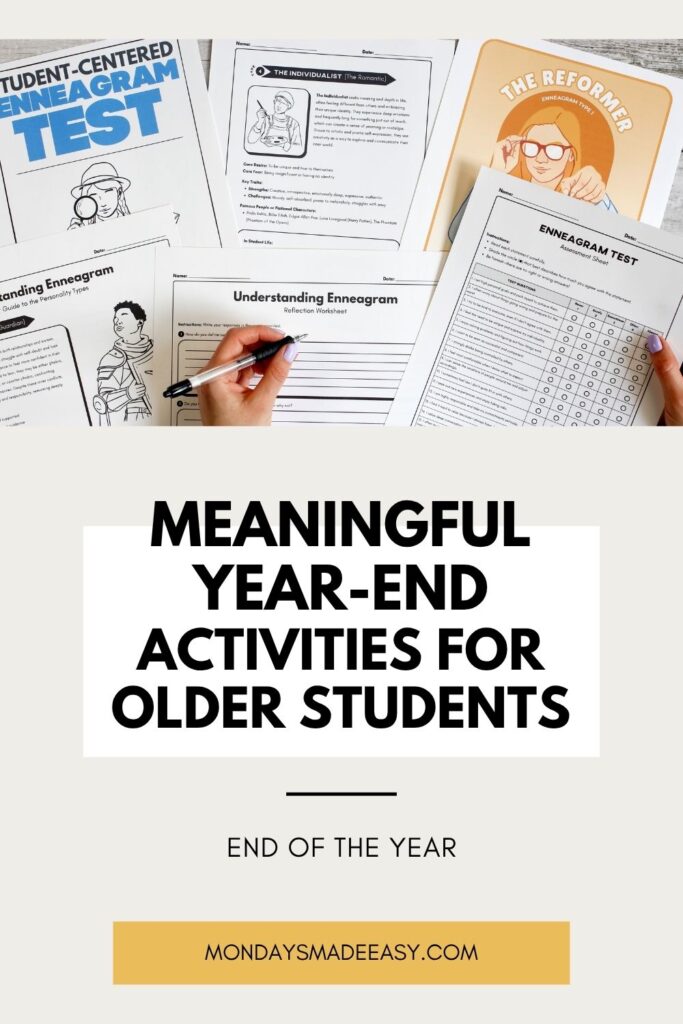
The Enneagram Personality Test serves a similar function through a different mechanism: the nine-type framework gives students a language for their motivational patterns that they can use in conversation with their peers, which generates the kind of authentic relational discussion that can be eye-opening in a traditional classroom.
“My original Enneagram material has disappeared. I had very little time to create new items. The slides with the different types of enneagram types have been a life saver. Thank you for posting this activity on TpT.”
Nancy T.
Middle School Teacher
Acknowledgment as Pedagogy
There is a version of the end of year that treats celebration as a reward for compliance and assessment completion. There is another version that treats acknowledgment as a pedagogical act in its own right. The difference matters for students who may not have had a year characterized by perfect attendance or high marks but who showed up when they could, contributed, and grew in ways that a grade does not capture.
These End of Year Awards include a set of 30 “Most Likely To” certificates that are perfect for older students. The categories (Most Likely to Start a Revolution, Most Likely to Become a Content Creator, Most Likely to Survive in the Wilderness) acknowledge student identity and potential rather than academic rank. For students who have spent the year feeling overlooked by traditional metrics of success, being named “Most Likely to Change the World” lands differently than another honor roll mention. The Motivational Student Bookmarks serve a similar function in a smaller format: a tangible gift that signals you saw the student as a person.
“Perfect and affordable option as an end of the year gift for students in my English classes. Thank you!”
Alex G.
Middle School Teacher
The Low-Prep, High-Impact Principle
I know the last thing you want to do after a long year in the classroom is spend more time planning the end of the year.
The resources referenced in this post are all classroom-ready from the moment you download them. They include clear instructions, student-facing materials, and rubrics or student examples where relevant. My End of Year Activity Bundle includes all of these resources and more; it’s packed with end of the year games, literary projects, reflection activities, and celebration resources to take end-of-year planning off your plate.
What the Last Few Weeks Can Be
The last few weeks of school can feel like pulling teeth – the slow erosion of attention and engagement as summer becomes visible and the academic stakes lower. That is one version. Another version is a deliberate close: structured reflection that produces real self-awareness, acknowledgment that names something true, and the kind of meaningful conversation that the rest of the year rarely makes room for. Both versions are available to you. The difference is in the activities you choose.
Frequently Asked Questions: How to Make the End of the School Year Meaningful
How do you make the end of the school year meaningful for secondary students?
Meaningful end of year closure for secondary students comes from three things: structured reflection (activities that produce genuine self-awareness, not surface gratitude), personal acknowledgment (recognition that names something true about individual students), and intentional sequencing (activities that build toward a real conclusion rather than simply trailing off). The most effective resources are ones that produce a tangible artifact students take home.
What is the difference between a meaningful end of year activity and a filler activity?
A meaningful activity asks students to produce original thinking, make a genuine choice, or reflect on something specific and personal. A filler activity asks students to fill time. The distinction is visible in the quality of student output: meaningful activities produce work that surprises you, while filler activities produce work that confirms what you already knew.
How much time do end of year reflection activities take?
The reflection activities in my End of Year Activity Bundle are designed to run efficiently within existing class time. The Literary Quotes Reflection Journal and End of Year Playlist Activity each run in one to two class periods. The End of Year Memory Book can be spread across the final week as a sustained independent project. None require out-of-class preparation from students beyond the initial engagement with the activity.