Quick Takeaways
- Your first week of school activities set the tone for how students experience reading, writing, and discussion all year. Community-building activities earn you the buy-in that sustains everything else.
- High school students need icebreakers that feel clever and low-stakes, not infantilizing.
- Weaving ELA skills into first-week activities (inference, discussion, plagiarism literacy) signals what your class values before formal curriculum begins.
- A student survey completed thoughtfully during the first week becomes one of the most useful tools in your back pocket all year.
- You don’t have to rebuild your first week of school activities from scratch every August; the right resources make this the easiest prep you do all year.
8 First Week of School Activities for High School ELA
My second year teaching, I made a decision I told myself was efficient: I jumped straight into the novel on Day 2. We were bound to get behind schedule, I reasoned, so the responsible thing was to get going immediately. No community-building, no warmup, no getting-to-know-you anything. Just “here’s your copy of the book, here’s the syllabus, here’s what we’re doing.”
By the end of that first week, I had a room full of students who knew nothing about each other, nothing about me, and not much about why they were sitting in an English class that felt exactly like every other English class they’d been in. The first discussion I tried to facilitate was met with silence so complete I could hear the fluorescent lights buzzing.
It’s safe to say I never made that mistake again!
The first week of school activities you choose for your high school ELA class aren’t a warmup to the real work. They ARE the real work! They’re how you establish that your classroom is a place where people talk, take risks, express their thoughts, and actually read. Done well, they create the psychological safety that makes every unit after September easier to get through. Done poorly (or skipped entirely) and you spend the whole semester wondering why each lesson feels like pulling teeth.
Here are the activities I come back to every year, and the resources that make them easy to facilitate.
What Are the Best First Week of School Activities for High School ELA?
The best first week of school activities for high school ELA blend community-building with hits of low-stakes academic content; connection comes first, then curriculum.
The distinction matters. Community-building activities that have nothing to do with English class can work, but they leave a gap: students walk away feeling good about each other and still having no idea what your class is actually going to demand of them. The first week is your chance to close that gap. Every activity you choose can do double duty — build trust and signal your values.

Start with Icebreakers That Feel Worth Their Time
High school students have strong opinions about icebreakers. They’ve sat through enough cringe-worthy “share your favorite animal and why” moments to be skeptical from the start. What works is anything that feels like a real game, gets people moving or laughing, and doesn’t require vulnerability from day one. These are the types of first week of school activities to shoot for!
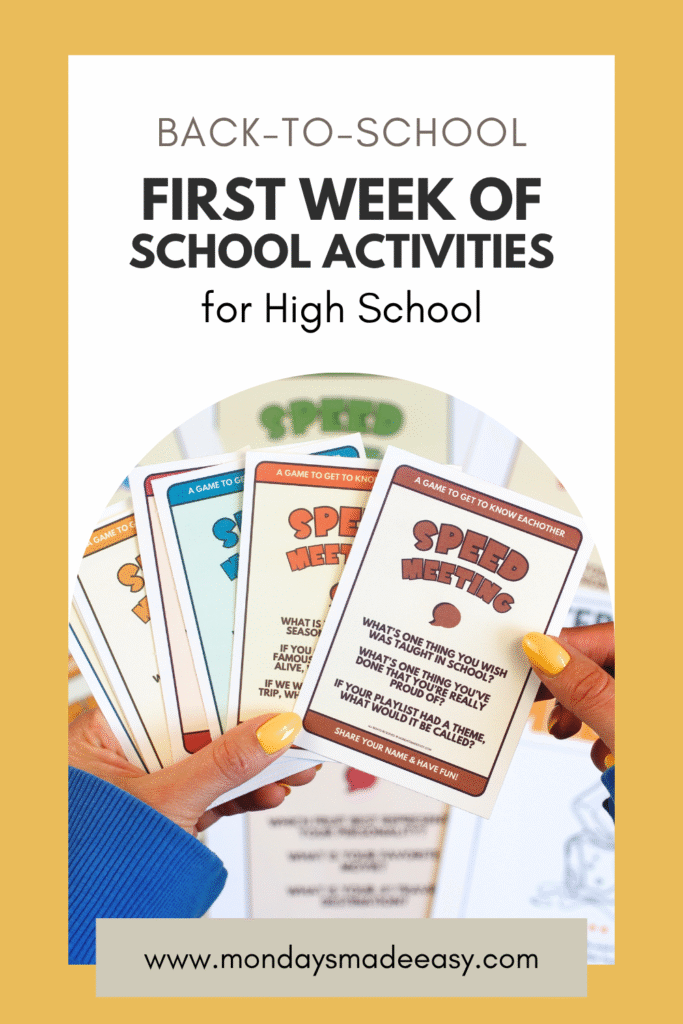
The activities in this Back to School Icebreaker Games Bundle have been my go-to for this. It includes Speed Meeting (a student-directed rotation that generates conversation without anyone being put on the spot), Back to School Bingo (designed specifically for teenagers), Find Your Partner (a card-matching warm-up that also introduces your partner pairing system), and a few others that move quickly and land consistently with older students. I’ve played with Grade 9 classes and Grade 12 classes and the reception is almost always the same: skepticism in the first thirty seconds, and a classroom buzzing with chatter after roughly five minutes.
“Loved the ice breaker games! That is something I always have a hard time initiating with students in my first week of school activities, but this resource helped a lot and can be used throughout the semester/year”
Ms. Bee
High School Teacher
A few things worth considering about running icebreakers with high school students: keep the time tight (7-10 minutes per activity, not 20), don’t make anyone share anything deeply personal, and be sure to participate, too. Your students love to see you join a rotation instead of supervising from the front.
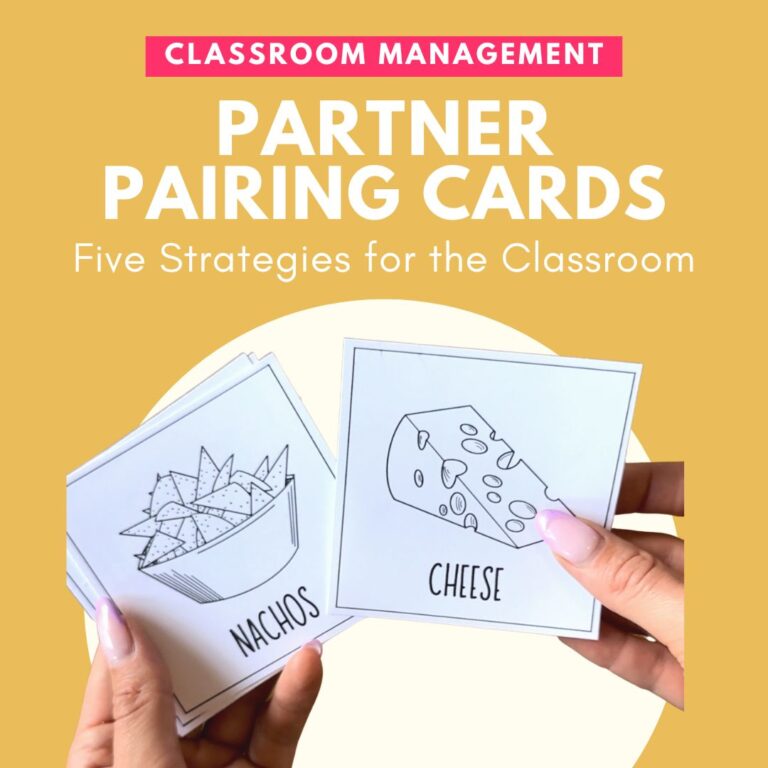
These Partner Pairing Cards are worth having on hand from Day 1. They serve double duty as a first-week icebreaker and as an ongoing classroom management tool. It includes 50+ pre-made cards for pairing students randomly throughout the year, so you’re not wasting time selecting partners for the next ten months. This way is more fun, too!

Go Deeper with Student Surveys and Personality Work
Community-building is one piece of the first-week puzzle. Understanding who your students actually are as readers, writers, and people is another. The following first week of school activities help to get to know your students on a personal level.
The Student Information Sheet is simple and works well on Day 1 or 2. It’s an editable survey that asks students about their reading habits, writing strengths and struggles, responsibilities outside school, and goals for the year. You’ll fill in things you didn’t know about your students in the first five minutes of reading through them, and you’ll reference them again when you’re trying to remember what that shy student in Period 2 said he cared about.
If you want to go deeper into student personality and identity, and create something that can anchor an early-semester bulletin board, the Enneagram Personality Test is top of list. It includes a 36-question assessment, a slideshow lesson, celebrity Enneagram types (which students love), reflection worksheets, and bulletin board posters. Students find their type, discuss how it shapes their approach to learning, and you end up with a classroom display that tells you a lot about who’s sitting in your room.
There’s also a useful ELA connection here: personality types map cleanly onto character analysis, which you’ll likely be touching on soon. Introducing the Enneagram in Week 1 gives you a shared vocabulary you can return to all semester.
Add a Low-Stakes ELA Skill Preview in Week 1
Students arrive in September with wildly different impressions of what English class is. Some expect five-paragraph essays and vocabulary worksheets. Some expect to sit in a circle and talk about their thoughts. The first week is your chance to show them what your version of Language Arts actually looks like.
The activity that does this best, in my experience, is the Making Inferences Mystery Game. It’s a skill-based lesson disguised as something so engaging that students don’t clock the learning until it’s already happened. The premise is “who stole the manuscript?” – students read clues, make inferences, collaborate, and problem-solve. It introduces inference as a reading skill, and it signals immediately that your class is going to be a lot of fun, but still requires thinking.

Build in Plagiarism Literacy Before You Need It
Every ELA teacher who’s made it through a writing unit without establishing clear plagiarism expectations first has a story. Usually the story involves a lot of identical sentences and a few very uncomfortable conversations. This is why discussing plagiarism is a worthy addition to your first week of school activities.
Building plagiarism literacy into the first week isn’t about announcing consequences. It’s about making sure students understand what academic integrity actually means before the first writing assignment lands. This Avoiding Plagiarism Unit covers types of plagiarism (including AI-generated content, which has to be part of the conversation now), provides student-facing materials that explain citation and paraphrasing in real language, and includes activities that make these concepts stick.
This unit also includes a Collaborative Plagiarism Policy, which serves as the perfect activity to wrap up the first week. It consolidates what you’ve taught so far about plagiarism, invites peer collaboration, and sets the tone for a productive new week ahead.
Close the First Week with a Clear Picture of Who Your Students Are
Successful first week of school activities can be measured in a few key areas. By Friday of Week 1, you want to have: a room where people know each other’s names, students who have some sense of what this class will feel like, and you with enough information about your students to make intentional decisions in the weeks ahead.
This Back to School Bundle pulls everything mentioned in this post together, and adds more: classroom management tools, a visual syllabus template, exit ticket templates, parent communication sheets, and additional community-building resources. These resources go beyond the first week to set you up with systems that support your classroom all year long.
“This bundle has so many practical tools for the first weeks of school! I love that it combines organization, management, and student activities. It really helped me feel prepared and gave my students fun ways to build classroom community.”
Hilary P.
High School Teacher

The Best First Week of School Activities for High School ELA
The first week of high school ELA isn’t throwaway time. It’s the most important investment you make in how the whole year runs. The students who feel like your classroom is a safe, interesting, worthwhile place to be will engage differently with every unit that follows. Keep in mind that with so many changes in student timetables during the first week of the year, you’re setting new students on your roster up for success by delaying content until week 2.
The first week of school activities above have a track record. Use them, adapt them to your class, and give yourself permission to start the year with intentionality rather than urgency. Your September self will thank you.
Frequently Asked Questions
How many icebreakers should I do in the first week of school?
Two to three is usually plenty for high school. You want enough variety to build momentum without the week feeling like an endless parade of games. Aim for one community-builder on Day 1, a skill-preview activity on Day 2 or 3, and a quieter survey or reflection activity by Thursday.
Should first week of school activities for high school ELA be ELA-specific?
First week of school activities don’t have to be exclusively ELA-focused, but the best plans include both. An activity that builds community and introduces how your class approaches reading or discussion is always going to serve you better than one that could happen in any subject.
What if my high school students resist icebreakers?
This is common and completely manageable. Choose first week of school activities that don’t require personal vulnerability, keep the time short, and participate yourself. The skepticism usually dissolves within the first few minutes once the activity has some momentum. Students who say they hate icebreakers are often the ones most engaged by the end.
Can I use the same first week of school activities every year?
Absolutely. Once you find a rotation of first week of school activities that works for your classroom and your students, there’s no reason to rebuild it from scratch annually. The strongest first weeks I’ve had have used the same core activities with minor tweaks for the specific group. Consistency is a feature, not a failure of creativity.
When should I start actual curriculum content in high school ELA?
Week 2 is typically the right rhythm for high school. Use Week 1 to build community, establish expectations, run a low-stakes ELA preview, and gather student information. Starting a formal curriculum in Week 2 with an already-connected classroom is dramatically more effective than jumping in on Day 2 with strangers.