
Quick Takeaways: Review Games for Test Prep
- Active retrieval outperforms passive review every time; review games work for test prep because they push students to produce answers rather than re-read notes.
- The four resources in the Review Game Pack (Jeopardy, Classroom Feud, 4 Pics 1 Word, and Editable Board Game Template) cover different modalities and work at different points in the review cycle.
- Editable formats mean you can layer in your own content, making every resource reusable across courses, units, and years.
- Competitive formats work better as review games for test prep than collaborative ones when students need the urgency of stakes to focus their recall.
The case for review games for test prep isn’t just that students like them (though they do). It’s that the research has been sitting in plain sight for over a decade, and secondary teachers are still underusing one of the highest-leverage tools available during test prep. Robert Marzano, whose meta-analyses have shaped how thousands of districts think about high-yield instructional strategies, found that “these studies showed that, on average, using academic games in the classroom is associated with a 20 percentile point gain in student achievement” (ASCD).
These four resources are designed specifically for secondary test prep. Each uses a different game format and serves a slightly different function in the review cycle. All four are editable, which means the content is yours to customize across courses and year levels.
End of Year Jeopardy
This End of Year Jeopardy resource is an editable Google Slides template built around the Jeopardy format with categories, point values, and the competitive structure that makes this game show so effective for test prep. The original version comes pre-populated with end of year school trivia, which generates engagement before any content review begins. The editable format means you can replace or supplement those categories with curriculum content from your course.
Jeopardy works particularly well as a review format because the answer-then-question structure requires students to retrieve information from a slightly unfamiliar angle, which strengthens the encoding in ways that straightforward Q&A does not. Run this in the class period before a major assessment when students have already done initial review and need to stress-test their knowledge.
Classroom Feud
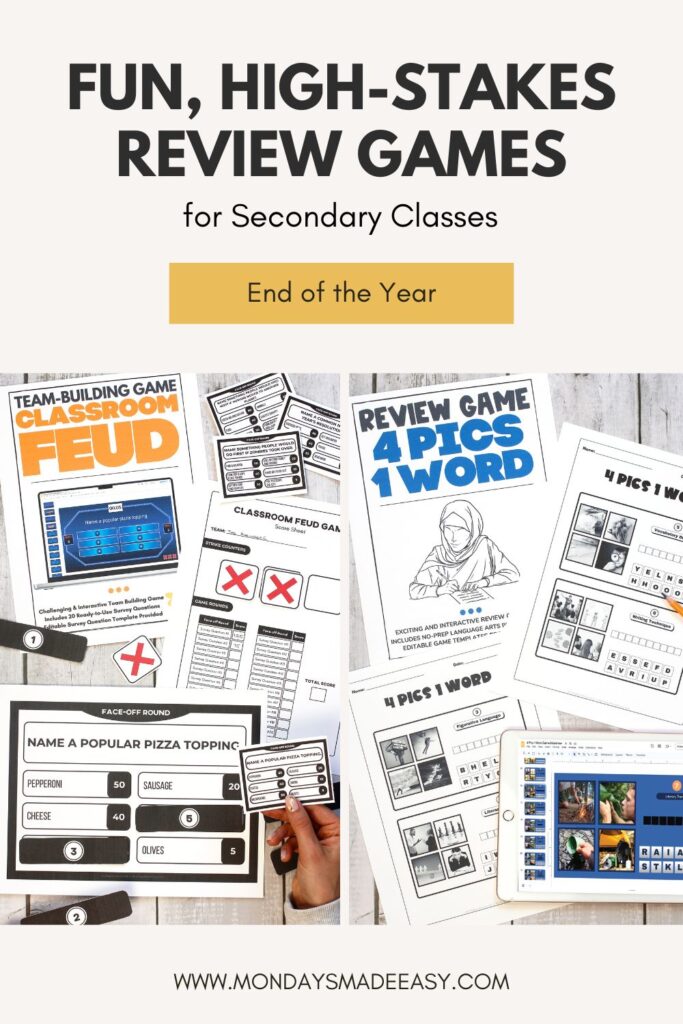
Classroom Feud is modeled on the Family Feud format and runs as a team-based activity in which students compete to name the most popular responses to survey-style prompts. The format rewards students who can think about how others think – a metacognitive task that goes beyond simple recall. It includes both digital and printable options, making this game adaptable to any classroom.
For test prep, this format works best with content that has multiple valid answers or that involves ranking, prioritizing, or categorizing. Literary themes, rhetorical strategies, character traits, and literary devices all lend themselves to the “name the top five” format that Classroom Feud uses. The social energy of the format is sure to sustain attention for a full period!
“Very easy to use. My students found it engaging and were talking about it days after we completed it. It provided a lot of good reference points for future topics and discussions!”
Michael C.
Middle School Teacher
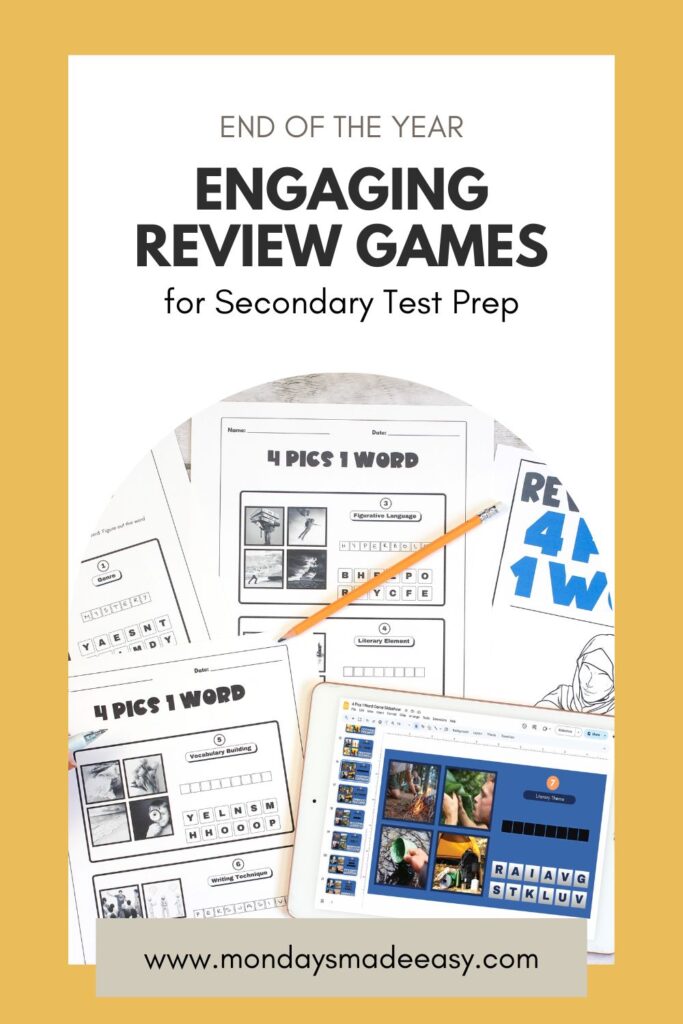
4 Pics 1 Word Review Game
This 4 Pics 1 Word Review Game uses the viral game format: students see four pictures and must identify the single word that connects them. The pre-built slideshow is designed for ELA content and is compatible with Google Slides and PowerPoint. Students can work individually or in teams, and the format creates a lower-stakes, higher-engagement review environment than traditional Q&A.
The visual format is particularly effective for vocabulary review, literary term identification, and thematic concept work. The connections students are asked to make between four seemingly unrelated images require the same kind of inferential reasoning that appears in higher-order test questions, which makes this more than a surface-level review tool.
Editable Board Game Template
This Editable Board Game Template takes test prep in a different direction: instead of delivering review content to students, it asks students to generate review content themselves. Students create their own questions, design their own game mechanics, and then play each other’s games. The cognitive demand of producing a good review question is substantially higher than answering one, which makes this one of the most effective retention-building formats available.
This works best when deployed earlier in the review cycle (two or three days before the assessment) so students have time to produce thoughtful game content and play through multiple versions. The social and creative investment in the creation process tends to produce longer-lasting recall than any passive review format.
How to Choose the Right Review Games for Test Prep
A practical sequence: use the Board Game Template three to four days before a major assessment when students need to consolidate content. Play Jeopardy or 4 Pics 1 Word two days out as a whole-class review with competitive stakes. Use Classroom Feud the day before the assessment as a lower-intensity review that maintains engagement without adding test anxiety. Each format serves a different cognitive function in the review cycle, and rotating through all four gives you variety without requiring new content creation for each session.
All four resources are available together in this Review Game Template Pack.
Frequently Asked Questions: Review Games for Test Prep
What are the best review games for test prep in high school?
The most effective review games for high school test prep are ones that require active retrieval rather than passive review. Jeopardy, Classroom Feud, and 4 Pics 1 Word all require students to produce answers under competitive or time-pressured conditions, which strengthens recall. The Editable Board Game Template takes this further by having students generate review content themselves.
Do review games actually help students retain information?
Yes. The research on active retrieval practice consistently shows that having to produce information from memory – even in a game format – leads to significantly better long-term retention than re-reading notes or passively reviewing material. Review games work because they replicate the cognitive conditions of a test in a lower-stakes environment.
Can these review games be used for any subject, or are they ELA-specific?
The 4 Pics 1 Word Review Game and “Language Pursuit” Board Game include pre-built questions for ELA content, but all of these review games are all fully customizable and can be adapted for any subject area.
How long does the Jeopardy review game take to run in class?
The Jeopardy review game runs comfortably in a standard 60-minute class period. With more categories or a competitive elimination format, it can extend to 75-80 minutes. It can also be split across two shorter periods if your schedule requires it.