
The following is a copy of an email sent to my subscribers. This is an archive, so it's possible some links are missing or expired. If you want strategies and ideas sent straight to your inbox, you can get on the list here.

<[email protected]> to you
Subject: 🎲 A fun game to teach literary devices

Solutions for your Sunday Scaries
There’s a difference between knowing what a metaphor is and actually catching it on the page.
When it comes to teaching figurative language, if your students need constant reteaching because these concepts don’t stick, I have just the thing for you:
This Figurative Language Matching Game uses game-based learning to reinforce students’ understanding of common literary devices.
These game cards showcase examples from classic literature. And because I’ll do just about anything to incorporate pop culture references, there are contemporary song lyrics included, too. 🙌
There are 16 terms and 32 examples in total. The examples explore poetic devices utilized by artists and poets including Lorde, Billie Eilish, Sylvia Plath, Katy Perry, Kendrick Lamar, T.S. Eliot, Queen, Oscar Wilde, Adele, Robert Frost, Bruno Mars, and many more.
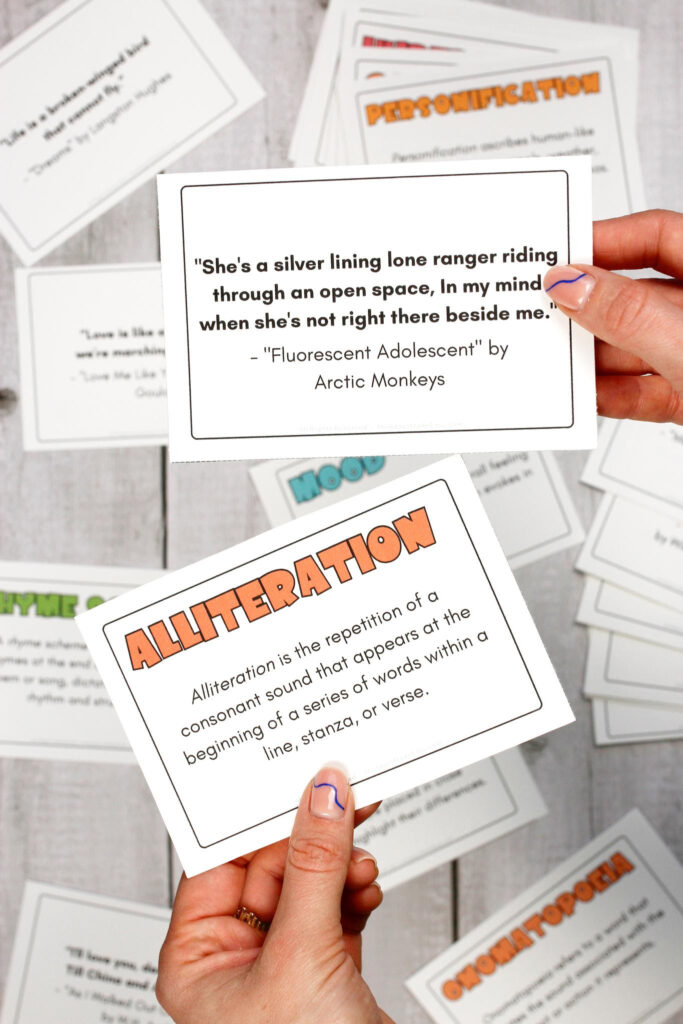

1. Use it as an engaging and collaborative group-work activity.
To introduce this game, divide the class into small groups and distribute the game cards. Be sure that each group receives a set of cards that match the corresponding literary devices. To ensure that each set matches, you can refer to the answer key provided.
After the game, you can lead a discussion to review correct matches and address any questions. Note that in some cases, there is more than one correct answer for each literary device. These possibilities are also noted in the answer key.
2. Use it as a diagnostic tool to assess students’ understanding.
If you’re beginning a literary analysis or poetry unit and want to gauge your students’ prior knowledge, this game-based approach offers a low-stakes way to assess their understanding. After the game, use the questions students struggled with most as a starting point for your unit.
3. Use it for a literary device scavenger hunt.
Once students have mastered the 32 examples in this resource, challenge them to find real-world examples of each literary device in the texts they read. Students can search for literary devices in song lyrics, short stories, advertisements, and novels – whether you provide the texts or let them explore independently, the possibilities are endless.
Assign each student a few terms and have them create their own game cards to expand the deck. This not only deepens their understanding but also provides future students with fresh, peer-selected examples to work through.
4. Use it for end-of-year review or standardized test prep.
Those weeks leading up to standardized testing and exams are absolutely exhausting for students – and probably leave you feeling like you’re searching for ways to keep them engaged.
When motivation is at an all-time low, game-based learning is the perfect opportunity for review. As they cram for their other subject-area evaluations, your students will definitely appreciate low-stress activities like these.
Enjoy!
Did a friend forward your email? You can also join the community here.

Hi, my name is Daina!
I’m the face behind Mondays Made Easy, and I design modern educational resources for dedicated English Language Arts teachers.
Latest Emails