Quick Takeaways
- Middle schoolers need icebreakers that give them permission to be playful without requiring vulnerability; the wrong activity can shut a room down fast
- Movement-based activities work especially well in grades 6-8, where first-day nerves translate directly into restless physical energy
- Grade 6, 7, and 8 respond very differently to the same activity — what hooks a sixth grader may make an eighth grader roll their eyes
- Team-based icebreakers tend to outperform individual ones at this age because the group absorbs the pressure no single student wants to carry
- Your own energy sets the tone more at this age than at any other; if you are genuinely having fun, most of them will follow
My Grade 8 class had one of those first-day energy readings that every teacher knows: very still and somehow volatile at the same time. Thirty students arranged in rows, watching me the way you watch a weather forecast in an unfamiliar city. A few were clearly interested. Most were in protective mode, performing mild disinterest until they could figure out whether this classroom was a safe place to be.
I had planned a go-around-the-room introduction: name, favourite subject, one thing you were looking forward to this year. You can probably already picture how it went. By the fifth student, the room had collectively decided this was going to be painful. By the tenth, “favourite subject” had become “I don’t like school” from three students in a row, and “something you’re looking forward to” was producing either silence or “lunch.”
I pivoted. Mid-circle, I stopped, asked students to push their desks back, and ran a game of Icebreaker Bingo instead. The energy shifted within about ninety seconds. Students were up, moving around the room, reading prompts off a card rather than being spotlit at the front. The student who’d said “I don’t like school” found out that four of his classmates had seen snow before (I was teaching in Thailand at the time). The conversation that followed ran longer than I planned.
That first day taught me something I’ve carried since. The go-around introduction didn’t fail because the students were disengaged. It failed because it asked too much, too soon, in an arrangement that put every social risk on the individual. Middle schoolers don’t open up when they’re spotlit. The structure of the activity needs to make connecting feel low-stakes and almost accidental.

What Makes Icebreakers for Middle School Students Different?
The most effective icebreakers for middle school students remove individual performance pressure, build in movement, and give students a reason to talk to each other that isn’t just “share something about yourself.”
Middle school is its own developmental territory. Students at this age are acutely self-conscious, highly attuned to peer judgment, and navigating identity questions that feel enormous to them. They’re doing their best to look like none of it matters, but if you know middle schoolers, you can catch their bluff.
What this means in practice: the wrong icebreaker can make the room feel less safe than it did before you started. Meanwhile, the right one can set you up for a year of successful relationships in your classroom. A few principles worth keeping in mind as you plan:
- Team-based activities outperform individual ones at this age. When the group absorbs the risk, no single student has to be “on.”
- Movement matters more here than at any other grade level. Middle schoolers carry their nerves in their bodies. Getting them out of their seats early changes the energy.
- Grade 6, 7, and 8 are not interchangeable, especially if you don’t teach in a K-8 school. Sixth graders might be brand new to your building and desperate to fit in. Seventh graders are often navigating a lot of changes. Eighth graders arrive with established dynamics and a reputation to manage.
- Your own energy sets the tone. Middle schoolers read the adults in the room carefully. Genuine enthusiasm is contagious at this age.
All eight activities below are built with those realities in mind. Some are better suited to day one; others work best once students know each other a little. I’ve noted where to keep this in consideration.
1. Icebreaker Bingo
Start here, especially on the first day. Of all the activities on this list, Icebreaker Bingo is the best choice for a room full of students who don’t know each other yet — because it puts students in motion before their nerves have time to calcify into silence.
This game is simple by design. Each student gets a bingo card loaded with prompts like “find someone who has moved to a new school,” “find someone who doesn’t like chocolate,” “find someone who plays a sport no one has heard of,” Students then move around the room collecting names until they complete a row. The card gives students a script for opening up conversations with their peers, making it easy for them to foster conversation.
Students will circulate, discover unexpected things about classmates they assumed they had nothing in common with, and sit back down having talked to people they might not have known well a few minutes ago. With 6th graders especially, model the “approach” before you start: walk up, introduce yourself, read a prompt from your card. It takes thirty seconds and prevents the “I don’t know how to start” paralysis that stalls some students at this age.
This Icebreaker Bingo includes ready-to-play cards with prompts designed for older students, plus an editable template so you can swap in prompts that reflect your classroom community or curriculum.
“This was a great resource to get students engaged and to feel comfortable with their classmates. They enjoyed the activities and got them talking and starting to build relationships early on. I will use the activities throughout the school year!”
Jennifer F.
Middle School Teacher

2. “Find Your Partner” Icebreaker
If Icebreaker Bingo gets students talking, Find Your Partner gets them thinking. Each student draws a card with one half of a pair (salt and pepper, sun and moon, Spongebob and Squarepants) and their task is to find their match using only yes or no questions. The catch: they can’t say the name of what’s on their card.
If you have an uneven number of students, build in one trio (red, yellow, blue for primary colors; or past, present, future; or beginning, middle, end). With a trio, it becomes easy to adjust for different grades: with 6th graders, keep it simple by letting students know there’s a trio (everyone will wonder if it’s them). With 8th grade, you can keep this detail a secret, making the game more interesting.
Middle schoolers love a mystery, and the combination of movement and low-stakes problem-solving makes this naturally engaging even for students who resist more direct forms of participation.
These partner pairing cards include 50+ ready-to-use pairs, and you can keep them in rotation all year. They’re just as useful for forming random groups during a unit as they are as a first day icebreaker.
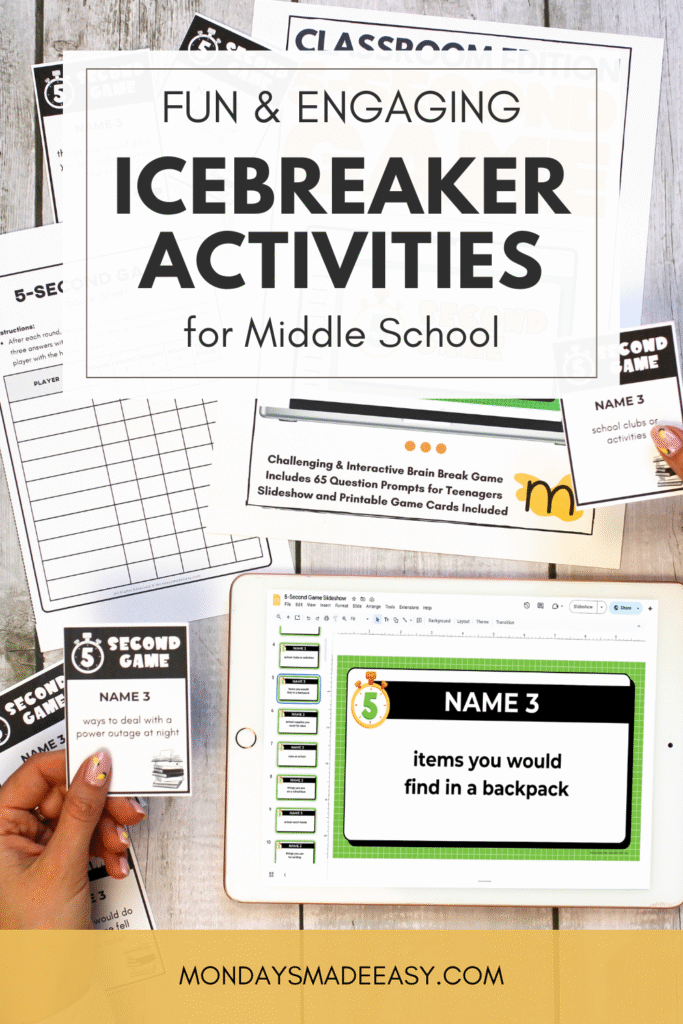
3. 5-Second Game
Of all the activities on this list, the 5-Second Game is the one that makes middle schoolers laugh the fastest. Project a category prompt, give one student five seconds to name three things that fit, and watch what happens! The silliness is intentional, and it’s contagious. At this age, shared laughter does more community-building work than almost anything else you can plan.
Play this as a whole-class game with the slideshow first: display the prompt, pick a student or let volunteers surface once the room warms up, and let the countdown timer do the dramatic work. Prompts like “things you’d do if gravity stopped working for a day,” “things you’d do if you woke up and everyone could hear your thoughts,” or “three things you’d do if your teacher turned into a robot” generate the most reaction. The absurdist ones land especially well in grades 6 and 7, where students are at peak appreciation for that kind of humor.
Eighth graders will sometimes perform too-cool disinterest for the first two minutes. Then somebody gets a ridiculous prompt, blurts something out, and the room breaks. It always happens! Once you get there, transition to partner or small-group play with the card decks.
This 5-Second Game includes a wide range of school-appropriate prompts with built-in countdown timers. The card deck and editable template let you create custom categories tied to your content or classroom culture.
4. Classroom Feud
Classroom Feud is the most overtly competitive activity on this list. For middle schoolers, team competition is highly effective, as long as the individual stakes stay low. When the group absorbs the energy, students who would never raise their hand alone will shout answers alongside their teammates without a second thought!
Modeled after the game show, teams compete to guess the most popular survey answers to questions that are both humorous and catered to kids — “name something people would do first if they could time travel,” or “name a type of music that most people listen to.” The relatability of the questions is a feature. Middle schoolers respond to content that reflects their actual world back at them, and they respond loudly!
The countdown timer and Fast Money Round at the end create an intense finish. I have seen this activity completely flip a first-day energy: students who walked in with their armor on are usually giggling by the halfway mark. The team structure makes it easy to lean into, because nobody has to be brilliant individually; the group carries the game.
This Classroom Feud Game includes 20 Face-Off Rounds with ready-to-play survey questions for middle schoolers, and is available in both a slideshow and a printable version.

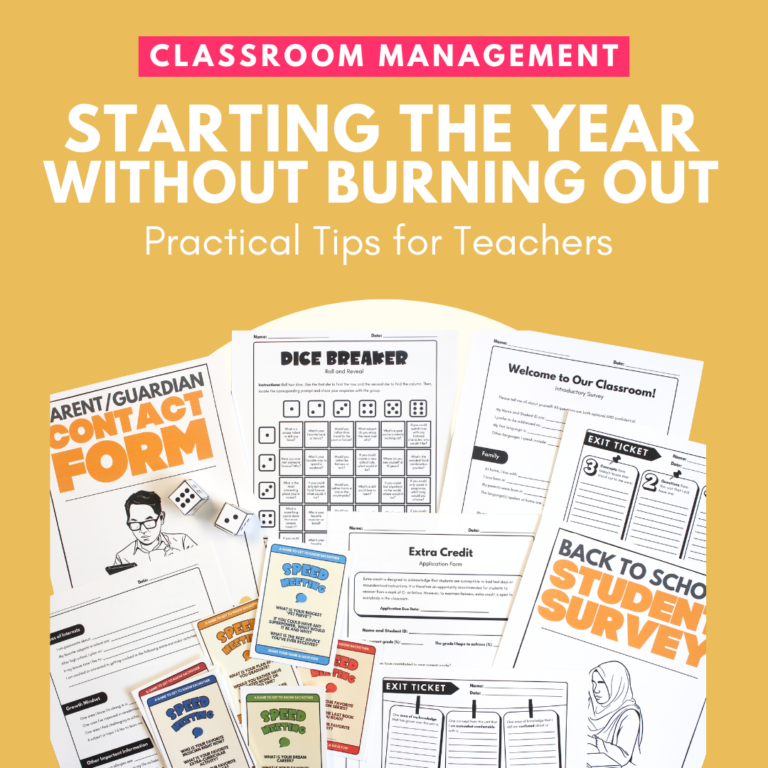
5. Speed Meeting
Speed Meeting works best as a mid-week activity rather than a day-one activity for middle schoolers. Once the initial anxiety has dropped a little, students are ready for the kind of rotating one-on-one conversation this activity requires. Before that, the social pressure of sitting directly across from someone they don’t know can overwhelm them.
The mechanics: students rotate through stations, spending a few minutes at each desk discussing a set of icebreaker questions before moving on. For middle school, keep rotations on the shorter end. Students at this age exhaust a topic faster than high schoolers do, and letting a station run too long produces the stare-at-the-ceiling silence that undoes whatever momentum you’ve built. Before you start, model one full rotation explicitly so the whole class knows what to do when they sit down across from someone new.
The questions in this card deck are designed to open conversation without demanding vulnerability. Questions like “what’s your favorite television series?” or “what’s one thing you wish was taught in school?” invite conversation without requiring too much from students or steering them in an inappropriate direction.
This Speed Meeting icebreaker includes 36 student-friendly, age-appropriate questions in a ready-to-print card deck format. There are also editable card deck templates to add your own questions if you wish!
6. Dicebreaker Game
This Dicebreaker Game is a natural follow-on to Speed Meeting and works especially well as a partner or small-group activity once students are more comfortable with each other. I recommend introducing it three or four days in, when the initial edge has worn off. The premise is simple: a game board full of questions, two dice to determine which square to answer, and a low-stakes conversation that follows.
What makes this particularly well-suited for middle school is the game-board structure itself. Students at this age still respond to activities that feel like playing; there’s something about rolling dice and locating your square that lowers the conversational stakes. This design creates just enough distance from the conversation to make it feel lower-risk.
The debatable questions tend to generate the most discussion once students are warmed up. “Would you rather have the ability to fly or be invisible” can probably turn into a ten minute deep dive in the right Grade 7 class. Let it!
This Dicebreaker Game includes a printable game board, an editable game template, and a printable dice pattern. The ready-to-play version offers enough variety in the questions alone to keep it fresh across multiple rounds.
7. Survival Scenario Escape Room
This Survival Scenario Escape Room is the most ambitious activity on this list, which is why it works best a few days into the year rather than on day one. Students need to know each other just well enough to take on a challenge together. This one rewards the groups that have already started to find their rhythm.
In this space-themed escape room, students become the crew of Spaceball One, a ship stranded after a catastrophic meteor shower. With oxygen running low and systems failing, they have four increasingly complex missions to complete before time runs out. The urgency is fictional, but the collaboration it requires is entirely real. Communication under pressure reveals personality fast — middle schoolers discover who on their team stays calm, who generates ideas, who organizes information, and who makes everyone laugh when things start to feel impossible.
This works across grade levels with some adjustment. With 6th graders, set group communication norms before you start: a brief conversation about what it looks like to hear everyone’s ideas before the group decides. Seventh and eighth graders can generally jump in with less scaffolding, though 7th grade groups sometimes need a reminder mid-game that the loudest voice isn’t automatically right. Differentiated reading passages are included to support the crossword challenge; the words appear in context, which helps since the puzzle is difficult.
The Survival Scenario Escape Room is available in both printable and digital versions to fit your classroom setup.
8. Meet the Teacher: Two Truths and a Lie
Middle schoolers are deeply curious about their teachers as human beings — more so, in my experience, than students at any other grade level. They want to know who you are outside this room. They want to know if you’re real! This slideshow lets you answer those questions on your terms, in a way that’s playful, controlled, and curiosity-driven.
Each slide presents three statements about you: two true, one a lie. Students use prediction sheets to mark their guess for each round. The questions span travel, food, hobbies, pets, and other personal-but-not-too-personal details that let you share just enough to feel human without oversharing. Before playing, hand out the prediction sheets so students have a way to participate while they watch. This handout also encourages careful listening and gives students the opportunity to engage and share their predictions.
What consistently surprises me about this activity is how long students hold onto what they learn. The things they discover about you on the first day — that you lived in another country, that you have certain preferences, that you can do something they didn’t anticipate — become the reference points they use to connect with you all year. Middle schoolers catalogue their teachers’ human details in a way that high schoolers often don’t, at least not as openly.
This Meet the Teacher: Two Truths and a Lie slideshow includes ready-to-present slides across a range of personal topics, a fully editable template so you can customize it to your own life, and prediction worksheets for students. All of the activities above are also available together in this Icebreaker Bundle for middle and high school.

FAQ: Icebreakers for Middle School Students
What makes a good icebreaker for middle school students?
The best icebreakers for middle school students remove individual performance pressure, build in movement, and give students a reason to talk to each other beyond “share something about yourself.” Team-based and movement-based activities consistently outperform go-around introductions at this age. The goal is accidental connection — guided activities where the talking feels organic rather than the assignment.
How long should icebreakers run in middle school?
Most middle school icebreakers work best in 15 to 25 minute windows. Beyond that, energy tends to drop sharply. For whole-class games like Classroom Feud, you can push toward 30 minutes if the energy is holding. For conversation-based activities like Speed Meeting, shorter rotations of a minute or two with multiple rounds keep things moving better than longer, open-ended discussions.
Can these icebreakers work for grades 6, 7, and 8?
Yes, but each grade benefits from slightly different approaches. Sixth graders need more explicit modeling and simpler activity structures. Eighth graders can handle more complex prompts and longer conversations. Seventh grade is often the most resistant to appearing enthusiastic; humor-based activities like the 5-Second Game and Classroom Feud tend to break through fastest at that age.
What do I do with students who won’t participate?
Resistance is normal in middle school, especially in grades 7 and 8. The most effective response is making participation feel low-risk rather than mandatory. Team activities help because the group moves with or without any single student’s full engagement. Giving a reluctant student a supporting role — keeping score, managing the timer, reading prompts — lets them be part of the activity without the social exposure of full participation. Most students who start on the sidelines find a way in once they see the room isn’t judging anyone.
Should I use icebreakers every day during the first week?
Not necessarily. One strong icebreaker on day one and one or two more spread across the first week is usually enough to warm up the room without it feeling like you’re avoiding academic content. The point of a first-week icebreaker isn’t entertainment — it’s building enough social safety that the learning you do the rest of the year has a better chance of landing. Once students feel like the room is safe, you’ve laid that important foundation.
Icebreakers for Middle School Students: Tying It All Together
First days in middle school are less about what you teach and more about showing students that the year ahead is going to be a good one. The right icebreaker creates the conditions for the classroom community to start forming organically. You give students a reason to turn toward each other, and then you get out of the way and let it happen.